

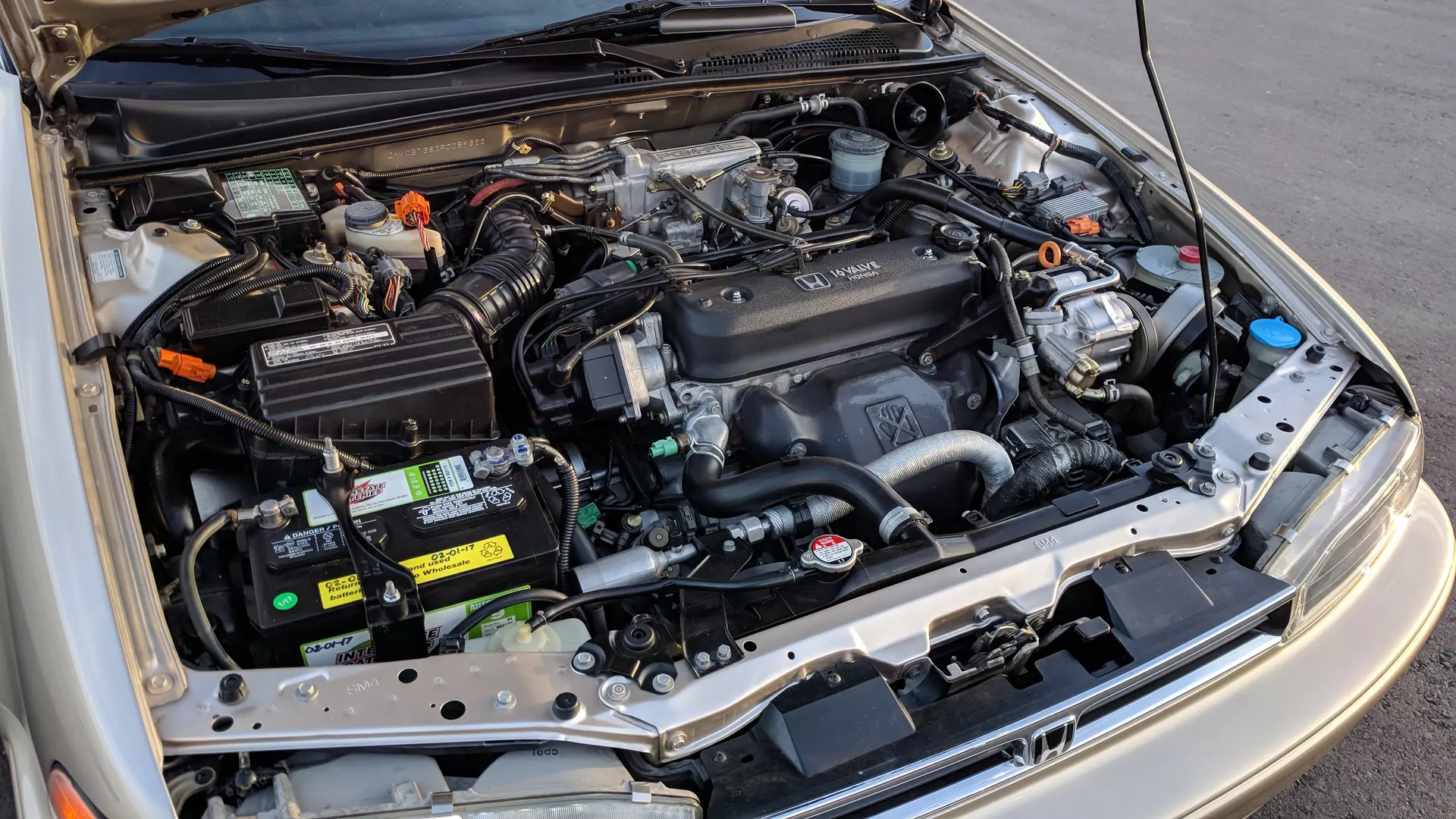
How a Gasoline Engine Works: Every Part, Explained
Turn the key or press the button and a lot happens in about a second. Here’s what’s going on under the hood of a gas car, part by part: what starts it, what feeds it, what lights the fuel, what keeps it alive, and which parts need your attention as the kilometres add up.
Engines Explained · Part 1 of 4
Updated September 2026 · 13 min read
The Gas Engine at a Glance
A modern gasoline engine is a precision machine running thousands of tiny, perfectly timed fires every minute. A few numbers to set the scene:
Strokes per cycle 4 Intake, compression, power, exhaust
Combustions a minute 6,000 A 4-cylinder engine at 3,000 rpm
Ideal air-to-fuel ratio 14.7 : 1 By weight, for a clean burn
Typical compression 10–14 : 1 Higher is more efficient
Best efficiency ~41% Toyota’s hybrid Dynamic Force engines
Combustion heat 2,000 °C+ For a split second, in each cylinder
01 · The basics
Four Strokes That Make It Go
A gasoline engine makes power by burning fuel in small, sealed chambers called cylinders. Inside each one, a piston slides up and down. A connecting rod links it to the crankshaft, which turns that up-and-down motion into rotation, the same way your legs turn the cranks of a bicycle.
Almost every car engine uses the four-stroke cycle that German engineer Nikolaus Otto developed in 1876. Each piston goes through four strokes, and the crankshaft turns twice for every power stroke. With four or more cylinders firing in turn, those power strokes overlap into smooth, steady power.
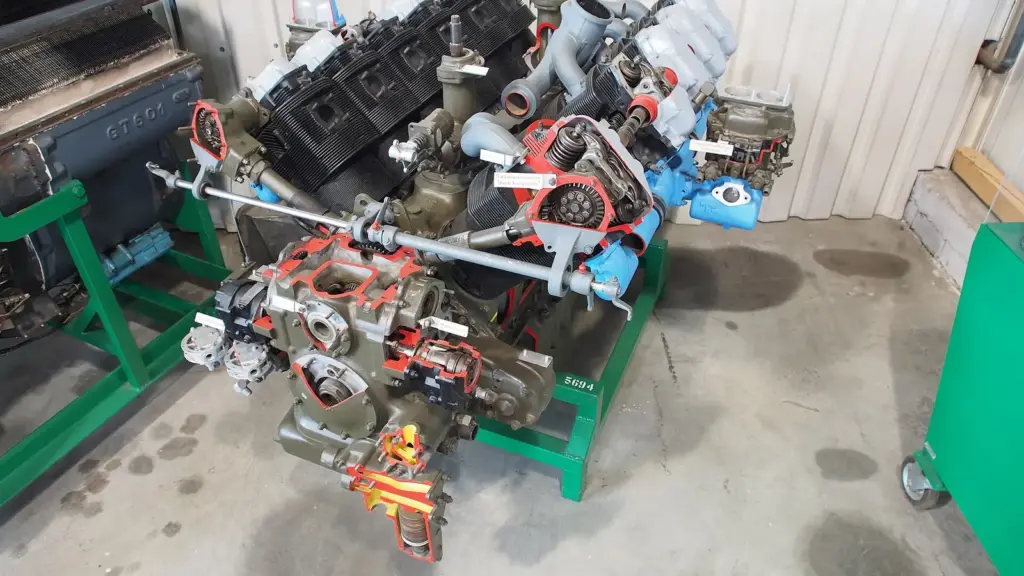
A cutaway engine: you can see the pistons, the valves above them and the crankshaft below.
- 1. IntakeThe piston moves down and the intake valve opens, drawing air (and, in many engines, fuel) into the cylinder.
- 2. CompressionBoth valves close and the piston rises, squeezing the mixture to about a tenth of its volume.
- 3. PowerThe spark plug fires. The burning mixture expands and drives the piston down. This is the only stroke that makes power.
- 4. ExhaustThe exhaust valve opens and the rising piston pushes the burned gases out into the exhaust system.
The core parts
Structure
Engine block
Iron or aluminium Holds the cylinders
The heavy casting at the heart of the engine. It holds the cylinders and has passages running through it for coolant and oil.
Moving parts
Pistons and rings
Takes the blast Seals the cylinder
Pistons take the force of each combustion. Thin rings around them seal against the cylinder wall, keeping pressure in and oil out.
Moving parts
Crankshaft and rods
Up-and-down to round and round Flywheel
Connecting rods link each piston to the crankshaft. A heavy flywheel on the end smooths out the pulses and gives the starter something to grab.
Breathing
Cylinder head and valves
Usually 4 valves per cylinder Intake and exhaust
The head sits on top of the block and seals the cylinders. Its valves open to let air in and exhaust out, then snap shut for compression and power.
Timing
Camshafts
Opens the valves Variable timing
Egg-shaped lobes on the camshaft push the valves open at exactly the right moment. Variable valve timing shifts that moment to favour power or economy.
Timing
Timing belt or chain
Keeps everything in sync Belt or chain
Links the crankshaft to the camshafts so valves and pistons never collide. If a belt snaps in an ‘interference’ engine, pistons can hit the valves and wreck the engine.
02 · Starting it up
What Happens When You Turn the Key
An engine can’t start itself. It has to be spun fast enough to draw in air and build compression before it can fire on its own. That job belongs to a small but mighty electric motor: the starter.
When you turn the key or press the start button, the car checks that the key fob is present and your foot is on the brake or clutch, then sends power to the starter. It spins the engine at roughly 200 rpm while the engine computer works out where each piston is and begins firing fuel and spark. Within a second or two, the engine catches and the starter lets go.
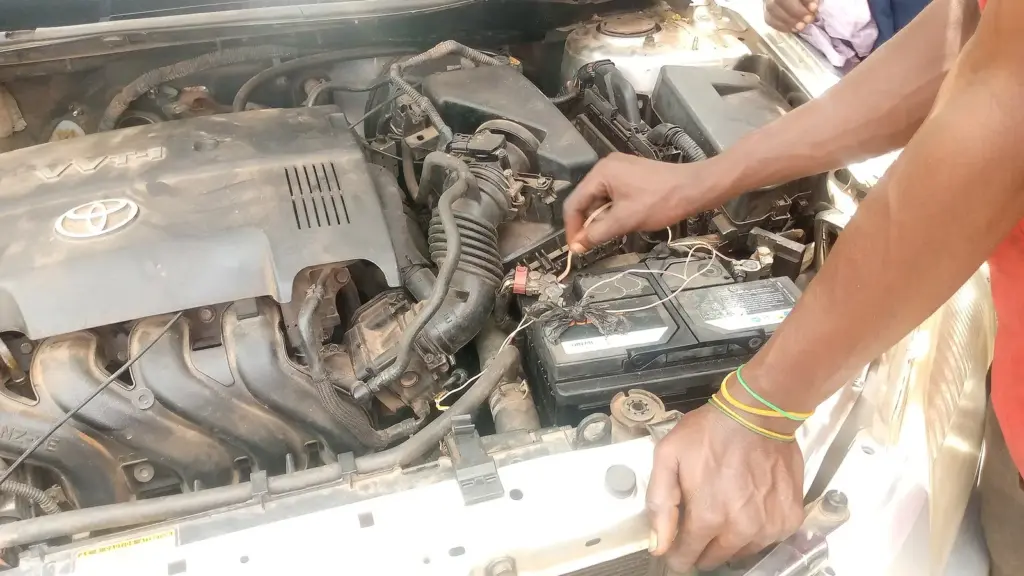
The 12-volt battery supplies the burst of power the starter needs.
- BatteryThe power sourceA 12-volt battery delivers a burst of well over 100 amps to crank the engine, more on a cold morning. A healthy one reads about 12.6 volts at rest.
- SolenoidThe heavy-duty switchA small current from the ignition energizes an electromagnet that closes a big contact to the starter and, in the same motion, pushes the starter’s gear forward.
- Starter motorThe muscleIts small gear, the pinion, meshes with teeth around the flywheel and spins the engine. A one-way clutch lets it disengage the instant the engine fires.
- Crank sensorThe timekeeperReads a toothed wheel on the crankshaft so the engine computer knows each piston’s position and can fire the right cylinder first.
- Engine computerThe brainThe ECU (engine control unit) controls fuel, spark and idle speed, adjusting them hundreds of times a second from the moment you start.
- AlternatorThe rechargerOnce the engine runs, a belt-driven alternator powers the whole car and refills the battery, putting out around 14 volts.
Cars with auto stop-start shut the engine off at red lights and restart it when you lift off the brake. They use a heavier-duty starter and a special AGM or EFB battery built to handle far more starts than a normal one. If you replace that battery, make sure it’s the same type.
03 · Fuel and injectors
From the Tank to the Cylinder
Fuel’s journey starts in the tank, where an electric fuel pump, usually sitting inside the tank and cooled by the fuel around it, pushes gasoline through a filter and up to the engine. There, a metal pipe called the fuel rail feeds the injectors.
A fuel injector is an electrically controlled valve with a tiny nozzle. When the engine computer sends it a pulse, it snaps open for a few thousandths of a second and sprays a fine mist of fuel. A longer pulse means more fuel. The computer adjusts those pulses constantly to keep the mix close to 14.7 parts air to 1 part fuel.
How and where that fuel gets sprayed has changed a lot over the years, and it’s one of the biggest differences between older and newer engines.
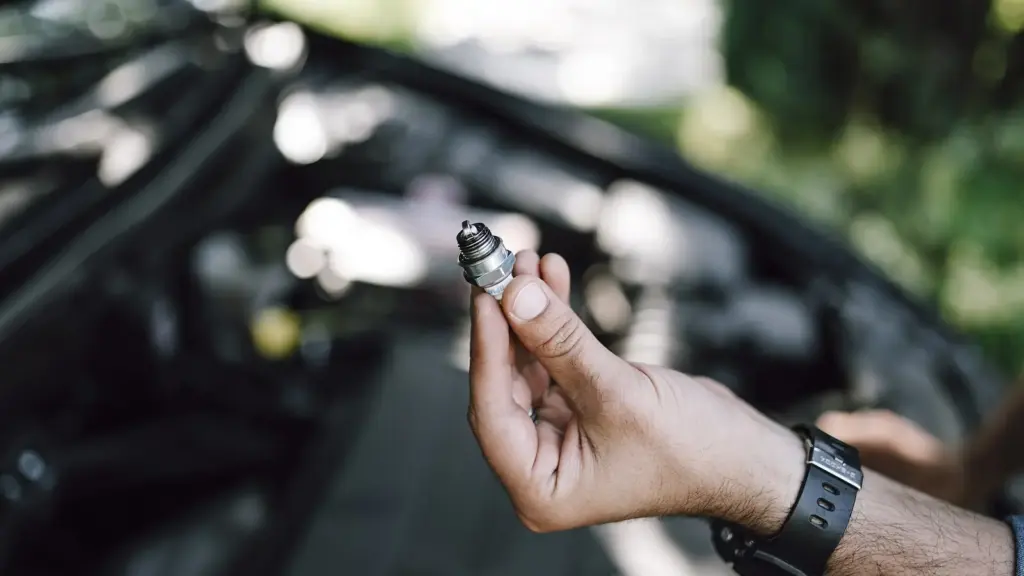
Injectors bolt into the engine and are fed by the fuel rail.
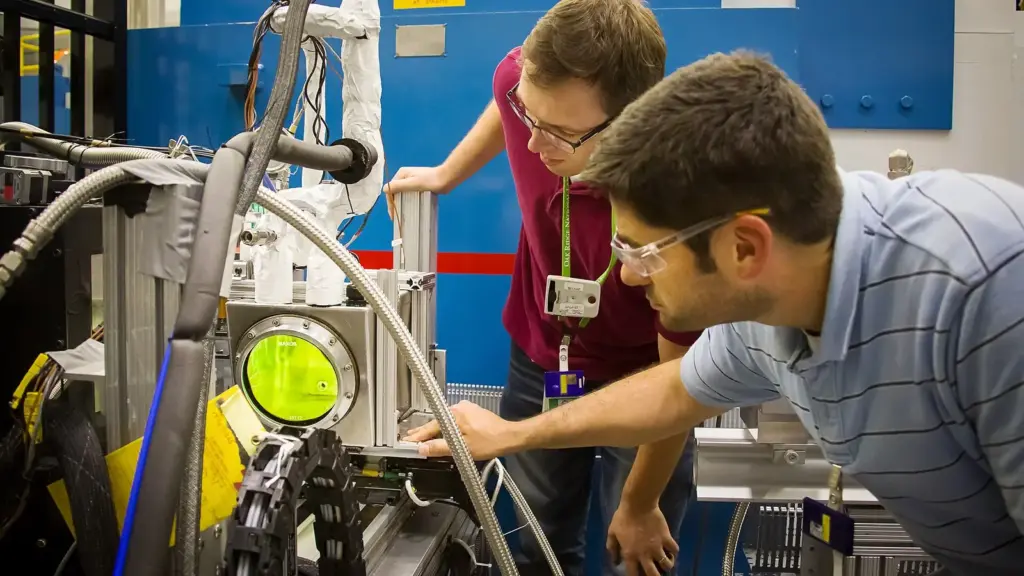
Researchers at Oak Ridge National Laboratory studying a six-hole direct injector.
Types of fuel delivery, from oldest to newest
Before the 1990s
Carburetor
No electronics Suction-fed
Not an injector at all. Air rushing through a narrow throat draws fuel from a small bowl. Simple, but imprecise and fussy in the cold. Gone from new cars in North America by the early 1990s.
1980s
Throttle body injection
One or two injectors Low pressure
The stepping stone. One or two injectors sit where the carburetor used to be and spray into the intake for all cylinders at once.
1990s to today
Port injection
One injector per cylinder About 3–4 bar
Each cylinder gets its own injector, spraying onto the back of its intake valve. Smooth and quiet, and the fuel keeps the valves clean.
2000s to today
Direct injection (GDI)
Sprays into the cylinder Up to 350 bar
Injectors spray straight into the combustion chamber at very high pressure, supplied by a camshaft-driven pump. More power and better economy, but carbon can build up on the intake valves.
Today
Dual injection
Port plus direct Best of both
Engines such as Toyota’s D-4S system have both port and direct injectors and blend them depending on load, getting direct injection’s efficiency with far less carbon build-up.
The supporting cast
Pump, filter and regulator
Keeps pressure steady Filters dirt
The fuel pump, filter and pressure regulator keep a steady supply at the right pressure. Many modern cars have a lifetime filter inside the tank.
| Type | Where the fuel goes | Fuel pressure | Pros | Cons |
|---|---|---|---|---|
| Carburetor | Into the intake, drawn by suction | Very low | Simple, cheap | Imprecise, hard cold starts |
| Throttle body | Into the intake, one spot | About 1 bar | Cheap upgrade | Uneven mix between cylinders |
| Port injection | Behind each intake valve | About 3–4 bar | Smooth, clean valves | Less efficient than direct |
| Direct injection | Straight into the cylinder | 200–350 bar | Power and economy | Carbon on valves, more noise |
| Dual injection | Both | Both | Efficient and clean | More parts and cost |
04 · Spark and sensors
Lighting the Fire
Gasoline doesn’t reliably ignite from compression alone, and when it does it’s called knock, which is bad news for an engine. It needs a spark, timed to within a fraction of a degree of crankshaft rotation.
Modern engines use coil-on-plug ignition: every spark plug has its own ignition coil sitting right on top of it. The coil turns the car’s 12 volts into a jolt of roughly 20,000 to 40,000 volts, which jumps a tiny gap at the tip of the plug and lights the mixture.
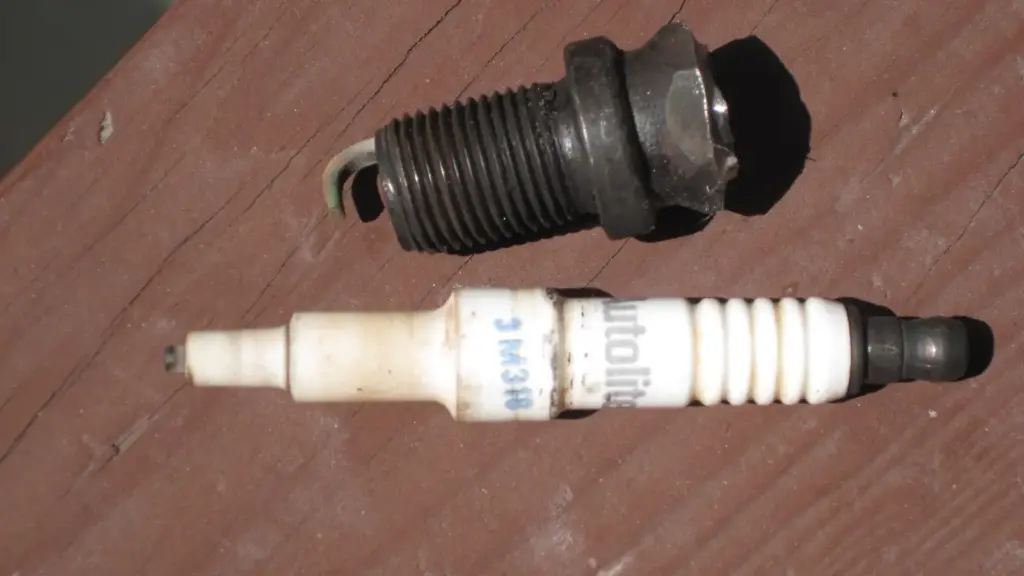
A spark plug cut open. The white ceramic insulator keeps tens of thousands of volts heading for the tip.
Spark plugs at a glance
- 30–50k kmCopper (nickel alloy) plugs
- ~100k kmPlatinum plugs
- 100–160k kmIridium plugs, in most new cars
- 20–40k VWhat the ignition coil delivers
The sensors that run the show
Sensor
Crankshaft position
If it fails: no start
Tells the computer exactly where each piston is and how fast the engine is turning. Without it, the engine usually won’t run at all.
Sensor
Camshaft position
Timing and valve control
Tells the computer which stroke each cylinder is on, so it can time injection and variable valve timing correctly.
Sensor
Mass airflow (MAF)
Measures incoming air
Measures how much air is entering the engine so the computer knows how much fuel to add. A dirty MAF can cause hesitation and poor economy.
Sensor
Oxygen (O2) sensors
In the exhaust
Check whether each burn was rich or lean, and let the computer fine-tune the fuel constantly. A second sensor watches the catalytic converter.
Sensor
Knock sensor
Engine protector
A small microphone bolted to the block that listens for knock and tells the computer to retard the spark timing before damage can happen.
Sensors
Throttle and temperature
Pedal and warm-up
Report how hard you’re pressing the pedal and how warm the engine is, which changes fuel, spark and idle speed from cold start to full throttle.
05 · Air, turbo and exhaust
Breathing In and Breathing Out
An engine burns about 14.7 kg of air for every kilogram of fuel, so moving air in and out is half the battle. Air enters through the air filter, passes the airflow sensor and the electronic throttle, then flows through the intake manifold to each cylinder.
Many modern engines add a turbocharger. Exhaust gas spins a small turbine, which drives a compressor on the same shaft that crams extra air into the engine. More air means more fuel can be burned, so a small turbo engine can match a much bigger one. A supercharger does the same job but is driven by a belt from the crankshaft.
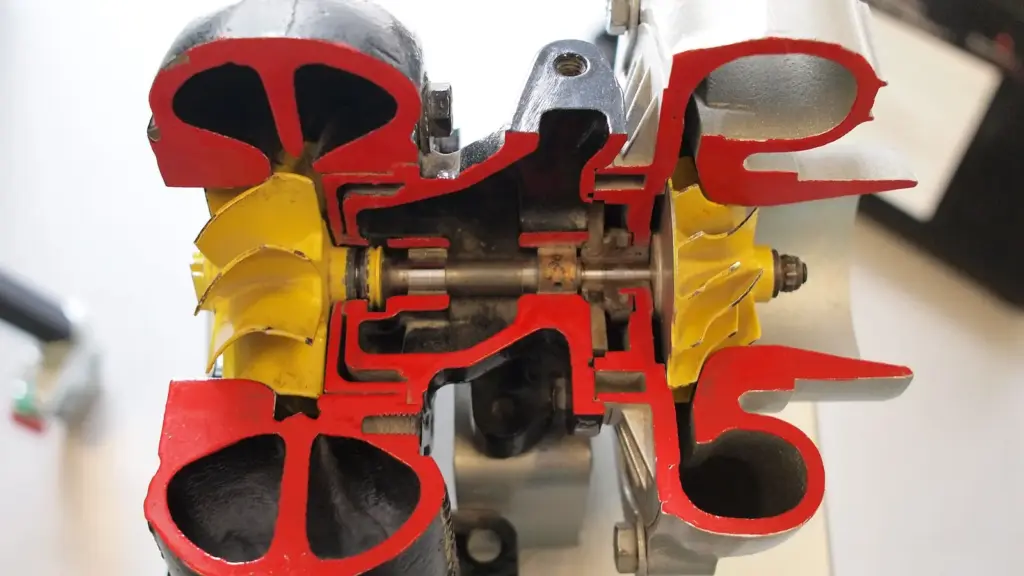
A turbocharger cut in half: exhaust spins one wheel, which drives the other to push in more air.
- Catalytic converterCleans the exhaustA honeycomb coated with platinum, palladium and rhodium turns carbon monoxide, unburned fuel and nitrogen oxides into carbon dioxide, water and nitrogen.
- EGR and PCVRecycles gasesExhaust gas recirculation feeds a little exhaust back in to cool combustion and cut nitrogen oxides. Crankcase ventilation pulls oil vapour out of the engine and burns it instead of venting it.
- MufflerKeeps it quietChambers and perforated tubes cancel out the pressure pulses from each exhaust stroke, turning a roar into a hum.
06 · Cooling and lubrication
Keeping It Cool and Slippery
Only about a third of the energy in gasoline turns into motion. Most of the rest becomes heat, and it has to go somewhere. A water pump pushes coolant, a mix of water and antifreeze, through passages in the block and head and out to the radiator at the front of the car, where air and electric fans carry the heat away. A thermostat keeps the coolant away from the radiator until the engine reaches its ideal temperature of roughly 90 to 105 °C.
Meanwhile, an oil pump pushes oil through the oil filter and into every bearing, the camshafts and the cylinder walls. The oil forms a film thinner than a human hair that stops metal from touching metal, and it carries heat and dirt away too. That’s why oil changes are the single most important maintenance job on a gas engine.
Watch the warning lights. A temperature needle climbing into the red, or an oil pressure light that stays on, means pull over safely and switch off. Driving on can wreck an engine within minutes.
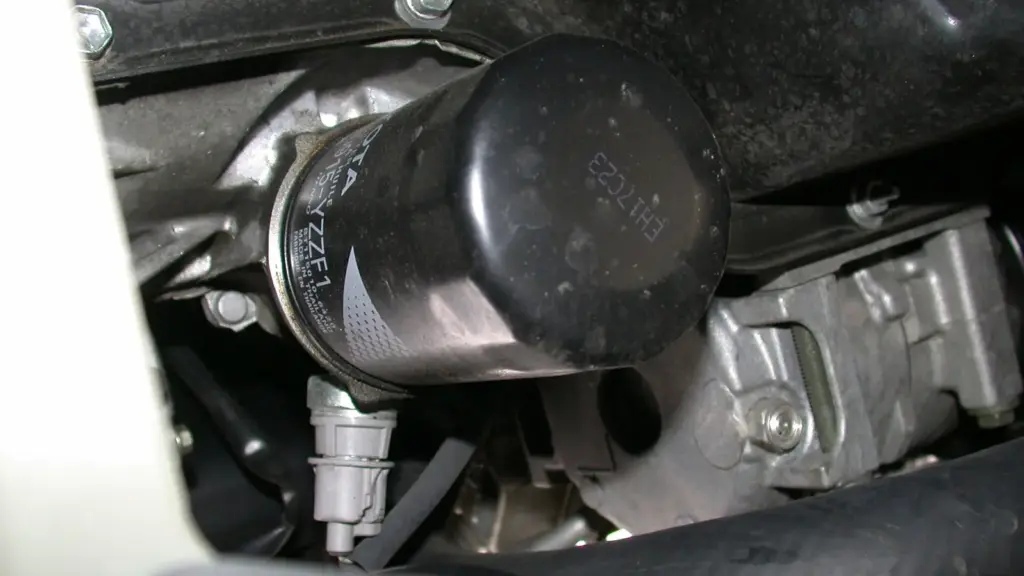
The oil filter traps metal particles and grime before the oil reaches the bearings.
07 · Maintenance
What Needs Maintenance, and When
Here’s the part most owners care about. The chart below shows typical service points for a modern gasoline car over its first 200,000 km. Your owner’s manual is always the final word, and ‘severe’ use, like lots of short trips, towing, dusty roads or extreme cold, shortens most intervals.
Regular maintenance is cheap insurance. An oil change costs a fraction of a new engine, and a timing belt costs far less than the damage a snapped one can cause.
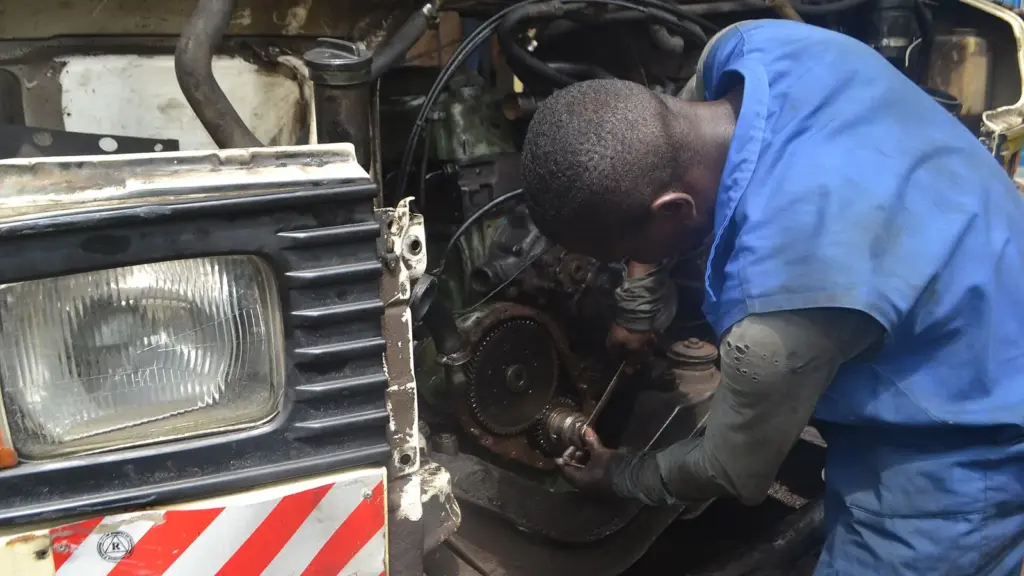
Most jobs on this chart take a shop well under an hour.
Regular maintenance schedule
● Replace or service ○ Inspect
| Part | 20k | 40k | 60k | 80k | 100k | 120k | 140k | 160k | 180k | 200k |
|---|---|---|---|---|---|---|---|---|---|---|
| Engine oil and filterEvery 8,000–16,000 km or yearly | ● | ● | ● | ● | ● | ● | ● | ● | ● | ● |
| Tire rotationEvery 10,000–13,000 km | ● | ● | ● | ● | ● | ● | ● | ● | ● | ● |
| Engine air filterEvery 25,000–50,000 km | ○ | ● | ○ | ● | ○ | ● | ○ | ● | ○ | ● |
| Cabin air filterEvery 20,000–40,000 km or yearly | ○ | ● | ○ | ● | ○ | ● | ○ | ● | ○ | ● |
| Brake pads and rotorsPads last 40,000–80,000 km | ○ | ○ | ● | ○ | ○ | ● | ○ | ○ | ● | ○ |
| Brake fluidEvery 2–3 years | ● | ● | ● | ● | ● | |||||
| Spark plugs (iridium)Every 100,000–160,000 km | ● | ● | ||||||||
| CoolantFirst at 100,000–160,000 km | ○ | ○ | ○ | ● | ○ | |||||
| Automatic transmission fluidEvery 60,000–160,000 km | ○ | ● | ○ | ● | ||||||
| Timing belt and water pumpIf fitted: 100,000–160,000 km | ● | |||||||||
| Drive (serpentine) beltInspect; replace at 80,000–160,000 km | ○ | ○ | ● | ○ | ○ | |||||
| 12-volt batteryEvery 4–6 years | ○ | ● | ○ | ● |
Parts that wear out as the kilometres add up
These parts aren’t on a fixed schedule. They wear gradually and get replaced when they start to fail, usually later in a car’s life.
| Part | Typical life | Warning signs |
|---|---|---|
| Brake rotors | 80,000–120,000 km | Vibration or pulsing when braking |
| Shocks and struts | 80,000–160,000 km | Bouncy ride, nose-dive when braking, uneven tire wear |
| Water pump | 100,000–160,000 km | Coolant leaks, whining noise, overheating |
| Oxygen sensors | 100,000–160,000 km | Check-engine light, worse fuel economy |
| Clutch (manual) | 100,000–200,000 km | Slipping, pedal engaging higher than it used to |
| Ignition coils | 150,000 km and up | Misfires, rough idle, flashing check-engine light |
| Starter motor | 150,000 km and up | Clicking, slow cranking or no crank |
| Alternator | 150,000 km and up | Dim lights, battery warning light, whining |
| Engine and transmission mounts | 150,000 km and up | Clunks when shifting, extra vibration at idle |
| Fuel pump | 160,000 km and up | Hard starting, sputtering at highway speed |
| Catalytic converter | 160,000 km and up | Rattling underneath, rotten-egg smell, sluggish acceleration |
| Timing chain | Usually the life of the engine | Rattle for a few seconds on a cold start |
Quick checks you can do every month
- Tire pressureCheck cold, including the spare
- Oil levelOn level ground, engine off
- LightsHeadlights, brake lights, signals
- FluidsCoolant and washer fluid levels
Frequently Asked Questions
Why won’t my car start?
Rapid clicking usually means the battery is too weak to spin the starter. A single click, or nothing at all, can point to a bad starter, solenoid or connection. If the engine cranks normally but won’t fire, the problem is more likely fuel or spark.
Does premium gas make my car faster?
Only if your engine is designed for it. High-compression and turbocharged engines that require or recommend premium can make more power on it. In an engine built for regular, premium just costs more.
How often should I change my oil?
Follow your owner’s manual or the car’s oil-life monitor. With modern synthetic oil that’s typically every 8,000 to 16,000 km, or at least once a year. Short trips, towing and dusty roads call for more frequent changes.
What’s the difference between a timing belt and a timing chain?
Both keep the crankshaft and camshafts in sync. A rubber belt is quieter and cheaper but must be replaced, usually every 100,000 to 160,000 km. A metal chain is designed to last the life of the engine, though it can stretch if oil changes are neglected.
What is engine knock?
Knock, or pinging, is fuel igniting on its own before or after the spark, creating a sharp pressure spike. Knock sensors catch it and adjust the timing, but using lower-octane fuel than your engine needs can make it worse.
Is carbon build-up on direct-injection engines a real problem?
It can be. Because fuel no longer washes over the intake valves, some direct-injection engines build up carbon on them over time, causing rough running. A professional cleaning fixes it, and dual-injection engines largely avoid it.
Next in the Series
This is part 1 of our Engines Explained series. Part 2, on diesel engines, is out now. Electric cars and hybrids are coming next.
Sources
Photo credits
- Header image: Hip~commonswiki, CC BY-SA 4.0, cropped and resized.
- Cutaway gasoline engine showing pistons, valves and…: Alf van Beem, Public domain, cropped and resized.
- Mechanic testing a 12-volt car battery: Azorbli, CC BY-SA 4.0, cropped and resized.
- Mechanic changing a fuel injector on a…: Shixart1985, CC BY 2.0, cropped and resized.
- Researchers studying a six-hole gasoline direct-injection fuel…: Oak Ridge National Laboratory, CC BY 2.0, cropped and resized.
- Spark plug cut open to show its…: User:Industry shill, Public domain, cropped and resized.
- Turbocharger cut in half to show the…: Tommi Nummelin, CC BY-SA 3.0, cropped and resized.
- Engine oil filter fitted to a car…: Dvortygirl, CC BY-SA 3.0, cropped and resized.
- Mechanic working under the hood of a…: Minette Lontsie, CC BY-SA 4.0, cropped and resized.