


How a Diesel Engine Works: No Spark Plugs, DEF and Everything in Between
A diesel has no spark plugs, runs on a heavier fuel and, if it’s a modern one, drinks a blue-capped fluid called DEF. Here’s how it all works, part by part, how diesel differs from Canada to Brazil to Japan, and what needs maintenance as the kilometres add up.
Engines Explained · Part 2 of 4
Updated September 2026 · 13 min read
The Diesel Engine at a Glance
A diesel looks a lot like a gas engine from the outside, but inside it plays by different rules. These numbers show how:
Spark plugs 0 It lights fuel with heat from compression
Compression ratio 14–20 : 1 Versus about 10–14 : 1 for gas
Injection pressure 2,700 bar In the latest common-rail systems
Energy per litre ~11% more Than a litre of gasoline
Best truck efficiency 45%+ Of fuel energy turned into work
DEF used 1.5–2 L Per 1,000 km in a light-duty diesel
01 · The big difference
Why a Diesel Doesn’t Need Spark Plugs
A gas engine mixes air and fuel, squeezes the mixture, then lights it with a spark. A diesel does something bolder: it squeezes plain air so hard that the air gets hot enough to set the fuel on fire the instant it’s sprayed in. No spark required.
Squeeze any gas and it heats up, which is why a bicycle pump gets warm. A diesel compresses air to between about a fourteenth and a twentieth of its volume, heating it to well over 500 °C. Diesel fuel ignites on its own at around 210 °C, so when the injector sprays a fine mist into that hot air, it lights immediately. Engineers call this compression ignition.
The idea belongs to German engineer Rudolf Diesel, who patented it in the early 1890s and had a working engine running by 1897. He wanted an engine far more efficient than the steam engines of his day, and more than a century later efficiency is still the diesel’s biggest advantage.
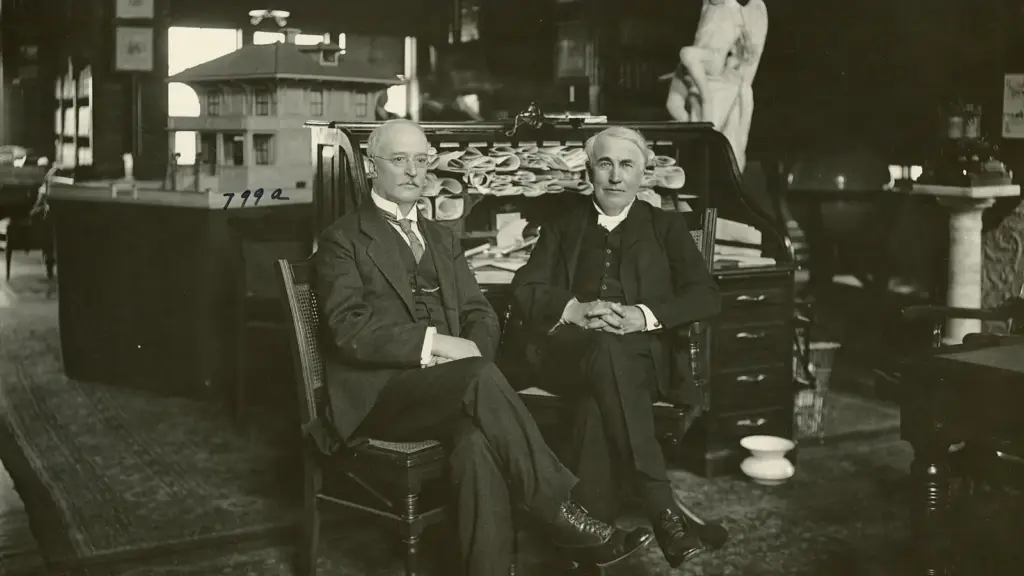
Rudolf Diesel visiting Thomas Edison’s laboratory in West Orange, New Jersey.
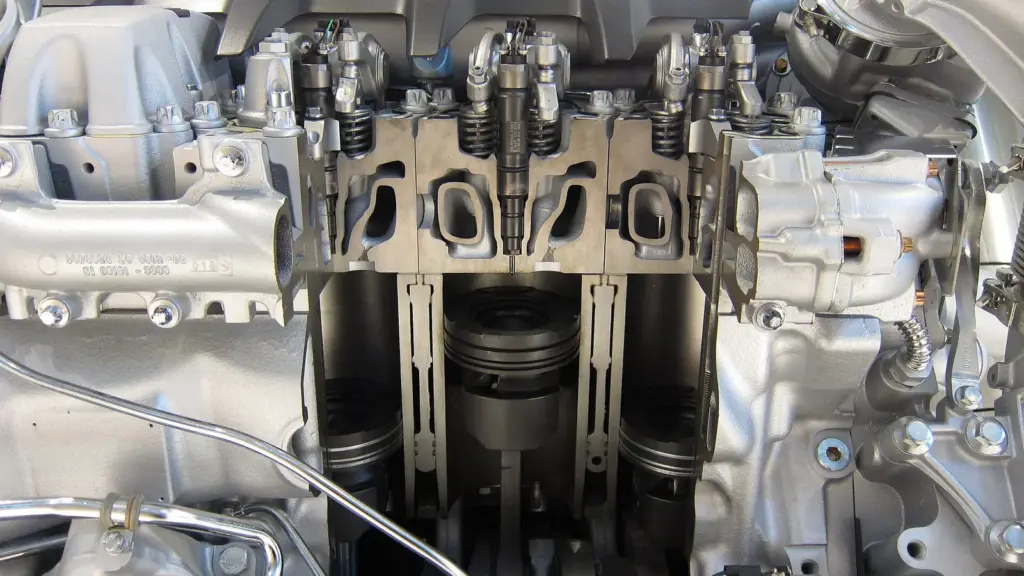
A cutaway truck diesel. Everything is built heavier to handle the pressure.
- 1. IntakeThe piston moves down and pulls in air only. There’s usually no throttle, so the engine breathes freely.
- 2. CompressionThe piston rises and squeezes the air to a fourteenth or less of its volume, heating it past 500 °C.
- 3. PowerThe injector sprays fuel into the hot air. It ignites instantly and the expanding gas drives the piston down.
- 4. ExhaustThe piston rises again and pushes the burned gases out, through the emissions system and into the air.
Gas versus diesel, side by side
| Gasoline engine | Diesel engine | |
|---|---|---|
| How fuel ignites | Spark plug | Heat of compression |
| Compression ratio | About 10–14 : 1 | About 14–20 : 1 |
| How power is controlled | Throttle limits the air | Amount of fuel injected |
| Fuel pressure | Up to about 350 bar | Up to about 2,700 bar |
| Pulling power | Moderate, at higher rpm | High, at low rpm |
| Emissions gear | Catalytic converter | Catalyst, particulate filter and SCR with DEF |
| Fuel quality rating | Octane (resists self-ignition) | Cetane (ignites easily) |
Why diesels last so long. To survive those pressures, diesels are built with heavier blocks, stronger crankshafts and beefier bearings, and they spend their lives at lower rpm. That’s a big reason well-maintained diesel trucks often pass 500,000 km.
02 · Starting it up
Glow Plugs and Cold Starts
On a cold morning, the cold metal of the engine soaks heat out of the compressed air, and the air may not get hot enough to light the fuel. That’s where glow plugs come in. Each cylinder has one: a pencil-shaped heater that pokes into the combustion chamber and glows red-hot, over 1,000 °C in modern ceramic plugs, within seconds.
In older diesels you waited for a coil-shaped ‘wait to start’ light on the dash before cranking. Modern glow plugs heat so quickly that the wait is usually a second or two, and they keep glowing after the engine starts to cut smoke and noise while it warms up.
The rest of the starting system works like a gas engine’s, just beefier. A diesel needs a stronger starter to crank against all that compression, and many diesel trucks carry two batteries.

Glow plugs from a car diesel after 130,000 km. There is one per cylinder.
- Glow plugsThe cold-start heatersControlled by a module that decides how long to heat based on engine temperature. When one fails, you’ll notice harder cold starts and white smoke.
- Block heaterThe Canadian essentialAn electric element in the coolant that you plug into an outlet overnight. It keeps the engine warm, so cold starts are easier and cause less wear.
- Winter dieselFuel that won’t gelDiesel contains natural waxes that thicken and clog filters in deep cold. Stations in cold regions switch to winter blends, and additives can lower the gelling point further.
03 · Fuel and injection
High Pressure, Tiny Droplets
Because a diesel controls its power by how much fuel it sprays, not by restricting the air, the injection system is the heart of the engine. Modern diesels use common-rail injection: a high-pressure pump feeds a shared ‘rail’ of fuel at roughly 2,000 to 2,700 bar, and electronically controlled injectors fire directly into each cylinder.
That pressure atomizes the fuel into droplets finer than mist, so it burns completely. The injectors can fire several times per power stroke, up to ten times in some Bosch systems: small pilot shots to soften the famous diesel clatter, a main shot for power, and later shots to heat the exhaust for the emissions system.
Diesel fuel also lubricates the pump and injectors, which is why water or dirt in the fuel is so damaging. Every diesel has a fuel filter and water separator, and keeping them serviced is one of the most important maintenance jobs.
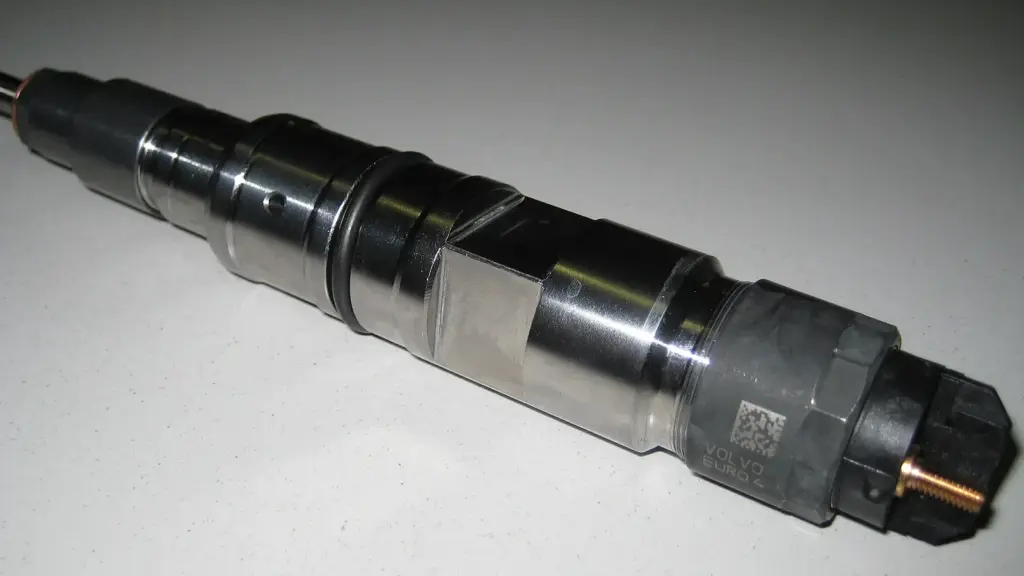
A common-rail injector. Its tip has holes smaller than a human hair.
Types of diesel injection, from oldest to newest
Until the 1990s
Indirect injection
Prechamber Quieter, less efficient
Fuel is sprayed into a small prechamber next to the cylinder. Easier to build and quieter, but less efficient and harder to start in the cold.
1980s to 2000s
Mechanical pump injection
Rotary or inline pump Famously tough
A mechanical pump meters and times the fuel for each cylinder. Simple and durable, and legendary in older pickups and farm equipment.
1990s to 2000s
Unit injectors
A pump in every injector Very high pressure
Each injector has its own camshaft-driven pump. Volkswagen’s ‘Pumpe Düse’ (pump-nozzle) TDI engines were the best-known example.
1997 to today
Common rail
One shared rail Multiple injections
A single high-pressure rail feeds electronically controlled injectors, allowing several precisely timed injections per cycle. First used in a production car in the 1997 Alfa Romeo 156, now the standard.
Today
Piezo common rail
Crystal-driven Finest control
Piezoelectric crystals open the injector in a fraction of a millisecond, for quieter running, cleaner exhaust and better economy.
The supporting cast
Filter and water separator
Protects the injectors Drain the water
Traps dirt and separates water from the fuel before it reaches the high-pressure pump. A warning light tells you when water needs draining.
Why nearly every diesel has a turbo. Diesels run with plenty of spare air and love extra boost. Almost every modern diesel uses a turbocharger, often a variable-geometry turbo whose vanes adjust to deliver boost even at low engine speed, plus an intercooler to cool the compressed air. That’s where the big low-rpm pulling power comes from.
04 · Emissions and DEF
Soot, NOx and the Blue Fluid
Diesels burn lean and hot, which is great for efficiency but produces two pollutants in larger amounts than gas engines: soot (tiny carbon particles) and nitrogen oxides, or NOx. Modern diesels clean their exhaust with a chain of devices, which is why a new diesel pickup’s exhaust is far cleaner than one from the 1990s.
Cleaner fuel made this possible. Canada and the United States cut on-road diesel to 15 ppm sulfur in 2006, and Europe went to 10 ppm in 2009, because sulfur poisons the catalysts and filters.
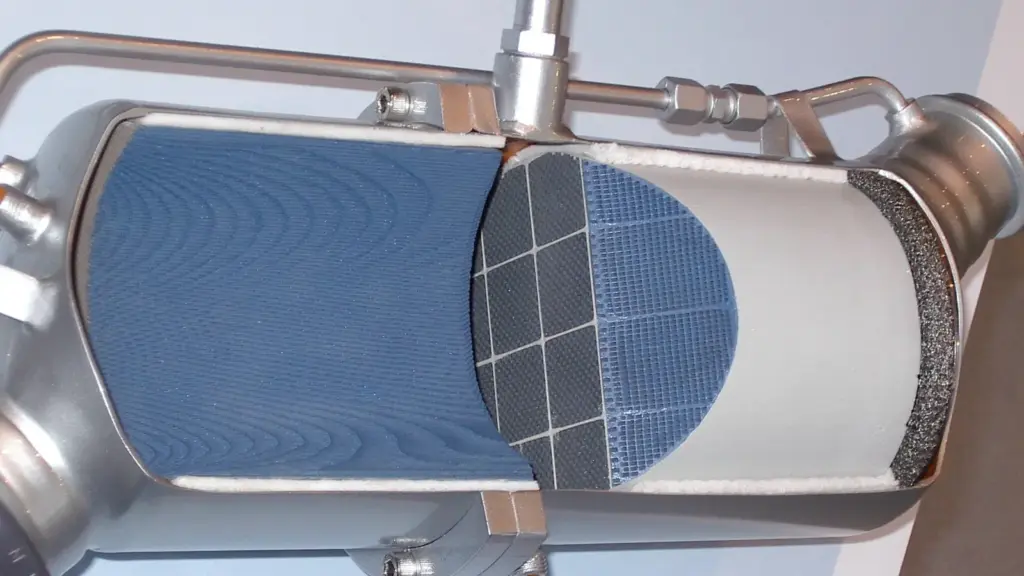
A diesel particulate filter (right) beside an oxidation catalyst. The honeycomb traps soot.
The exhaust clean-up line, in order
- 1. EGRCools the fireExhaust gas recirculation feeds some exhaust back into the intake. Less oxygen means cooler combustion and less NOx, though the valve and cooler can clog with soot over time.
- 2. Oxidation catalystBurns off the easy stuffConverts carbon monoxide and unburned fuel into carbon dioxide and water, and heats the exhaust for the next stage.
- 3. Particulate filterTraps the sootA ceramic honeycomb with alternate channels blocked, so exhaust must pass through the walls. Trapped soot is burned off at high temperature in a process called regeneration.
- 4. DEF injectorAdds the blue fluidA dosing injector sprays diesel exhaust fluid into the hot exhaust, where it breaks down into ammonia.
- 5. SCR catalystRemoves the NOxOn the selective catalytic reduction catalyst, the ammonia reacts with NOx and turns it into harmless nitrogen and water vapour.
- 6. NOx sensorsKeep scoreSensors before and after the SCR check that it’s working. Faults trigger a warning and, if ignored, reduced power.
DEF: what every diesel owner should know
- 32.5%Urea, mixed with purified water
- −11 °CFreezing point (the tank is heated)
- 1.5–2 LUsed per 1,000 km in a light-duty diesel
- ISO 22241The quality standard on the label
DEF goes in its own tank, usually with a blue cap next to the fuel filler or under the hood. Never put it in the fuel tank, or diesel in the DEF tank: both mistakes can cause very expensive damage. If you let it run low, the vehicle gives plenty of warning, then, by law, limits your speed or won’t restart until you top it up. North American heavy trucks have used DEF since 2010, and most diesel pickups since the early 2010s.
Short trips and modern diesels don’t mix. If most of your driving is under 15 minutes around town, the particulate filter may never get hot enough to clean itself. The warning light comes on, and ignoring it can mean a replacement filter costing thousands. A steady 30 to 50 minute highway run usually lets it regenerate.
05 · Around the world
How Diesel Differs Around the World
The engine works the same everywhere, but how much people use diesel, what the fuel contains and even what the blue fluid is called change a lot from one market to the next.
One fluid, many names
| Region | What it’s called |
|---|---|
| Canada and the United States | DEF (diesel exhaust fluid) |
| Europe and Japan | AdBlue |
| Brazil | ARLA 32 |
| Australia and the ISO standard | AUS 32 |
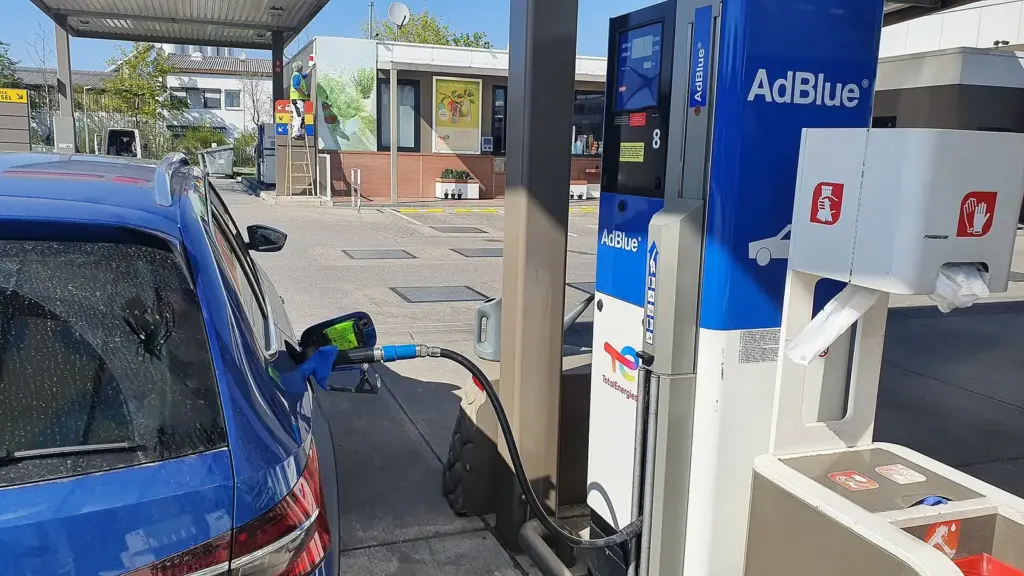
Filling up with AdBlue at a pump in Munich, Germany.

DEF pumps at a truck-friendly fuel station in the United States.
North America
Trucks, vans and big rigs
DEF 15 ppm sulfur
Diesel cars are rare. Diesel lives in heavy-duty pickups, vans, buses and transport trucks. On-road diesel has been ultra-low-sulfur in both Canada and the US since 2006, and winter blends and block heaters are a way of life up north.
Europe
From king to niche
AdBlue EN 590 fuel
Diesel once ruled: in September 2015, 64% of new cars in Spain were diesel, and about half in Germany. Then came ‘Dieselgate’, when Volkswagen was caught cheating emissions tests. By 2025, diesel was down to 8.9% of new cars in the EU.
Japan
Clean diesel, the Mazda way
Low compression No urea
Diesel cars are a small niche in Japan. Mazda’s Skyactiv-D, launched in the 2012 CX-5, used an unusually low 14:1 compression ratio to meet Japan’s rules and Euro 6 without any urea (DEF) system, a world first.
India
Leaving diesel cars behind
BS6 rules Maruti exit
When India’s BS6 rules, roughly equal to Euro 6, took effect in April 2020, Maruti Suzuki, the country’s biggest carmaker, stopped selling diesel cars altogether rather than add costly emissions hardware.
Brazil
Diesel cars not allowed
ARLA 32 Pickups and trucks only
Since the 1970s, Brazil has not allowed diesel passenger cars. Only vehicles with at least 1,000 kg of cargo capacity, like pickups and trucks, can run on diesel, a rule first meant to cut oil imports.
Fuel standards
Not all diesel is the same
Cetane Sulfur
Europe’s EN 590 diesel must have a cetane number of at least 51 and no more than 10 ppm sulfur. North America’s ASTM D975 diesel allows a cetane number as low as 40 and up to 15 ppm sulfur. Higher cetane means easier starts and quieter running.
06 · Maintenance
What Needs Maintenance, and When
Diesels reward good maintenance with very long lives, and punish neglect with expensive repairs. The chart shows typical service points for a modern diesel pickup or SUV over its first 200,000 km. Your owner’s manual is the final word, and towing, dusty roads, short trips and extreme cold all shorten the intervals.
Regular maintenance schedule
● Replace or service ○ Inspect
| Part | 20k | 40k | 60k | 80k | 100k | 120k | 140k | 160k | 180k | 200k |
|---|---|---|---|---|---|---|---|---|---|---|
| Engine oil and filterEvery 8,000–16,000 km, diesel-rated oil | ● | ● | ● | ● | ● | ● | ● | ● | ● | ● |
| DEF top-upEvery 5,000–15,000 km | ● | ● | ● | ● | ● | ● | ● | ● | ● | ● |
| Tire rotationEvery 10,000–13,000 km | ● | ● | ● | ● | ● | ● | ● | ● | ● | ● |
| Fuel filter and water separatorEvery 25,000–50,000 km; drain water as needed | ○ | ● | ○ | ● | ○ | ● | ○ | ● | ○ | ● |
| Engine air filterEvery 25,000–50,000 km, sooner when dusty | ○ | ● | ○ | ● | ○ | ● | ○ | ● | ○ | ● |
| Cabin air filterEvery 20,000–40,000 km or yearly | ○ | ● | ○ | ● | ○ | ● | ○ | ● | ○ | ● |
| Brake pads and rotorsPads last 40,000–80,000 km | ○ | ○ | ● | ○ | ○ | ● | ○ | ○ | ● | ○ |
| Brake fluidEvery 2–3 years | ● | ● | ● | ● | ● | |||||
| CoolantFirst at 100,000–160,000 km | ○ | ○ | ○ | ● | ○ | |||||
| Transmission fluidEvery 60,000–160,000 km | ○ | ● | ○ | ● | ||||||
| Glow plugsAround 100,000–160,000 km, or when failing | ○ | ● | ○ | |||||||
| EGR valve and coolerInspect and clean from 100,000 km | ○ | ○ | ||||||||
| Particulate filter (DPF)Inspect; cleaning often due around 200,000 km | ○ | ○ | ● | |||||||
| Drive (serpentine) beltInspect; replace at 80,000–160,000 km | ○ | ○ | ● | ○ | ○ | |||||
| Batteries (often two)Every 4–6 years | ○ | ● | ○ | ● |
Parts that wear out as the kilometres add up
These parts wear gradually and are replaced when they start to fail. Several are specific to diesels and can be costly, so catching the warning signs early pays off.
| Part | Typical life | Warning signs |
|---|---|---|
| Clutch and dual-mass flywheel (manual) | 150,000–250,000 km | Rattle at idle, vibration, slipping |
| Fuel injectors | 150,000–300,000 km | Rough idle, smoke, knocking, worse economy |
| EGR valve | 100,000–200,000 km | Black smoke, rough idle, check-engine light |
| NOx sensors, DEF pump and heater | 100,000–200,000 km | DEF warning, reduced power |
| Particulate filter (DPF) | 200,000 km and up | Warning light, frequent regenerations, lost power |
| Turbocharger | 200,000 km and up | Whistling or whining, smoke, loss of power |
| High-pressure fuel pump | 200,000 km and up | Hard starting, stalling, power loss |
| Glow plug control module | 150,000 km and up | Hard cold starts, glow plug warning light |
| Water pump | 100,000–160,000 km | Coolant leaks, overheating |
| Starter and alternator | 150,000 km and up | Slow cranking, battery warning light |
Quick checks you can do every month
- DEF levelTop up before the warnings start
- Water in fuelDrain the separator when the light comes on
- Oil levelOn level ground, engine off
- Tire pressureCheck cold, especially when towing
Frequently Asked Questions
Why doesn’t a diesel need spark plugs?
It squeezes air so hard, to a fourteenth or less of its volume, that the air heats past 500 °C. Diesel fuel ignites on its own at around 210 °C, so it lights the moment it’s sprayed in. Glow plugs only help on cold starts.
What happens if I run out of DEF?
The vehicle warns you well in advance. If you ignore the warnings, emissions rules require it to limit your speed or stop it from restarting. Topping up with a few litres of ISO 22241 DEF clears it, though some vehicles need a short drive to reset.
I put DEF in the fuel tank by mistake. What should I do?
Don’t start the engine. Have the vehicle towed and the fuel system drained and flushed. Running it with DEF in the fuel can destroy the high-pressure pump and injectors.
Why does my diesel’s filter warning come on after short trips?
The particulate filter needs heat to burn off trapped soot. Short trips never get it hot enough. A steady 30 to 50 minute highway drive usually lets it regenerate; if the light stays on, have it checked.
Are diesels still worth buying?
For heavy towing, hauling and long highway distances, yes: nothing matches their low-speed pulling power and range. For mostly short city trips, a gas, hybrid or electric vehicle is usually cheaper and less trouble.
Can I use biodiesel?
Most diesel sold in Canada and the US already contains a little renewable content. Many trucks are approved for blends up to B20, meaning 20% biodiesel. Check your owner’s manual before using anything stronger.
Next in the Series
This is part 2 of our Engines Explained series. Coming next: how electric cars work, then hybrids and plug-in hybrids. In the meantime, keep reading:
Sources
- ACEA: EU new car registrations in 2025
- ICCT: cities driving diesel out of the European car market
- DieselNet: Mazda begins CX-5 production with Skyactiv-D
- Bosch: common-rail system with piezo injectors
- BAS World: all about AdBlue
- RAC: diesel particulate filters explained
- Ultra-low-sulfur diesel (US, Canada and EU timelines)
- EN 590 diesel fuel standard
- ICCT: Brazil is not ready for diesel cars
- Autocar India: Maruti Suzuki to phase out all diesel cars by April 2020
Photo credits
- Header image: Elise240SX, CC BY-SA 4.0, cropped and resized.
- Cutaway of a V8 diesel truck engine…: Olivier Cleynen, CC BY-SA 3.0, cropped and resized.
- Rudolf Diesel with Thomas Edison in Edison's…: Unknown author, Public domain, cropped and resized.
- Glow plugs removed from a car diesel…: Johann H. Addicks, CC BY-SA 3.0, cropped and resized.
- Common-rail diesel fuel injector: Panoha, CC BY-SA 3.0, cropped and resized.
- Diesel car being refilled at an AdBlue…: Alexander Noé, CC BY-SA 4.0, cropped and resized.
- Diesel exhaust fluid pumps at a fuel…: DanTD, CC BY-SA 4.0, cropped and resized.
- Silicon carbide diesel particulate filter next to…: Michael KR, CC BY-SA 4.0, cropped and resized.