
 Written by
Timing Belt vs. Timing Chain: What’s the Difference and When to Replace
Few maintenance items cause more confusion, or bigger repair bills when they’re ignored, than the timing belt. Some cars need a new one every 96,000 to 193,000 km (60,000 to 120,000 miles). Others have a metal timing chain that’s supposed to last as long as the engine. And a few have a belt that lives inside the engine, bathed in oil, which is its own can of worms.
This guide sorts it all out in plain English: what the timing belt or chain actually does, how to find out which one your car has, when to replace it, what happens if you don’t, what the job costs in 2026, and the engines that earned a bad reputation for timing problems.
Guide · Engine Maintenance
Updated November 2026 · 18 min read
Timing Belts and Chains at a Glance
The numbers worth knowing before your next service visit:
Typical belt interval 60K–120K mi About 96,000–193,000 km, or a time limit, whichever comes first
Honda 3.5L V6 belt 105,000 mi About 168,000 km or 7 years, 60,000 mi for severe service
Timing belt job $918–$1,338 RepairPal US average, updated 2026
Timing chain job $2,120–$2,764 RepairPal US average, updated 2026
Chain labor vs. belt About 2.2x Most of the extra cost is shop time
Ford 1.0 wet belt failures ~70,000 mi Average failure mileage in NHTSA’s 2026 investigation
01 · The basics
What a Timing Belt or Chain Actually Does
Inside every four-stroke engine, the crankshaft (spun by the pistons) has to stay perfectly in step with the camshafts (which open and close the valves). The timing belt or chain is the link between them. It makes sure each valve opens at exactly the right moment, and on most modern engines it does that while the pistons are coming within a whisker of those valves. If you want the bigger picture, our guide to how a gasoline engine works walks through every part.
A timing belt is a toothed belt made of tough synthetic rubber. Gates, one of the biggest belt makers, uses a highly saturated nitrile rubber compound reinforced with spiral-wound fiberglass cords that resist stretching, and Dayco adds a wear-resistant fabric facing on the teeth. It runs dry, behind a plastic cover that keeps oil and dirt out, and a tensioner and one or more idler pulleys keep it snug.
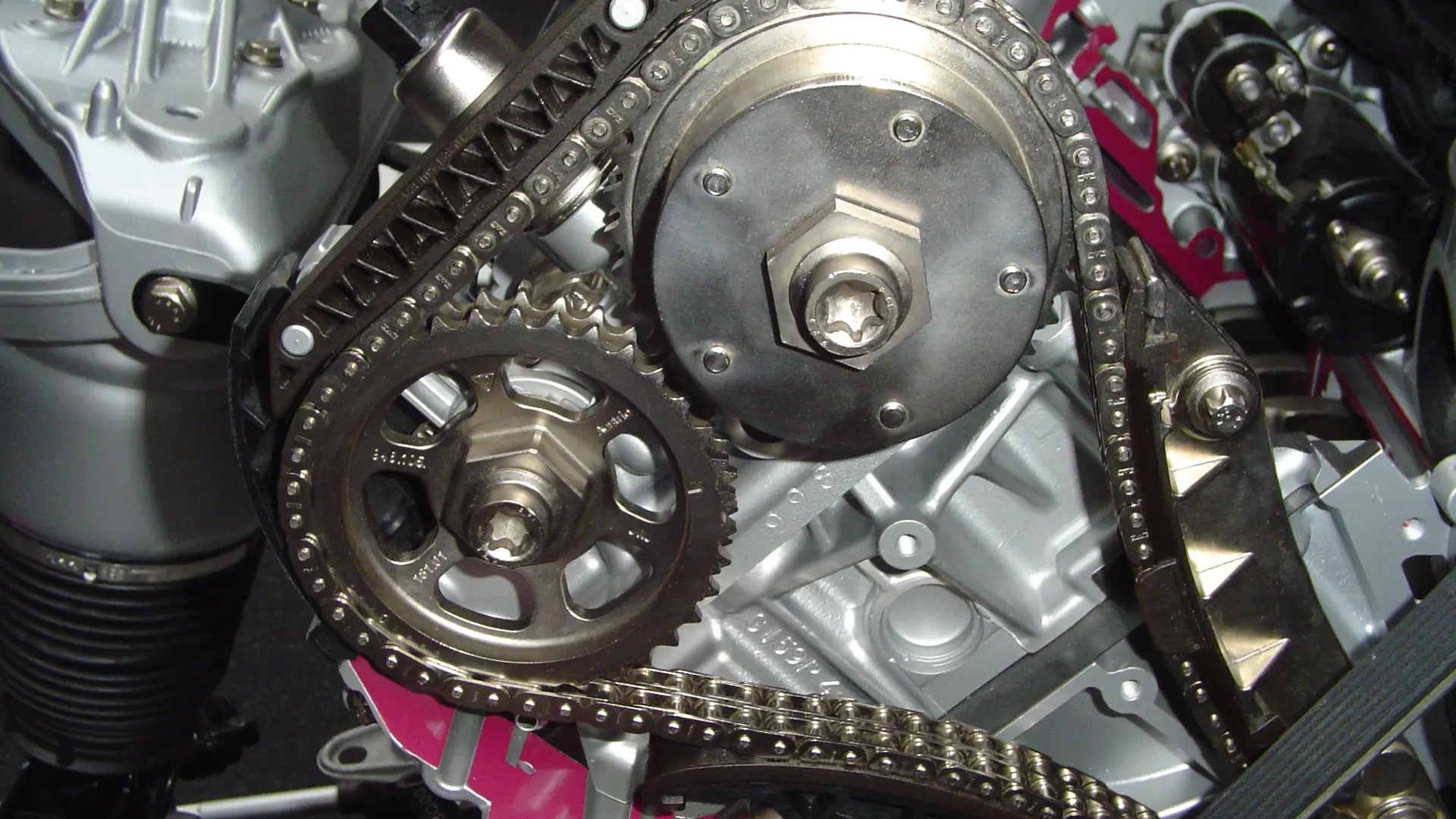
A timing chain is a metal chain, a bit like a heavy-duty bicycle chain, running on steel sprockets behind a metal cover where it’s constantly bathed in engine oil. Plastic-faced guides keep it on track, and a hydraulic tensioner fed by engine oil takes up slack. Many modern engines use a quieter “silent” or inverted-tooth chain instead of the classic roller type.
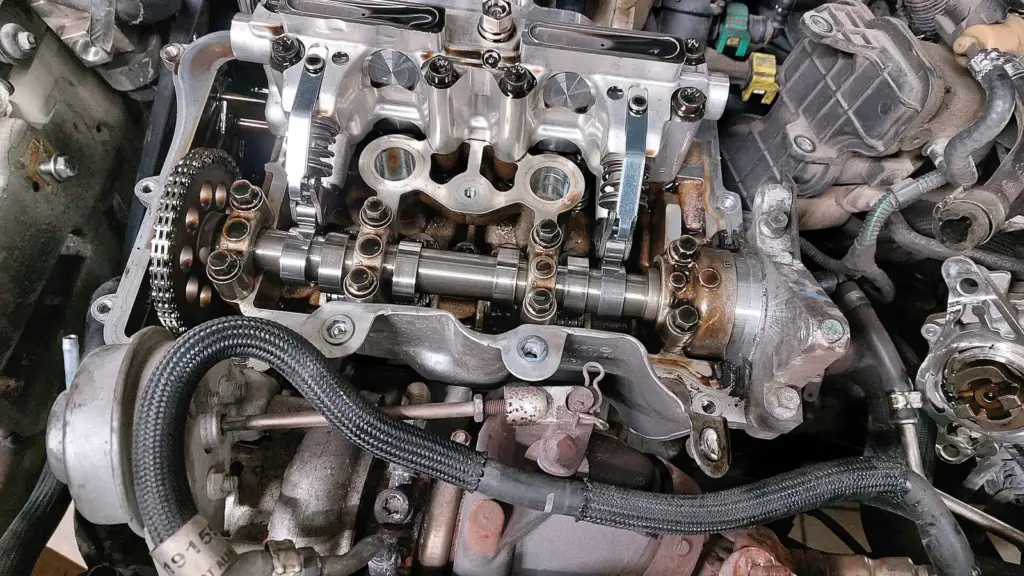
A timing chain lives inside the engine, lubricated by the same oil as the camshafts.
The third option: the “wet” belt
Some newer small engines use a belt-in-oil design, usually called a wet belt. It’s a timing belt that runs inside the engine like a chain, lubricated by engine oil. Dayco, which introduced its Belt-in-Oil system in 2007, says it has less friction than a chain, runs quieter and weighs less. The Autopian put the real-world fuel saving at about 1%. Most wet-belt engines are small three- and four-cylinders of 1.5 liters or less, and they’ve been far more common in Europe than in North America.
| Timing belt (dry) | Timing chain | Wet belt (belt in oil) | |
|---|---|---|---|
| Made of | Rubber with fiberglass or aramid cords | Steel links and sprockets | Oil-resistant rubber with fiber cords |
| Lives | Outside the engine, behind a plastic cover | Inside the engine, in oil | Inside the engine, in oil |
| Replacement | Scheduled, by miles or years | Usually not scheduled; replaced when worn | Scheduled, and often a big job |
| Biggest weakness | Snaps with little warning if overdue | Wears and “stretches” with poor oil care | Sensitive to oil type and change intervals |
| Why makers use it | Quiet, light, cheap | Long life, no scheduled change | Low friction, quiet, compact |
Is my car belt or chain? Check the maintenance schedule in your owner’s manual. If it lists a “timing belt” replacement, you’ve got a belt. If it doesn’t mention one, it’s almost certainly a chain. A dealer service desk can also tell you in seconds from your VIN.
02 · When to replace
When to Replace a Timing Belt (and Whether a Chain Ever Needs It)
Here’s the short version: a timing belt is a wear item with a replacement date, and a timing chain is designed to go much longer, often the life of the engine, but it isn’t guaranteed to.
- 60K–120K miTypical timing belt range (96,000–193,000 km)
- Miles or yearsBelts have a time limit too, whichever comes first
- Life of engineWhat most chains are designed for
- Oil changesThe biggest factor in how long a chain lasts
Timing belts: follow the schedule, not your gut
Sources put the typical belt interval anywhere from 60,000 to 120,000 miles (about 96,000 to 193,000 km), and most carmakers add a time limit, because rubber ages even when the car sits. The only number that really matters is the one in your owner’s manual, and it’s worth checking whether you fall under the “severe service” schedule. Towing, very hot or very cold weather and lots of short trips can cut the interval a lot.
Take Honda’s popular 3.5-liter V6, which has long used a timing belt in the Pilot, Passport, Ridgeline and Odyssey. Car and Driver noted that the new V6 in the 2023 Pilot kept the belt, too. Honda’s schedule calls for a new belt at 105,000 miles (about 168,000 km) or 7 years, and older owner’s manuals cut that to 60,000 miles (about 96,000 km) for severe use like towing or extreme temperatures.
Belt maker Gates’ replacement guide lists similar numbers for plenty of older engines. Just remember those intervals cover older model years, and your car’s own schedule always wins.
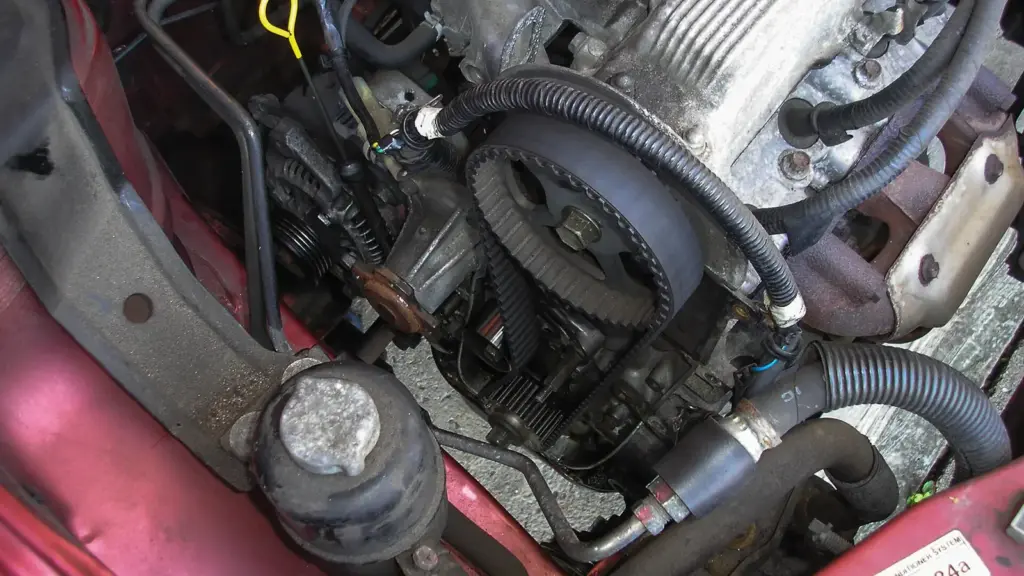
A dry timing belt sits behind a plastic cover at the end of the engine.
| Engine | Found in | Belt interval | Interference? |
|---|---|---|---|
| Honda 3.5L V6 | Pilot, Odyssey, Ridgeline, Passport, older Accord V6 | 105,000 mi (168,000 km) or 7 years; 60,000 mi severe | Yes |
| Subaru 2.5L flat-four (EJ) | 2005–2009 Forester, Impreza, Legacy, Outback | 105,000 mi (168,000 km) | Yes |
| Hyundai 2.7L V6 | 2001–2009 Santa Fe, 2002–2005 Sonata | 60,000 mi (96,000 km) | Yes |
| Toyota 3.0L / 3.3L V6 | 2005–2006 Camry; Highlander, Sienna | 90,000–100,000 mi (145,000–161,000 km) | Not listed as interference |
| Ford 1.0L EcoBoost (wet belt) | 2014–2017 Fiesta, 2015–2018 Focus, 2018–2021 EcoSport | Now 100,000 mi (161,000 km) or 6 years; was 150,000 mi | Failure can seize the engine |
Timing chains: long life, not forever
Most timing chains have no scheduled replacement. NAPA puts it simply: some last the life of the car, others eventually need a new chain or tensioner. Estimates for when that happens are all over the place, from about 80,000 miles to 250,000 miles, which tells you how much it depends on the engine and how it was looked after.
When mechanics say a chain has “stretched,” the steel itself isn’t stretching. Snap-on describes it as elongation caused by wear in the chain’s pins and links. A chain that’s a little longer than it should be lets the camshaft timing drift, and that’s when trouble starts.
Chains love clean oil. Timing-parts maker Cloyes says skipped oil changes, the wrong oil viscosity and contaminated oil are the main causes of chain wear, and that hydraulic tensioners depend on a healthy oil supply. After timing failures on its 3.6-liter V6, GM capped oil-change intervals at 7,500 miles (about 12,000 km) on 2013 and later models. Our guide to how often you really need an oil change has the details.
03 · Why it matters
Interference Engines: Why a Snapped Belt Can Wreck Your Engine
Whether a broken belt is a tow-truck inconvenience or a catastrophe depends on one thing: whether your engine is an interference engine.
In an interference engine, the valves and pistons share some of the same space, just at different times. That’s fine while the timing belt keeps everything in sync. But if the belt snaps or jumps teeth, the camshaft stops while the crankshaft keeps spinning, and pistons slam into open valves. The result is usually bent valves (most often the intake valves) and sometimes broken pistons, a repair that runs into thousands of dollars or calls for a whole new engine.
In a non-interference engine, there’s enough clearance that the pistons can’t reach the valves. A broken belt still leaves you stranded, but a new belt usually gets you going again. Most modern high-compression engines are interference designs, which is exactly why belt intervals aren’t a suggestion.
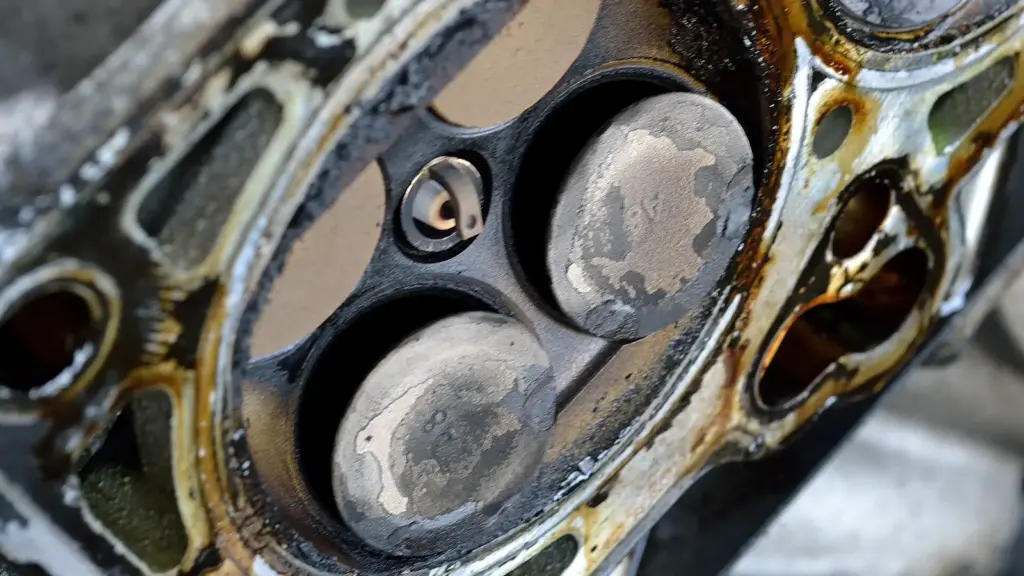
Intake valves bent after a timing belt broke on an interference engine.
- 1. Check the manualLook up your timing belt interval and whether you fall under the severe-service schedule.
- 2. Look it upGates’ part locator and replacement guides flag interference engines, and a dealer or good independent shop can confirm it.
- 3. Check the recordsBuying used? Ask for a receipt for the last belt job. No proof means you should budget for one.
- 4. Don’t stretch itOn an interference engine, an overdue belt is a gamble with the whole engine.
Buying a used car with a belt? If the seller can’t show the timing belt was done on schedule, treat it as due and factor the cost into your offer. Our used car inspection checklist covers what else to look for.
04 · Warning signs
Warning Signs of a Worn Timing Belt or Stretched Chain
Here’s the uncomfortable truth about timing belts: they often give little or no warning before they snap. That’s why the schedule matters so much. Chains are kinder, because a worn chain usually makes noise or sets a code well before it fails. Here’s what to watch and listen for.
A worn timing belt may show… cracks or separations in the rubber, a glazed, shiny back, worn teeth, or oil or coolant contamination (both attack the rubber and can make it slip). Out on the road, look for rough running, a ticking or slapping noise from the front of the engine, loss of power, a Check Engine light, or an engine that cranks but won’t start.
A stretched timing chain may show… a rattle from the front of the engine that’s loudest on a cold start, when oil pressure is lowest. You might also see a Check Engine light, misfires, stalling, a hard start, low power, or metal flakes in the drained oil. Engines with variable valve timing often set a code before you hear anything at all.
The trouble codes that point to timing
When a chain stretches or a belt jumps a tooth, the engine computer notices that the camshaft and crankshaft sensors no longer line up the way they should. GM’s service bulletin for its 3.6-liter V6 lists these as stretched-chain codes:
- P0008 / P0009Engine position system performanceThe computer sees the cam and crank out of step on bank 1 (P0008) or bank 2 (P0009). On GM’s 3.6 V6 these were classic signs of a stretched chain.
- P0016 / P0017Crankshaft and camshaft correlation, bank 1The intake (P0016) or exhaust (P0017) camshaft isn’t where it should be relative to the crankshaft. Can mean a stretched chain, a belt that jumped a tooth, or a cam phaser or sensor problem.
- P0018 / P0019Crankshaft and camshaft correlation, bank 2The same check on the other side of a V6 or V8.
A code isn’t a diagnosis. These codes can also come from low oil, a faulty sensor or a sticky cam phaser, so a good shop will check before quoting a timing job. Our guide to the Check Engine light explains how to read codes and what to do next.
Our take: if your engine has a chain and starts rattling on cold mornings, don’t wait for it to get louder. A chain job caught early costs a few thousand dollars; a chain that skips on an interference engine can cost you the engine.
05 · The job and the bill
What a Timing Belt or Chain Replacement Costs
Neither job is cheap, and the price is mostly labor. Getting to the belt or chain means pulling off accessory belts, covers, sometimes an engine mount and, on some cars, a lot more. Here’s what US shops charge on average, according to RepairPal’s estimates updated in September 2026 (before tax, and prices vary a lot by car and region):
$2,120–$2,764
Timing chain replacement
Labor $1,334–$1,957 of that
$1,467–$1,963
Timing chain tensioner only
Still a big job to reach it
$1,536–$1,697
2025 Honda Odyssey timing belt
Kelley Blue Book dealer estimate
$918–$1,338
Timing belt replacement
Labor $603–$885 of that
Those are averages, and the spread between cars is huge. RepairPal’s estimate for a Toyota Camry belt job runs $633 to $1,081, while engines with tight engine bays or two camshaft banks, like many V6s, cost a lot more. Wherever you live, get a written quote from a dealer and an independent shop before you book.
Replace the whole kit, not just the belt
A belt job is mostly labor, so the parts that sit next to the belt should come out at the same time. Gates says belt-driven water pumps should always be replaced with the belt, because a new belt runs at higher tension that can finish off a worn pump, and a seized pump can destroy the new belt. One belt maker estimated that around half of all failures of newly replaced belts come from reusing worn tensioners or idlers.
- 1. Timing beltThe main event, replaced on schedule.
- 2. Tensioner and idlersThe pulleys that keep the belt tight and on track. Reusing worn ones is a common cause of early belt failure.
- 3. Water pumpIf the belt drives it, replace it now. You’d pay most of the same labor again to do it later.
- 4. Seals and accessory beltsCamshaft and crankshaft seals stop oil from soaking the new belt, and the serpentine belt is already off.
Pay for the full kit if… you plan to keep the car. Many shops sell a belt-and-water-pump package, and the extra parts cost far less than paying for the same labor twice.
Think hard before a big chain job if… the car is old and worth little. Get a diagnosis first, since a noisy tensioner or guide may cost less than a complete chain set, and compare the quote with what the car is worth.
Cloyes recommends the same whole-kit approach for chain jobs: when the chain is worn, replace the guides, tensioner and sprockets too.
06 · Known trouble
The Engines With a Timing Belt or Chain Reputation
Most belts and chains do their job without drama. A handful of engines, though, ended up in class actions, service bulletins or federal investigations. If you own or are shopping for one of these, it pays to know the history.
The wet-belt headache. Ford’s 1.0-liter EcoBoost three-cylinder, sold in the US in the 2014–2017 Fiesta, 2015–2018 Focus and 2018–2021 EcoSport, uses a belt that runs in oil. NHTSA opened an investigation in December 2025 and upgraded it to an engineering analysis in July 2026, covering about 136,000 vehicles. It counted 355 belt failures at an average of roughly 70,000 miles (113,000 km), almost all well before Ford’s original 150,000-mile interval. Belt material can break down and clog the oil pump pickup, so oil pressure drops and the engine can lose power or seize. When NHTSA upgraded the probe there was no recall for the timing belt itself (an earlier recall, 23V-905, fixed the separate belt that drives the oil pump, and NHTSA says it’s unrelated), but Ford cut the interval to 100,000 miles (161,000 km) or 6 years under a customer satisfaction program and may reimburse owners who paid for belt-related engine repairs.
In Europe, Stellantis’ 1.0 and 1.2 PureTech engines (never sold in North America) had a similar belt-degradation problem. Stellantis offers extended cover of up to 10 years or 180,000 km (112,000 miles) on conditions, and its new 1.2 “Turbo 100” engine for 2026 switched to a timing chain.
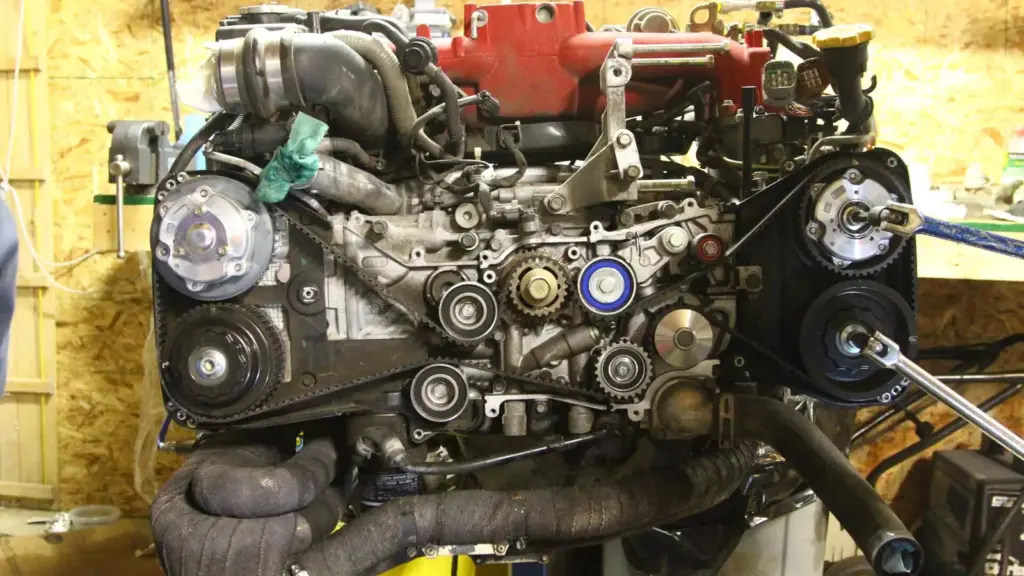
A belt job means working around tensioners, idlers and often the water pump.
Timing chain trouble spots
- VW and Audi 2.0T and 1.8T2008–2014 VW, 2008–2013 AudiTiming chain tensioner failures on the EA888 engines in the GTI, Jetta, CC, Passat, Tiguan, Eos and Beetle, plus the Audi A3, A4, A5, A6, Q5 and TT. A US class-action settlement extended timing chain coverage to 10 years or 100,000 miles. See our Volkswagen and Audi pages for more on the brands.
- BMW N20 and N26 four-cylinder2012–2015 modelsTiming chain guide and oil-pump chain problems in the X1, 320i, 328i, 428i, 528i, X3, X4, 228i and Z4. A settlement given final approval in 2021 reimburses repairs on a sliding scale up to 8 years or 100,000 miles.
- GM 3.6L V6About 2007–2012The Chevrolet Traverse and Equinox, GMC Acadia and Terrain, Buick Enclave and Cadillac CTS and SRX, among others. GM issued a service bulletin for stretched chains, and later shortened oil-change intervals.
- GM 2.4L Ecotec2010–2013 Equinox and TerrainHeavy oil consumption from piston-ring wear was linked to timing chain damage in a class action. The settlement covered certain repairs; GM denied the claims.
- Nissan V6 and 2.5L fourMid-2000sChain tensioner and guide problems in the 2004–2008 Maxima, 2004–2009 Quest, 2004–2006 Altima and 2005–2007 Pathfinder, Xterra and Frontier, settled in 2020.
Our take: a timing chain isn’t automatically better than a belt. A well-maintained belt engine with a fresh belt on record is a safer bet than a chain engine with a cold-start rattle and patchy oil-change history. Whichever you have, the cheapest timing repair is the one you never need, and that comes down to oil changes and following the schedule.
Want to understand how engine layouts differ beyond the timing drive? Our explainer on gasoline engine types covers everything from boxers to rotaries.
Frequently Asked Questions
How do I know if my car has a timing belt or a timing chain?
Check the maintenance schedule in your owner’s manual. If it lists a timing belt replacement, your engine has a belt. If it doesn’t, it almost certainly has a chain. A dealer can also confirm it from your VIN.
How often should a timing belt be replaced?
Typically every 60,000 to 120,000 miles (96,000 to 193,000 km), or after a set number of years, whichever comes first. Your owner’s manual has the exact interval, and severe use like towing or extreme temperatures can shorten it.
Do timing chains ever need to be replaced?
Most are designed to last the life of the engine and have no scheduled replacement, but chains, guides and tensioners can wear out, especially with skipped oil changes. A cold-start rattle or timing-related trouble codes are the usual warning signs.
What happens if a timing belt breaks while driving?
The engine stops running immediately. On a non-interference engine a new belt usually fixes it. On an interference engine the pistons can hit the valves, bending them and sometimes breaking pistons, which can cost thousands or require a new engine.
Should I replace the water pump with the timing belt?
If the timing belt drives the water pump, yes. Belt makers like Gates recommend it, because you’ve already paid for most of the labor and a failing pump can destroy the new belt. Replace the tensioner and idlers at the same time, too.
How much does it cost to replace a timing belt or chain?
RepairPal’s US averages, updated in 2026, are $918 to $1,338 for a timing belt and $2,120 to $2,764 for a timing chain, before tax. Your car’s price can be much higher or lower depending on how hard the parts are to reach.
Keep Your Engine Healthy
Timing belts and chains are only one part of looking after your engine. These guides cover the rest.
Sources
- Gates TechZone: PowerGrip timing belts
- Gates TechZone: why to change the water pump with the timing belt
- Gates: timing belt replacement interval guide (2010)
- Dayco: timing belts
- Dayco: Belt-in-Oil system
- NAPA Know How: timing chain versus timing belt
- NAPA Know How: why cars use one or the other
- The Autopian: why so many people hate wet timing belts
- Cloyes: timing chain system FAQ
- Cloyes: clean oil in timing chain systems
- Snap-on via Vehicle Service Pros: timing chain diagnostics
- Bernardi Honda Parts: Honda timing belt replacement guide
- Honda Pilot owner’s manual: maintenance schedule
- Car and Driver: Honda’s new 3.5-liter V6 keeps its timing belt
- AA1Car: timing belts and interference engines
- MOTOR: timing is critical (2004)
- GM service bulletin 12-06-01-009E: 3.6L V6 timing chain
- RepairPal: timing belt replacement cost
- RepairPal: timing chain replacement cost
- Kelley Blue Book: 2025 Honda Odyssey timing belt replacement
- ConsumerAffairs: timing chain replacement cost
- Repairer Driven News: NHTSA upgrades Ford 1.0L timing belt probe (2026)
- Autoblog: Ford’s wet timing belt problem (2026)
- NHTSA: EA26004 information request to Ford (2026)
- Peugeot UK: PureTech engine solutions
- evo: Peugeot’s new engine swaps belts for chains (2026)
- CarComplaints: VW and Audi timing chain settlement
- CarComplaints: BMW N20/N26 timing chain settlement
- CarComplaints: GM 2.4L oil consumption settlement
- CarComplaints: Nissan timing chain settlement
Photo credits
- Header image: Kolossos, CC BY-SA 3.0, cropped and resized.
- Subaru EJ boxer engine on a stand…: Grant.C, CC BY 2.0, cropped and resized.
- Cylinder head with intake valves bent after…: Maz2331, CC BY-SA 3.0, cropped and resized.
- Small three-cylinder engine in a car with…: Thilo Parg, CC BY-SA 3.0, cropped and resized.
- Car engine with the valve cover removed,…: Anna.Massini, CC BY-SA 4.0, cropped and resized.