
 Written by
How to Read a Tire Sidewall: Size, Load, Speed Rating and Date Code
Every tire sidewall is basically a spec sheet molded into rubber. It tells you the tire’s size, how much weight it can carry, how fast it’s built to go, when it was made, how it scored on government tests and whether it’s fit for real snow. The problem is that it’s written in a code that looks like a Wi-Fi password.
This guide cracks that code one piece at a time, from 225/45R17 94W to the four-digit date stamp that tells you how old your tires really are. Once you can read it, you’ll buy the right replacements, spot a stale “new” tire at the shop and know when old rubber needs to go, whatever the tread looks like.
Guide · Tires
Updated November 2026 · 19 min read
The Sidewall at a Glance
The numbers worth knowing before you shop for tires:
Example size 225/45R17 Width, aspect ratio, radial, rim diameter
Load index 94 670 kg 1,477 lb maximum load per tire
Speed rating W 270 km/h 168 mph maximum speed
Date code 2324 Week 23 Of 2024: the last four digits of the DOT code
Oldest you should run 10 years From the date of manufacture, per Michelin, Bridgestone and Continental
Worn out at 1.6 mm 2/32 in of tread, NHTSA’s replacement point
01 · Tire size
Tire Size, Decoded: What 225/45R17 Means
Start with the biggest text on the sidewall after the brand name. On most car tires it looks something like 225/45R17 94W. The first half is the size, the second half (94W) is the service description, which we’ll get to in a minute. Here’s the size, piece by piece:
- 225Section width in millimeters, measured from sidewall to sidewall on the right-size rim. Yes, a tire sold in America is measured in metric.
- 45Aspect ratio: the sidewall’s height is 45% of the width. Lower numbers mean shorter, stiffer sidewalls, the look you see on sporty cars.
- RRadial construction, where the body cords run across the tire from bead to bead. Almost every modern car tire is a radial.
- 17Rim diameter in inches. The tire only fits a 17-inch wheel, so this number has to match your wheels exactly.
Want to know how tall the tire is? Do the math: 45% of 225 mm is about 101 mm (4.0 in) of sidewall. Add that twice to a 17-inch (432 mm) wheel and you get an overall diameter of about 634 mm (25.0 in). That’s handy when you’re comparing sizes, because a tire that’s much taller or shorter than stock throws off your speedometer and can rub on the bodywork.
The easiest way to find your car’s correct size isn’t the tires already on it, since a previous owner might have changed them. Look at the Tire and Loading Information placard on the driver’s door jamb or in the owner’s manual instead.
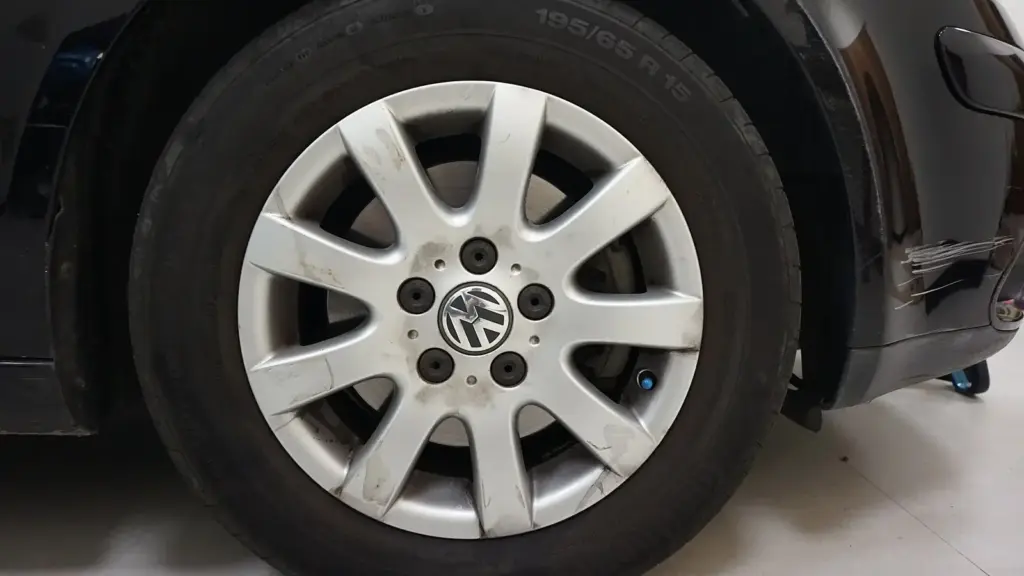
The size is usually the biggest code on the sidewall, right after the brand and model names.
P, LT or nothing at all: the letters in front
- P-metricP225/45R17The P stands for passenger car. Its load ratings follow the US Tire and Rim Association’s standards, and it’s common on North American cars, minivans and crossovers.
- Euro-metric225/45R17No letter in front. Same dimensions as the P-metric version, but its load ratings come from Europe’s ETRTO tables, so Tire Rack notes the load capacity and inflation tables differ slightly. Check your placard before swapping one for the other.
- Light truckLT265/70R17Built for pickups and heavy SUVs that tow and haul. LT tires use load ranges (more on those below) and usually run higher pressures than passenger tires.
Putting car tires on a truck? When a P-metric or Euro-metric tire goes on a light truck or SUV, the industry knocks its load rating down by dividing it by 1.1. Tire Rack’s example: a tire rated for 2,000 lb ends up good for about 1,818 lb (roughly 825 kg). That’s why an SUV sometimes needs a higher load index than the same size on a sedan.
02 · Load and speed
Load Index and Speed Rating: The “94W” Part
Right after the size you’ll find a number and a letter, like 94W. Together they’re called the service description, and they set the limits your tire was built for.
The load index
The number is a code for the most weight one tire can carry when it’s properly inflated. It isn’t kilograms or pounds; you look it up on a chart. Multiply by four and you get the most the full set can carry, which needs to cover your vehicle’s maximum loaded weight.
| Load index | Max load per tire | Set of four |
|---|---|---|
| 91 | 615 kg (1,356 lb) | 2,460 kg (5,424 lb) |
| 94 | 670 kg (1,477 lb) | 2,680 kg (5,908 lb) |
| 100 | 800 kg (1,764 lb) | 3,200 kg (7,056 lb) |
- SLStandard LoadThe default. If a passenger tire doesn’t say anything about load, it’s a standard-load tire.
- XLExtra Load or ReinforcedBuilt to carry more than a standard tire of the same size, usually at a higher inflation pressure. Michelin says to always replace an XL tire with another XL tire.
- C, D, ELight truck load rangesLoad Range C is a 6-ply rating with a 345 kPa (50 psi) max, D is 8-ply at 450 kPa (65 psi) and E is 10-ply at 550 kPa (80 psi), for tires up to 295 mm wide. The ply rating describes strength, not an actual count of layers.
The speed rating
The letter is the highest speed the tire is built to sustain at its rated load. The letters mostly climb in alphabetical order, with one oddball: H sits between U and V. Here are the ones you’ll actually see on cars and crossovers:
| Rating | Max speed | Where you’ll see it |
|---|---|---|
| Q | 160 km/h (99 mph) | Many winter tires |
| S | 180 km/h (112 mph) | Family cars, some light trucks |
| T | 190 km/h (118 mph) | Family sedans and minivans |
| H | 210 km/h (130 mph) | Sporty sedans and many crossovers |
| V | 240 km/h (149 mph) | Performance sedans and coupes |
| W | 270 km/h (168 mph) | High-performance cars |
| Y | 300 km/h (186 mph) | Exotic and supercar tires |
Does a higher speed rating mean a better tire? Sort of. BFGoodrich says higher-rated tires typically grip and stop better but give up some tread life. Goodyear points out the rating itself says nothing about handling, though. Treat it as a hint, not a guarantee.
Our take: replace tires with ones that match or beat the load index and speed rating on your door placard. Goodyear notes that a car with mixed tires is only as fast as its lowest-rated pair, and Michelin says the one sensible exception is winter tires, which can carry a lower rating as long as you stay under their limit.
03 · DOT date code
The DOT Code: How Old Are Your Tires?
Somewhere near the rim you’ll find the letters DOT followed by a string of letters and numbers. That’s the Tire Identification Number, or TIN, and it’s what the US Department of Transportation uses to trace a tire back to the plant and week it was made. You only need the last four digits, though.
Those last four digits are the date code: week first, then year. So 2324 means the 23rd week of 2024, and the 0312 in the photo here means the third week of 2012. The date code is often in a little oval or box of its own, because it’s the part of the mold that changes every week.
Only three digits? That tire was made before July 2, 2000, when the four-digit code became mandatory. The old code used two digits for the week and one for the year. A tire that old shouldn’t be on a car, whatever the tread looks like.
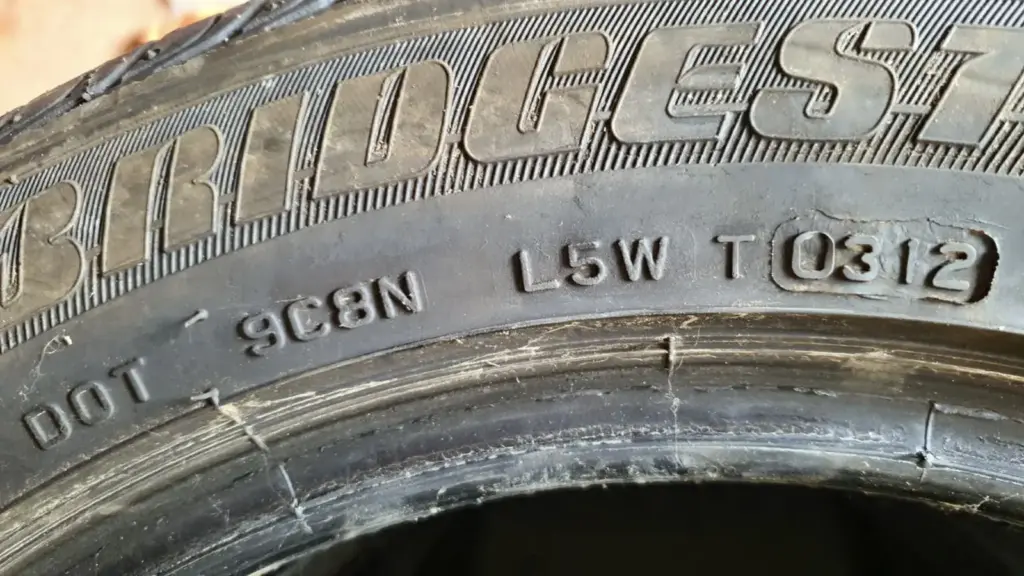
The boxed 0312 is the date code: the third week of 2012.
- 1. Find the DOTLook low on the sidewall, near the wheel, for the letters DOT. The code that follows is the TIN.
- 2. Read the last four digitsWeek, then year. 0125 is the first week of 2025; 5223 is the last week of 2023.
- 3. No date? Flip sidesFor tires made since September 2009, the full TIN goes on the side meant to face out. The other side can show a partial code without the date, so check the inside if you’re looking at a reversed or unmounted tire.
- 4. Do the mathCount from the date of manufacture, not the day the tire went on your car. Tires age on the shelf too.
Newer tires carry a slightly different code. Since April 13, 2015, NHTSA has handed out three-character plant codes to new factories, and two-character codes were phased out entirely by April 13, 2025. A current TIN is 13 characters: DOT, a three-character plant code, a six-character manufacturer’s code and the four-digit date. None of that changes how you read the date.
How old is too old?
Here’s where it gets fuzzy. Rubber hardens and cracks with age even when a tire sits in the garage, and NHTSA warns that you can’t judge tire aging just by looking. But NHTSA doesn’t set an age limit of its own. It says some vehicle and tire manufacturers recommend replacing tires that are six to 10 years old, regardless of tread. Here’s what the big names say:
- Michelin10 years, inspect yearly after 5After five years in service, have a tire pro inspect your tires at least once a year. Replace any tire 10 years after its date of manufacture, spare included. On original-equipment tires, follow your vehicle maker if it says sooner.
- Bridgestone10 years, inspect after 5Take tires made 10 or more years ago out of service. After five years, Bridgestone calls an inspection essential.
- Continental10 yearsReplace all tires that are more than 10 years old. Continental also says unused tires stored properly can be sold as new for up to five years after they’re made.
- Some automakers6 yearsSome carmakers go shorter. Chrysler, for example, started telling owners in its 2006-model manuals to replace tires and the spare after six years, regardless of tread. Your owner’s manual has the final word for your car.
Buying “new” tires? Check the date code before they’re mounted. A tire that sat in a warehouse for a couple of years is still sold as new. You’re within your rights to ask for fresher stock, and it’s worth checking the spare and any used car you’re looking at too. Our used car inspection checklist covers the rest.
04 · UTQG grades
UTQG Grades: Treadwear, Traction and Temperature
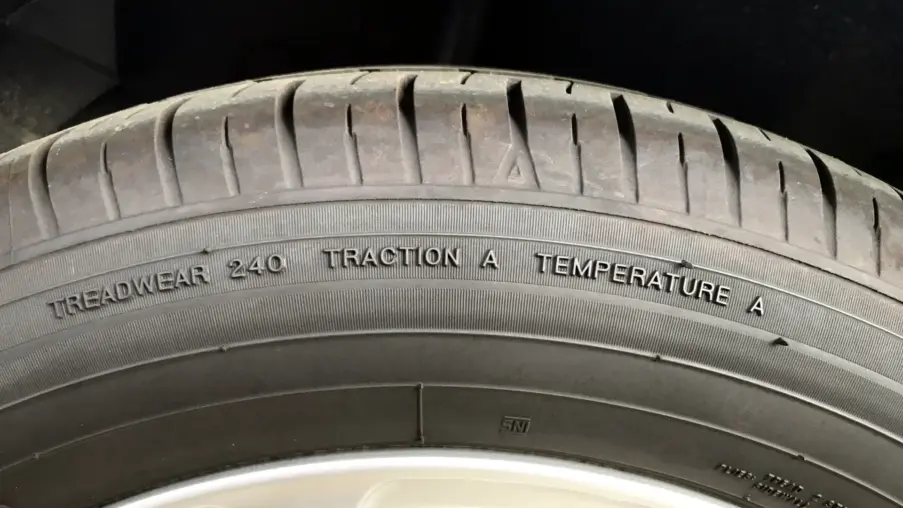
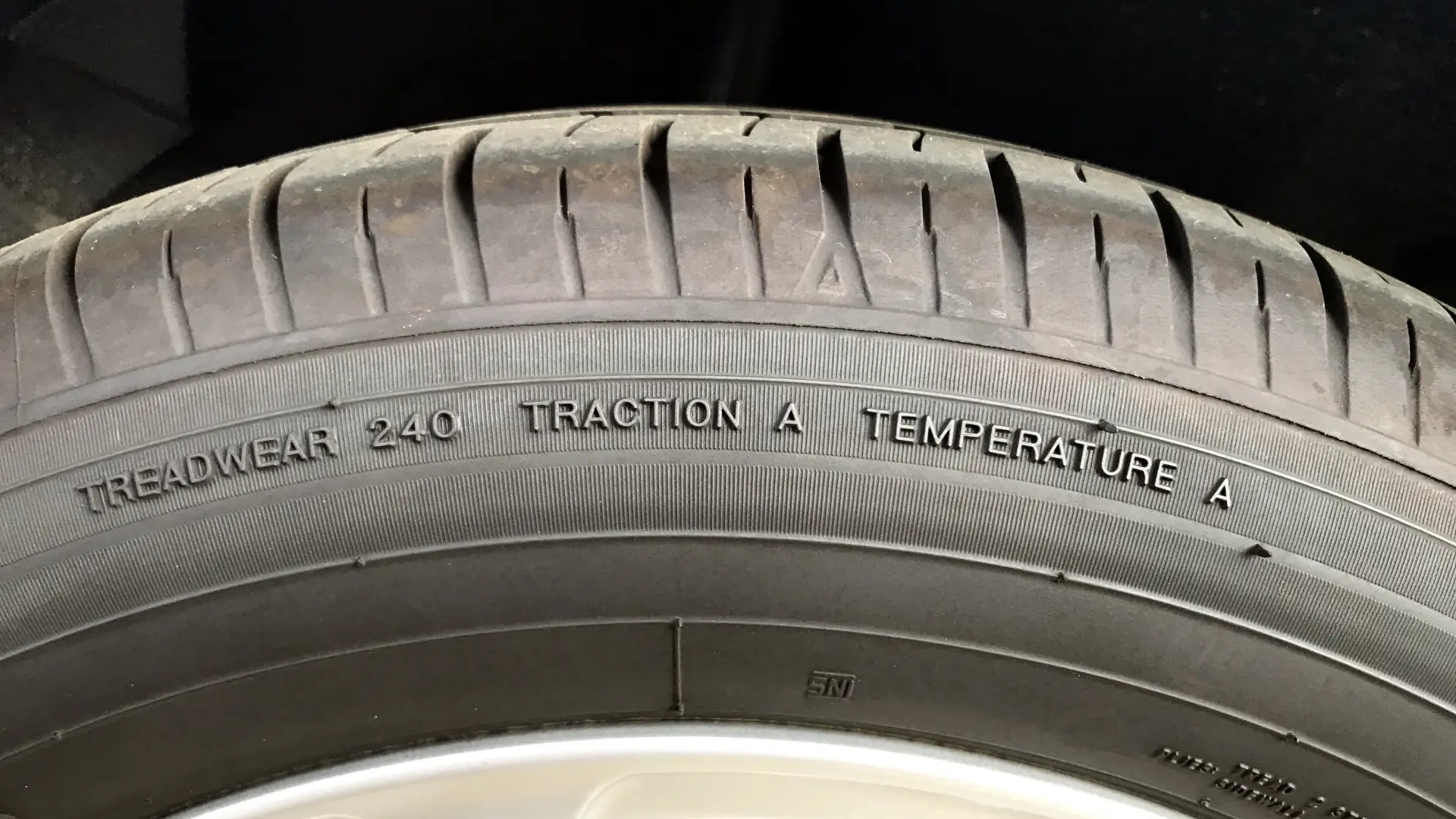
Most passenger tires sold in the US carry three government-mandated grades under the Uniform Tire Quality Grading system, or UTQG. You’ll see something like TREADWEAR 400 TRACTION A TEMPERATURE A in small letters near the rim. Here’s how to read them:
- 100Treadwear baseline: the control tire’s grade
- 1.5×How long a 150 lasts vs a 100 on the test course
- AA to CTraction grades, best to worst
- A to CTemperature grades, best to worst
Treadwear
The treadwear number compares the tire against a control tire graded 100, after an 11,600 km (7,200-mile) run on a government course near San Angelo, Texas. The rule puts it simply: a tire graded 150 would wear one and a half times as well on that course as a tire graded 100. Higher is better.
The catch? The manufacturer runs the tests and assigns the grade itself, and your driving, roads and climate aren’t a Texas test loop. Tire Rack doesn’t recommend comparing treadwear grades between brands. Use them to compare tires from the same company, and lean on the mileage warranty when you’re shopping across brands.
Traction
This is wet braking grip, measured with the wheels locked while the tire skids in a straight line on wet asphalt and wet concrete. It doesn’t measure cornering grip or dry stopping.
| Grade | Wet asphalt | Wet concrete |
|---|---|---|
| AA | Above 0.54 | Above 0.38 |
| A | Above 0.47 | Above 0.35 |
| B | Above 0.38 | Above 0.26 |
| C | 0.38 or less | 0.26 or less |
Temperature
This one measures how well a tire sheds heat at speed, tested on a lab wheel. Heat is a tire’s enemy, so it matters most if you drive long distances at highway speeds or in hot weather.
A
Over 185 km/h (115 mph)
Best heat resistance
B
161–185 km/h (100–115 mph)
Middle of the pack
C
137–161 km/h (85–100 mph)
The federal minimum
What doesn’t get graded: UTQG only covers passenger-car tires, so light truck (LT) tires skip it. Deep-tread tires, winter-type snow tires, temporary spares, tires for rims of 12 inches or smaller and limited-production tires are exempt too.
What to look for: for a daily driver, a traction grade of A or AA and a temperature grade of A or B. Then compare treadwear within the same brand and check the mileage warranty.
05 · Snow symbols
M+S vs the Three-Peak Mountain Snowflake
Two winter markings cause more confusion than anything else on the sidewall, and the difference between them really matters once it snows.
M+S (mud and snow) only describes the tread design: enough open grooves to qualify. There’s no performance test behind it, which is why plenty of ordinary all-season tires wear it.
The three-peak mountain snowflake (3PMSF) is earned. US and Canadian tire industry groups introduced it in 1999, and a tire only gets it by scoring a traction index of at least 110 against a standard reference tire (100) in ASTM packed-snow acceleration tests. In plain English: at least 10% better than the reference tire at getting going on snow.
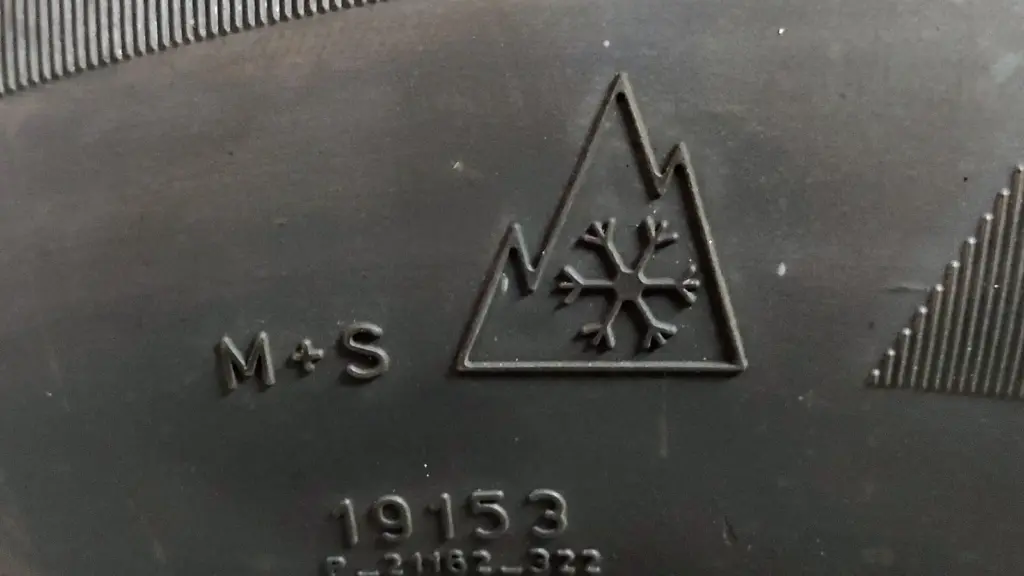
M+S is a tread description. The mountain and snowflake means the tire passed a snow test.
Don’t read too much into the snowflake, though. The test only measures acceleration on packed snow, not braking, cornering or ice. Dedicated winter tires and so-called all-weather tires both carry the symbol, and Tire Rack says all-weather tires aren’t a replacement for true winter tires in a hard winter. Our guide to winter vs. all-season vs. all-weather tires digs into that choice.
Where the symbol is the law: Canada
| Province | When | What counts |
|---|---|---|
| Quebec | December 1 to March 15 | Winter tires with the snowflake pictogram, or studded tires, on all Quebec-registered passenger vehicles, rentals included. Fines run $200 to $300. |
| British Columbia | October 1 to April 30 on most designated highways (some end March 31) | M+S is the legal minimum, 3PMSF is recommended, with at least 3.5 mm of tread. At least two matching winter tires on the drive axle; four recommended. Chains are the alternative. |
Winter tires often carry a lower speed rating (Q or T is common) than the all-seasons they replace. That’s normal, and Michelin says it’s fine on 3PMSF tires as long as you stay under the tire’s maximum speed.
Driving an EV in the cold? Winter rubber is only half the story; our guide to EV range in winter covers the rest.
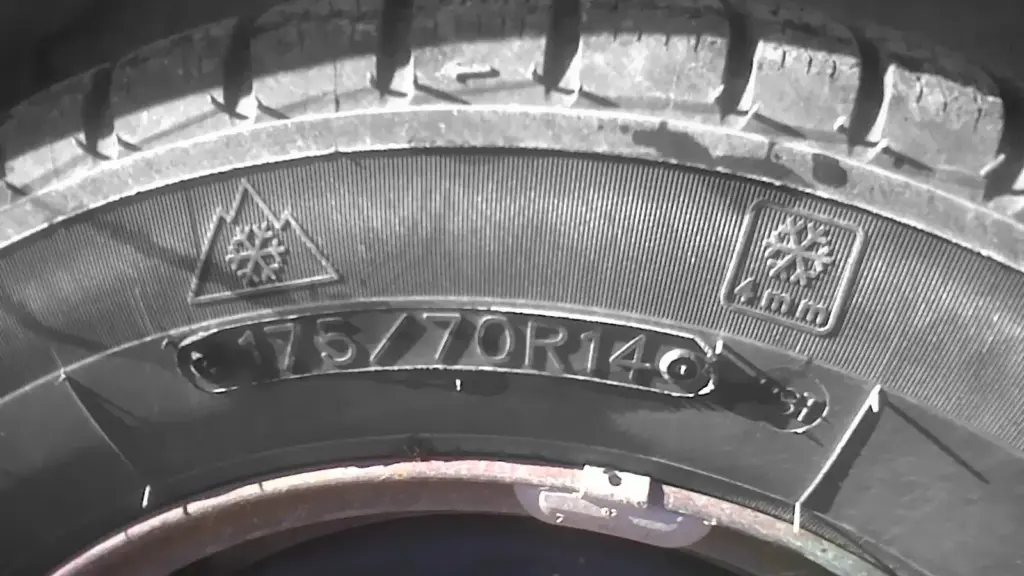
A winter tire: the snowflake symbol sits right next to the size.
06 · The fine print
Everything Else on the Sidewall
Once you’ve got the big codes, the rest of the sidewall is mostly fine print. A few bits of it are worth knowing.
Don’t inflate to this
Max pressure
MAX PRESS Design limit
The pressure on the sidewall is the most the tire can safely hold, not what you should run. NHTSA says to use the figure your vehicle maker lists on the door placard, not the one on the tire.
Wear bars
TWI
Tread wear indicator 1.6 mm
A small TWI mark or triangle on the shoulder shows where the wear bars sit in the grooves. When the tread is level with them, you’re down to 1.6 mm (2/32 in) and it’s time for new tires.
Fitting
Rotation and Outside
Directional Asymmetric
An arrow means a directional tire that has to roll one way. OUTSIDE or INSIDE marks an asymmetric tire that has to be mounted with the right face out. Get either wrong and grip suffers.
Built in
Ply composition
Tread plies Sidewall plies
Tires must list the materials and number of layers, for example 2 polyester + 2 steel + 1 polyamide under the tread. Mostly useful to tire nerds and recyclers.
No tube
Tubeless
TUBELESS
The tire seals against the rim with no inner tube, which is how every modern car tire works.
Limited use
Temporary spare
T-type Temporary Use Only
Compact spares are marked Temporary Use Only and are meant to get you to a shop, not to stay on the car. Check the speed and distance limits in your manual.
Want to check the tread without a gauge? NHTSA’s penny test still works: put a penny into a groove with Lincoln’s head upside down. If you can see the top of his head, you’re at or below 2/32 in and it’s time for new tires.
A cheap tread depth gauge is more precise, and it’s useful for checking uneven wear across the tread. Wear on one edge often points to alignment or pressure problems, and that’s worth fixing before it chews through a new set. Spotting tire trouble pairs nicely with knowing when to replace brake pads and rotors.
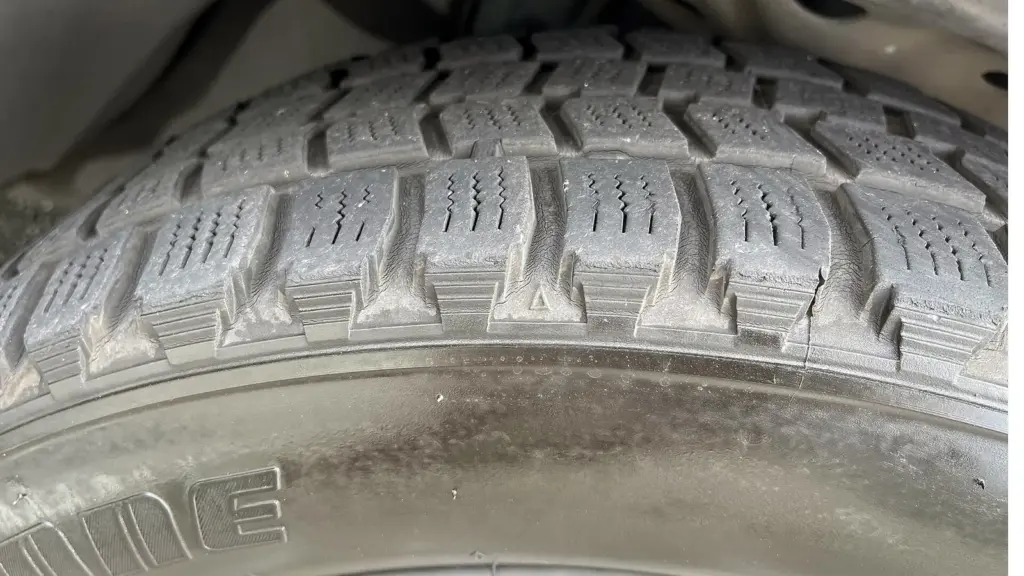
Wear bars sit in the grooves. When the tread wears down to them, the tire is done.
Run-flat markings by brand
Run-flat tires can keep going for a limited distance after losing air, and each brand marks them differently. If your car came with run-flats and no spare, look for one of these before you buy replacements:
| Brand | Run-flat marking |
|---|---|
| Bridgestone and Firestone | RFT |
| Michelin | ZP |
| Goodyear | EMT or ROF |
| Dunlop | DSST or ROF |
| Pirelli | Run Flat or RunForward |
| Yokohama | ZPS |
| Continental | SSR (Self Supporting Runflat) |
Our take: you don’t need to memorize the whole sidewall. Know your size, load index and speed rating (they’re on your door placard), check the date code every time you buy tires, and look for the snowflake if you drive in real winter. That covers most of what matters.
Frequently Asked Questions
What do the numbers on a tire mean?
In a size like 225/45R17 94W, 225 is the width in millimeters, 45 is the sidewall height as a percentage of the width, R means radial, 17 is the wheel diameter in inches, 94 is the load index (670 kg or 1,477 lb per tire) and W is the speed rating (270 km/h or 168 mph).
How do I tell how old my tires are?
Find the DOT code near the rim and read its last four digits: week, then year. 2324 means the 23rd week of 2024. If you can’t find a date, check the other sidewall, since one side can carry a partial code without it.
How old is too old for tires?
Michelin, Bridgestone and Continental all say to replace tires 10 years after they were made, whatever the tread looks like, and Michelin and Bridgestone want an inspection every year after five. Some automakers say six years, so check your owner’s manual.
Should I inflate my tires to the pressure on the sidewall?
No. That’s the maximum pressure the tire can hold. Use the pressure on the placard in your driver’s door jamb or in the owner’s manual, and check it when the tires are cold.
Can I use a tire with a different speed rating?
Go for the same rating as your door placard or higher. Michelin says a lower rating is acceptable on 3PMSF winter tires, as long as you stay below that tire’s maximum speed. If you mix tires, the car is only as fast as the lowest-rated ones.
Is M+S the same as a winter tire?
No. M+S only describes the tread pattern and involves no testing. The three-peak mountain snowflake means the tire passed a packed-snow traction test, and it’s the symbol Quebec requires from December 1 to March 15.
Shopping for Tires Next?
Now that you can read the sidewall, pick the right type of tire for your climate and check the rest of the car while you’re at it.
Sources
- NHTSA: tires, tire aging, pressure and tread
- 49 CFR 574.5: tire identification number requirements
- 49 CFR 571.139 (FMVSS 139): sidewall labeling
- Federal Register (2015): three-character plant codes
- Federal Register (1999): four-digit date code
- 49 CFR 575.104: Uniform Tire Quality Grading standards
- Tire Rack: UTQG explained
- Tire Rack: reading the DOT date code
- Tire Rack: load index chart
- Tire Rack: speed rating chart
- Tire Rack: P-metric vs Euro-metric tires
- Tire Rack: load ranges and ply ratings
- Tire Rack: maximum vs recommended inflation pressure
- Tire Rack: ply composition markings
- Tire Rack: run-flat tire identification
- Tire Rack: the three-peak mountain snowflake symbol
- Michelin: when do I need new tires
- Michelin: load rating and speed rating
- Michelin: tire markings explained
- Bridgestone Americas: tire replacement guidance
- Continental: tire age
- Goodyear: tire speed ratings
- BFGoodrich: speed rating and tread life
- Automotive Fleet (2005): Chrysler Group advises changing tires after six years
- Government of Quebec: requirements for winter tires
- Government of BC: winter tire and chain-up routes
- Government of BC: about winter tires
- Edmunds: tire date code
Photo credits
- Header image: VVVN, CC BY 3.0, cropped and resized.
- DOT tire identification number on a Bridgestone…: Richard Huber, CC BY-SA 4.0, cropped and resized.
- M+S marking next to the three-peak mountain…: MatthewGhera, CC BY 3.0, cropped and resized.
- Winter tire sidewall with the size 175/70R14…: A7N8X, CC BY-SA 3.0, cropped and resized.
- Temporary spare tire marked Temporary Use Only…: Schumi4ever, CC BY-SA 4.0, cropped and resized.
- Close-up of a winter tire tread showing…: VVVN, CC BY 3.0, cropped and resized.
- Front wheel and tire of a Volkswagen…: Tbatb, CC BY-SA 4.0, cropped and resized.
- Plastic tread depth gauge with marks at…: Fahi, Public domain, cropped and resized.