
Red Bull Ring
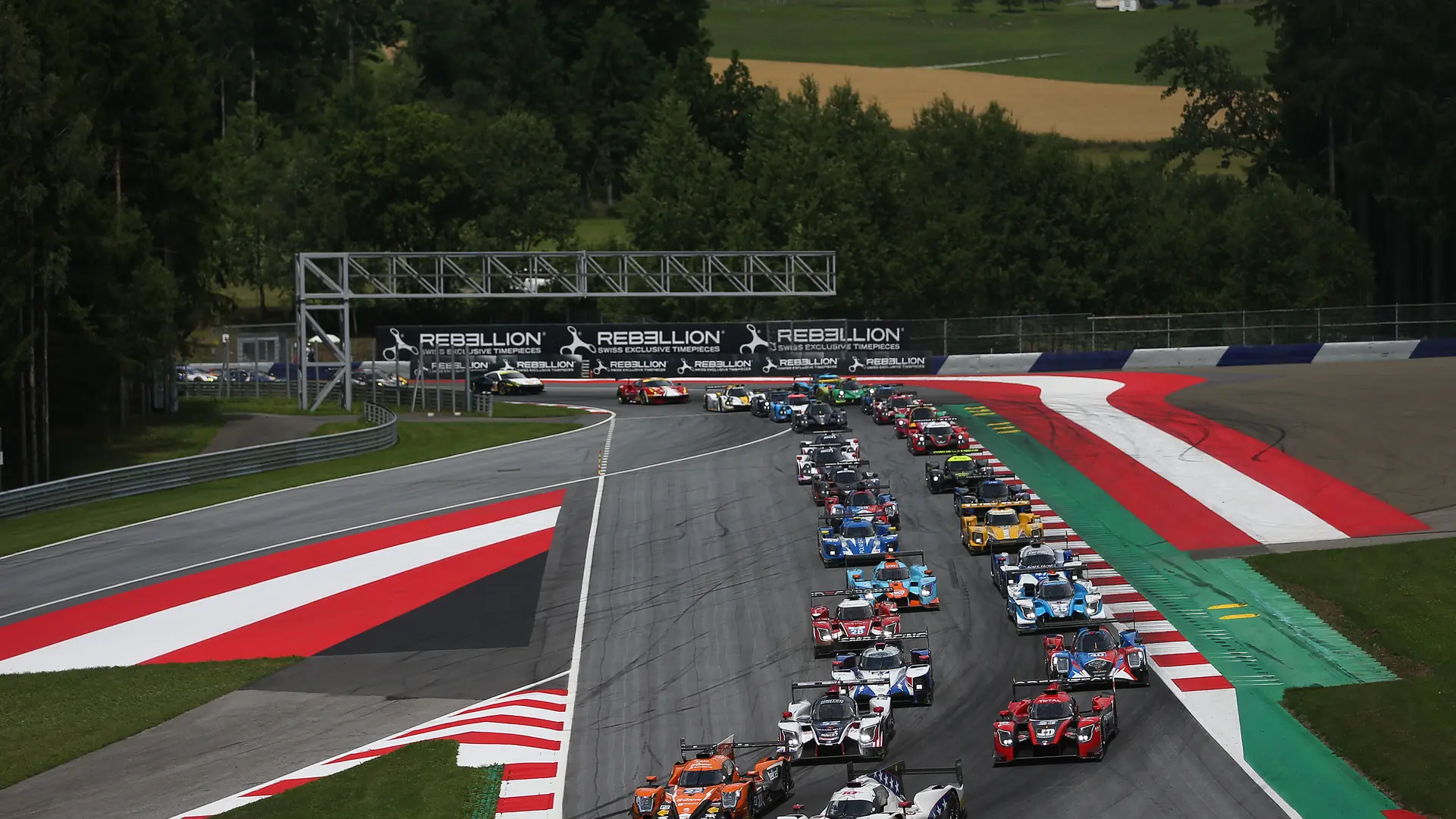
The Red Bull Ring is the short, steep circuit on a green hillside in the Styrian mountains that hosts the Austrian Grand Prix, the Austrian motorcycle Grand Prix and the DTM season opener. It has just 10 turns, but the lap climbs and drops 65 m, with heavy braking zones at the top of the hill and fast sweepers on the way back down. Here’s the name, the history, a lap corner by corner, the records, what races there and how to visit or drive it yourself.
Red Bull Ring at a Glance
Length 4.326 km / 2.688 mi Formula 1 layout, remeasured in 2025; bikes use 4.348 km
Turns 10 3 left-handers and 7 right-handers
Elevation change 65 m / 213 ft with gradients of up to 12% uphill
Opened July 26, 1969 as the Österreichring; reopened as the Red Bull Ring in 2011
Location & owner Spielberg, Styria owned by the Mateschitz family company, run by Projekt Spielberg
Race lap record 1:07.924 Oscar Piastri, McLaren, 2025
Österreichring, A1-Ring or Red Bull Ring?
All three are the same piece of hillside near Spielberg, in three different eras. It opened in 1969 as the Österreichring (“Austria Ring”), a fast, sweeping circuit of nearly 6 km. In the mid-1990s it was cut down and redesigned by Hermann Tilke and renamed the A1-Ring after an Austrian mobile phone company. Since 2011, after Red Bull co-founder Dietrich Mateschitz bought and rebuilt it, it has been the Red Bull Ring.
The track is owned by the Mateschitz family’s holding company and run by Projekt Spielberg, which also operates the driving center, hotels and off-road areas around it. Many fans still just call it “Spielberg,” after the town; it has nothing to do with the film director.
Several corners carry names: Turn 1 has been the Niki Lauda Kurve since 2019, in honor of the three-time world champion, Turn 4 is Rauch and Turn 9 is named for Jochen Rindt, Formula 1’s only posthumous world champion. Other corners have carried sponsor names that change from time to time.
Red Bull Ring History
The Österreichring was one of the fastest tracks in Formula 1, a sweeping hillside circuit that hosted the Austrian Grand Prix through 1987. Safety concerns ended that era, and the shorter A1-Ring brought F1 back for seven seasons. After a few quiet years the site was rebuilt again, and today it has F1, MotoGP and DTM on its calendar every year.
- 1969 The Österreichring opens on July 26 in the hills near Spielberg and Zeltweg.
- 1975 American driver Mark Donohue is fatally injured in a crash at the Hella-Licht corner. Vittorio Brambilla wins the rain-shortened Grand Prix.
- 1987 The last Formula 1 race on the original layout. Nigel Mansell sets its lap record of 1:28.318.
- 1996 The track reopens as the A1-Ring after a redesign by Hermann Tilke. F1 returns from 1997 to 2003.
- 2002 Rubens Barrichello is ordered to hand the win to Ferrari teammate Michael Schumacher on the final straight, one of F1’s most controversial finishes.
- 2004 Dietrich Mateschitz buys the site, and the old grandstands and pit buildings are torn down.
- 2011 The rebuilt circuit reopens as the Red Bull Ring on May 15.
- 2014 Formula 1 returns to Austria after 11 years.
- 2016 MotoGP returns to Austria for the first time since 1997.
- 2020 Spielberg hosts the first two races of the COVID-delayed F1 season, the Austrian and Styrian Grands Prix, plus two MotoGP races.
- 2022 A chicane is added at Turn 2 for motorcycle racing.
- 2025 Lando Norris wins the Austrian Grand Prix, and Oscar Piastri sets the current lap record. F1 extends its contract with the track through 2041.
- 2026 George Russell wins the Austrian Grand Prix from pole on June 28, and Pedro Acosta takes his first MotoGP win at the Austrian motorcycle Grand Prix on September 20.
The Climb to Turn 3
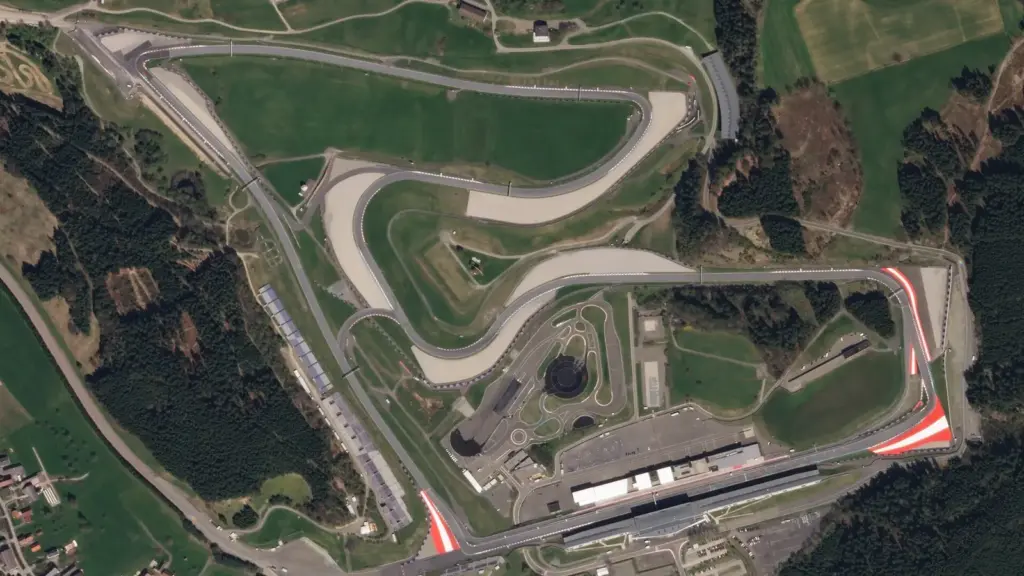
The first part of every lap at the Red Bull Ring is a climb. You leave the start line, swing right through the Niki Lauda Kurve and then keep going uphill on a long straight toward Turn 3, a slow right-hander at the top of the hill. Braking hard while the car is still pointing uphill makes it easier to stop late, and that’s exactly why so many passes happen here.
T1
Niki Lauda Kurve
An uphill right at the end of the start straight, taken while the track is still climbing.
12%
Steepest climb
The run from Turn 1 up to Turn 3 is the steepest part of the lap, and engines work hard all the way.
T3
Top of the hill
A tight right-hand hairpin at the high point of the circuit, and the main overtaking spot on the lap.
From Turn 3 the track plunges back downhill on another straight to Turn 4, a second big braking zone and the next chance to pass. After that, the back half of the lap is all about fast, flowing corners on the way back down the hill, which is why a lap here takes barely more than a minute in a Formula 1 car.
Red Bull Ring Track Guide: A Lap, Corner by Corner
With only 10 turns, the lap is easy to learn and hard to master. The first half is a series of climbs and big stops, and the second half is fast and flowing on the way back down. The track sits 677 m above sea level, and in 2025 a new FIA scan found it about 8 m longer than before, so the official F1 length went from 4.318 km to 4.326 km without any change to the layout.
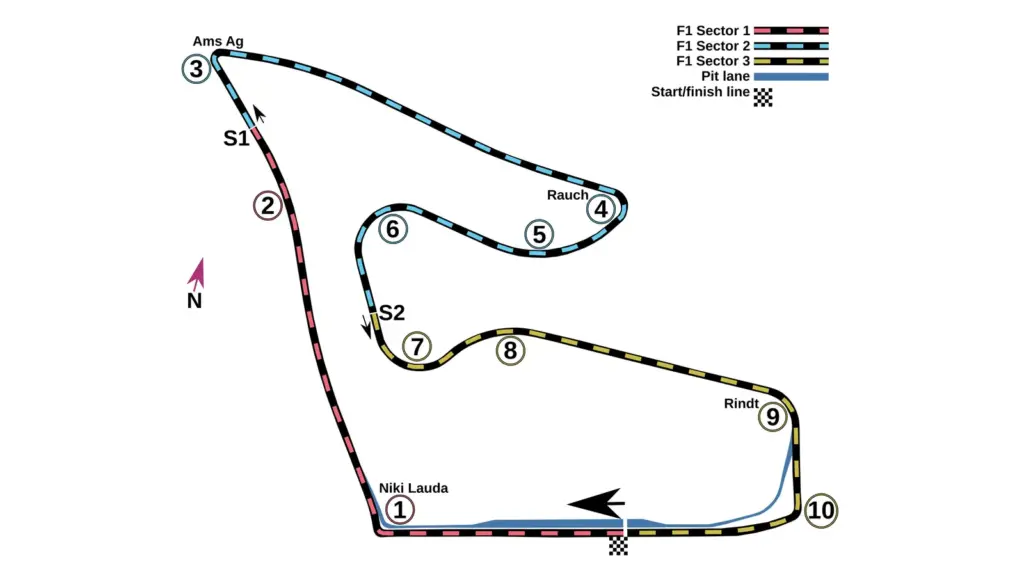
T1
Niki Lauda Kurve
An uphill right just after the start. On lap one the field fans out across the track, and a good exit sets up the long climb.
T2
Kink (chicane for bikes)
A flat-out kink for cars on the climb. Since 2022, motorcycles use a chicane here to slow them before Turn 3.
T3
The top hairpin
A slow right at the highest point of the lap and the main overtaking spot. Late braking uphill is the key to a pass.
T4
Rauch
Downhill to another heavy stop, this time a right-hander. It’s the second big passing chance, often for a driver who got a run out of Turn 3.
T5–6
The descent
A fast pair of corners as the lap starts to fall back down the hill. Commitment and a stable car matter more than braking here.
T7–8
Graz and Turn 8
Two quick corners that link the back of the circuit, where carrying speed matters more than braking.
T9
Jochen Rindt
A fast right that sweeps toward the final corner and is easy to overcook.
T10
The final corner
A long, fast right onto the start straight. Exit speed here decides how much of a run you get toward Turn 1 and the climb.
Red Bull Ring Lap Records
Only laps set in a race count as official lap records. Because F1 lengthened the official track measurement in 2025, the series now lists a new record on the 4.326 km figure alongside the older one.
1:07.924
F1 race lap record
Oscar Piastri set it in a McLaren during the 2025 Austrian Grand Prix, on the remeasured track. Carlos Sainz’s 1:05.619 from 2020 is listed for the old measurement.
1:02.939
Fastest F1 lap
Valtteri Bottas’s pole lap for Mercedes in 2020. It was set in qualifying, so it isn’t the official record.
1:29.519
MotoGP race lap record
Francesco Bagnaia’s lap on a Ducati in 2024.
1:27.748
Fastest MotoGP lap
Jorge Martín’s 2024 lap in qualifying, the quickest a MotoGP bike has gone around the Red Bull Ring.
Races and Events at the Red Bull Ring
Few tracks host Formula 1, MotoGP and the DTM in the same year, and the Red Bull Ring does it every season. Classic-car fans get the Red Bull Ring Classics in late summer, and support series and club events fill the rest of the calendar.
Summer
Formula 1 Austrian Grand Prix
The biggest weekend of the year. George Russell won from pole in 2026, ahead of Max Verstappen and Kimi Antonelli, and Verstappen holds the record for most wins here with four. F1’s contract with the track now runs through 2041.
Late summer
MotoGP Austrian Grand Prix
MotoGP Motorcycle Grand Prix
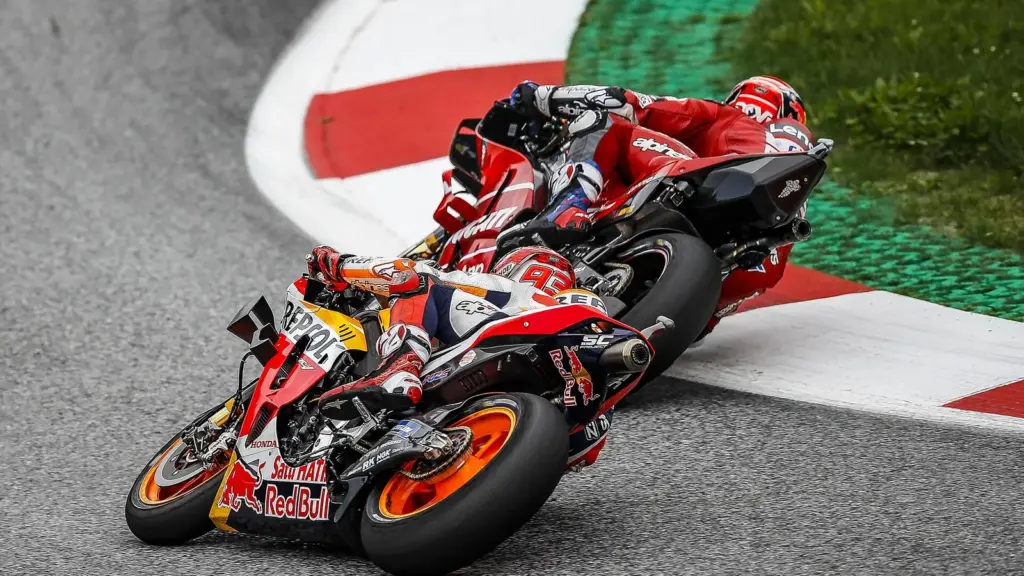
MotoGP has raced here every year since 2016. In 2026 Pedro Acosta took his first MotoGP win for KTM, Austria’s home manufacturer, ahead of Jorge Martín and Marco Bezzecchi. The contract runs through 2030.
April
DTM season opener
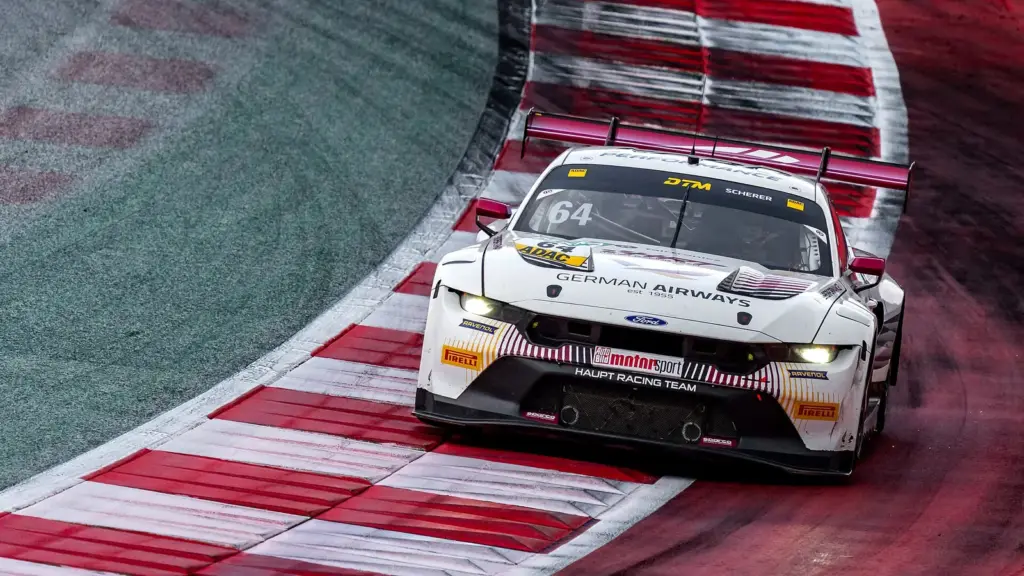
Germany’s DTM opens its season here. In April 2026, Austria’s Thomas Preining won the first race for Porsche, ahead of fellow Austrian Lucas Auer.
Red Bull Ring Race Calendar: 2026 and 2027
Here are the headline weekends. The 2026 season at the track is over, and the main 2027 dates have been announced by the series. Dates marked TBA haven’t been confirmed yet, so check the official calendar before you book.
2026 season
| Dates | Event | Series | Status |
|---|---|---|---|
| Apr 24–26 | DTM season opener | DTM | Done |
| Jun 26–28 | Formula 1 Austrian Grand Prix | Formula 1 | Done |
| Aug 29–30 | Red Bull Ring Classics | Historic racing | Done |
| Sep 18–20 | MotoGP Austrian Grand Prix | MotoGP | Done |
2027 season
| Dates | Event | Series | Status |
|---|---|---|---|
| Apr 23–25 | DTM season opener | DTM | Upcoming |
| Jul 9–11 | Formula 1 Austrian Grand Prix | Formula 1 | Upcoming |
| Aug 29 (race day) | MotoGP Austrian Grand Prix | MotoGP | Upcoming |
| TBA | Red Bull Ring Classics | Historic racing | Date TBA |
Red Bull Ring Weather by Season
The Red Bull Ring sits in an Alpine valley at about 677 m above sea level, so expect warm days and cool nights in summer and a properly cold winter. The figures below are 1971–2000 averages for nearby Zeltweg from Austria’s national weather service (ZAMG, now GeoSphere Austria).
22–24°C / 72–75°F
Summer · Jun–Aug
Warm days with highs of 22–24°C (72–75°F) but cool nights around 9–11°C (48–52°F), which matters if you’re camping. It’s also the wettest season, with 109–124 mm (4.3–4.9 in) of rain a month, often in afternoon thunderstorms.
7–20°C / 44–68°F
Autumn · Sep–Nov
September is still pleasant at about 20°C (68°F), but it cools quickly to around 7°C (44°F) by November, with frosty nights.
1–4°C / 34–39°F
Winter · Dec–Feb
Cold: highs barely above freezing and lows of about −7 to −9°C (16–19°F). The track hosts winter driving training rather than racing.
9–19°C / 48–66°F
Spring · Mar–May
Highs climb from about 9°C (48°F) to 19°C (66°F), and nights stay cold until May. Bring warm layers for the April DTM opener.
Visiting the Red Bull Ring: Tickets, Getting There and Tips
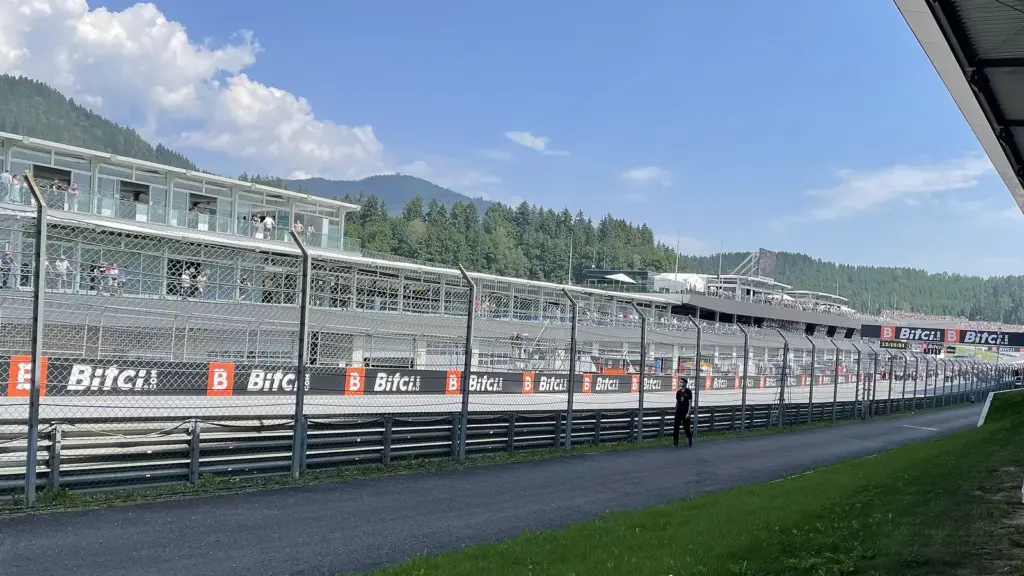
The Red Bull Ring is built like a natural amphitheater, so from the grandstands and grass banks you can see a big part of the lap. On race weekends the campsites around it fill up with fans.
Tickets
Tickets for every event are sold through the track’s official ticket shop at redbullring.com, which also offers a season pass for 2027. Buy F1 and MotoGP tickets early, because the most popular grandstands and camping areas sell out.
Getting there
The circuit is at Red Bull Ring Straße 1 in Spielberg. By car from Vienna, take the A2, then the S6 and S36, and exit at Zeltweg Ost/Spielberg. On F1 weekend, trains run to Knittelfeld station, where a free shuttle takes you to the track every 20 minutes from 7 a.m. to 8 p.m., then every 30 minutes until 11 p.m. (until 8 p.m. on Sunday). Graz is the nearest big city and airport.
Tips
Camping is part of the experience on big weekends; organizers ask campers to arrive on Wednesday or Thursday. Pack for both sun and storms, and a warm layer for the evenings. Outside race weekends, the track runs guided tours (from €21), and the giant steel bull sculpture by the circuit is a popular photo stop.
Can You Drive the Red Bull Ring?
Yes, and there are plenty of ways to do it. The track’s own driving-experience program lists dozens of options, from a passenger ride in a KTM X-Bow race taxi (from €126) to a Formula 4 car on the shorter South Track (from €774) and a Porsche GT4 RS Clubsport on the Grand Prix circuit (from €6,270). There’s also off-road driving in a Land Rover Defender or buggy, enduro riding on your own bike, karting and winter driver training in the Driving Center.
In the virtual world, the Red Bull Ring is in Gran Turismo 7, iRacing (since 2021) and Assetto Corsa Competizione’s GT2 Pack, and it appears in the official F1 and MotoGP games as a calendar venue. It’s a good track for learning, since 10 corners means you can memorize a lap quickly.
Talk Red Bull Ring With Other Enthusiasts
Heading to Spielberg for F1 or MotoGP, booking a driving experience or chasing a sim lap time? Share what you know, ask questions and find people camping the same weekend in the AutoGathering community.
- Austrian Grand Prix trips
- Camping at the Red Bull Ring
- MotoGP in Spielberg
- DTM season opener
- Driving experiences
- Getting there by train
- Sim racing lap times
- Österreichring history
Red Bull Ring FAQ
How long is the Red Bull Ring?
The F1 layout is officially 4.326 km (2.688 miles) after a 2025 remeasurement; it was listed as 4.318 km before. The motorcycle layout, with a Turn 2 chicane, is 4.348 km.
How many turns does the Red Bull Ring have?
Ten: three left-handers and seven right-handers, the fewest of any track on the F1 calendar.
What is the lap record at the Red Bull Ring?
The F1 race lap record is 1:07.924, set by Oscar Piastri in 2025. The fastest F1 lap ever there is Valtteri Bottas’s 1:02.939 pole lap from 2020.
Who won the 2026 Austrian Grand Prix?
George Russell won for Mercedes from pole on June 28, 2026, ahead of Max Verstappen and Kimi Antonelli.
When is the 2027 Austrian Grand Prix?
July 9–11, 2027, according to the 2027 F1 calendar.
What was the Red Bull Ring called before?
It opened in 1969 as the Österreichring and was rebuilt and renamed the A1-Ring in 1996. It became the Red Bull Ring in 2011.
How do you get to the Red Bull Ring by train?
Take the train to Knittelfeld; on F1 weekend a free shuttle bus runs from the station to the circuit.
Can you drive the Red Bull Ring?
Yes. The track sells driving experiences, from passenger rides to Porsche GT4 laps on the Grand Prix circuit, plus off-road and winter training.
Explore More Racing Circuits
The Red Bull Ring is one of 40 circuits in our European racing directory. The Hungaroring near Budapest is the closest Formula 1 neighbor, and our Monza guide covers Italy’s historic Grand Prix track to the south.
Photo credits
- Header image: United Autosports, CC BY-SA 2.0, cropped and resized.
- Map of the Red Bull Ring with…: HumanBodyPiloter5 (based on Planet Labs imagery), CC BY-SA 4.0, cropped and resized.
- Satellite view of the Red Bull Ring…: Planet Labs, Inc., CC BY-SA 4.0, cropped and resized.
- The start-finish straight and main grandstand at…: Fitschy99, CC BY-SA 4.0, cropped and resized.
- Andrea Dovizioso and Marc Márquez battling at…: Box Repsol, CC BY 2.0, cropped and resized.
- A DTM car riding the red-and-white curbs…: Martin-Motorsport, CC BY-SA 4.0, cropped and resized.