
Albert Park Circuit
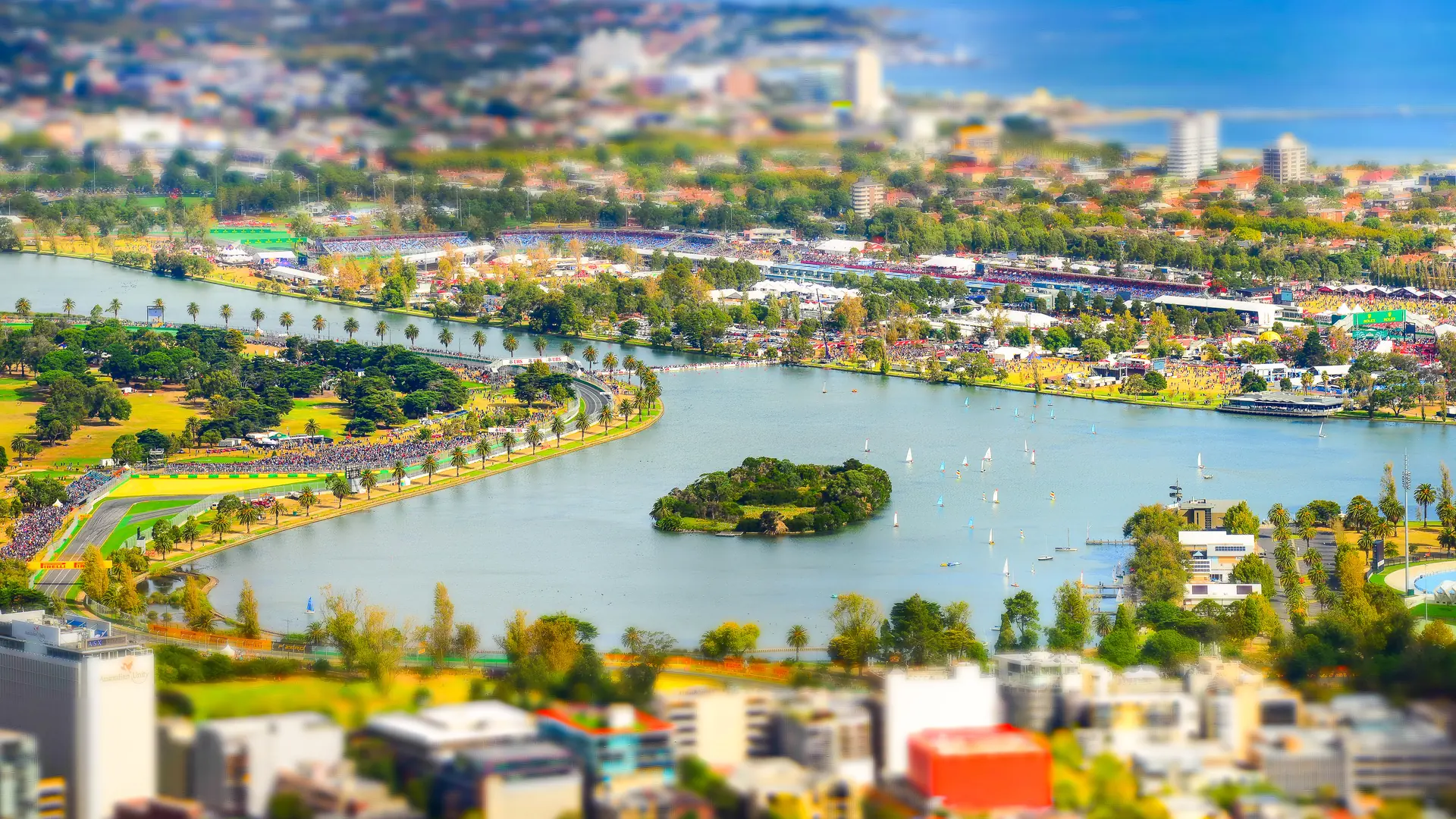
Albert Park is the temporary street circuit wrapped around a lake a few minutes from downtown Melbourne, and it has hosted the Formula 1 Australian Grand Prix since 1996. For most of the year it’s just park roads; for a few weeks it turns into a 5.278 km racetrack with crowds of more than 450,000 over the weekend. Here’s the name, the history, a lap turn by turn, the records, what races there and how to visit.
Albert Park at a Glance
Length 5.278 km / 3.280 mi current layout, raced since 2022
Turns 14 run clockwise, down from 16 before the 2021 changes
Circuit type Temporary street circuit on public roads around Albert Park Lake
F1 debut March 1996 the park first hosted racing from 1953 to 1958
Location & organizer Melbourne, Victoria run by the Australian Grand Prix Corporation on Parks Victoria land
Race lap record 1:19.813 Charles Leclerc, Ferrari, 2024
Albert Park or the Melbourne Grand Prix Circuit?
Same place. The track takes its name from Albert Park, which was named after Prince Albert, Queen Victoria’s husband, and proclaimed a public park in 1864. You’ll also see it called the Melbourne Grand Prix Circuit, and in conversation most people just say “Albert Park” or “Melbourne.”
The park covers about 225 hectares, and the circuit wraps around Albert Park Lake, a long, man-made lake of about 49 hectares. Outside race season the roads that make up the track, mainly Aughtie Drive and Lakeside Drive, carry everyday traffic, joggers and cyclists.
There are no official corner names here; the turns are simply numbered. The names you hear on race weekend, such as Brabham, Prost, Lauda or Clark, belong to grandstands named after racing champions, which is handy when you’re choosing where to sit.
Albert Park History
Albert Park had two racing lives. In the 1950s it hosted sports car meetings and Australian Grands Prix on a course through the park, before racing stopped in 1958. Nearly four decades later the state of Victoria took the Australian Grand Prix from Adelaide, and the park has been F1’s Australian home ever since, apart from the pandemic years.
- 1953 Racing first comes to the park in November on a 5.027 km anticlockwise course. Doug Whiteford wins the Australian Grand Prix in a Talbot-Lago.
- 1956 Stirling Moss wins the Australian Grand Prix and the Australian Tourist Trophy, both in Maseratis. The original circuit closes after its last meeting in 1958.
- 1985–95 The Formula 1 Australian Grand Prix runs on the Adelaide street circuit as the season finale.
- 1996 F1 moves to Melbourne despite protests from the Save Albert Park group. In the first race, Martin Brundle’s Jordan is launched over Johnny Herbert’s Sauber at Turn 3 on lap 1, and he walks away.
- 2002 Mark Webber finishes fifth on his F1 debut for Minardi, to a hero’s reception from the home crowd.
- 2009 Jenson Button wins on Brawn GP’s first race, the start of a championship season.
- 2020 The Grand Prix is called off about two hours before first practice after a McLaren team member tests positive for COVID-19. The 2021 race is later cancelled too.
- 2021–22 The layout is reworked: the Turn 9–10 chicane is removed, several corners are widened, the pit lane is widened and the whole track is resurfaced for the first time in 25 years. Charles Leclerc wins the 2022 return from pole, leading every lap and setting fastest lap.
- 2023 Max Verstappen wins his first Australian Grand Prix in a race that becomes the first in F1 history with three red flags.
- 2024 Carlos Sainz wins about two weeks after having his appendix removed, in front of a then-record crowd.
- 2025 Lando Norris wins a wet-dry race after taking pole with the fastest lap ever recorded here.
- 2026 The season opener on March 8 is the first race under F1’s new car and engine rules. George Russell wins from pole, leading a Mercedes one-two, in front of a record crowd of 483,934. The Grand Prix is contracted to stay in Melbourne until 2037.
Lakeside Drive: The Fast Side of Albert Park
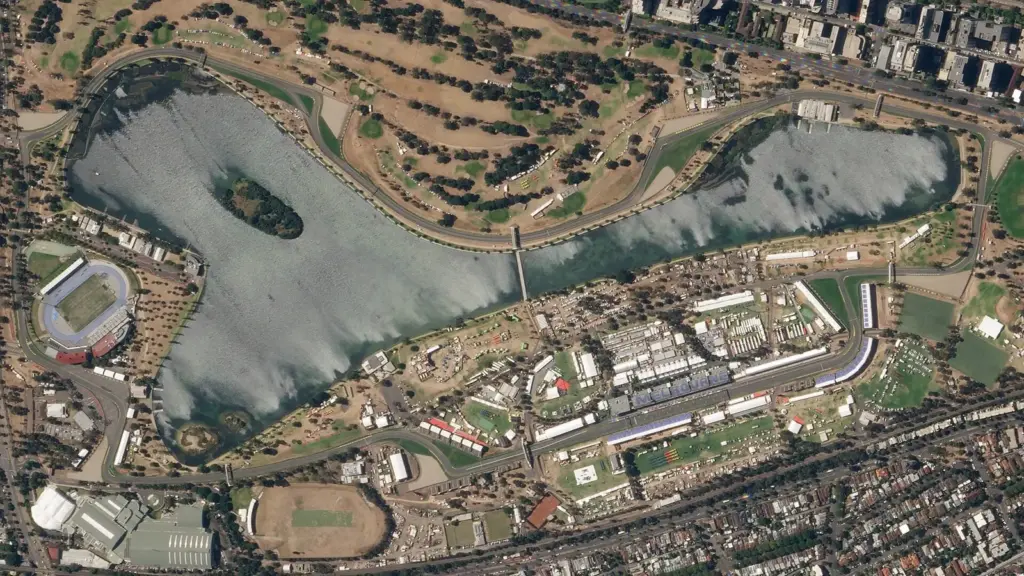
The lap has two personalities. The first half, along the city side of the park, is stop-start, with tight turns and heavy braking. Then you swing onto Lakeside Drive, which runs from Turn 7 to Turn 13 along the water, and things get fast. Since the old chicane was taken out, modern F1 cars run through Turns 9 and 10 essentially flat out, with the lake on one side and the walls close on the other.
2022
A faster layout
The first race on the revised track, after the old Turn 9–10 chicane was removed during the pandemic break.
25 years
Before a full resurface
The 2021–22 rework included the first complete resurfacing since the Grand Prix arrived in 1996.
14 turns
Down from 16
Removing the chicane cut two corners and turned the lake side of the lap into one long, fast sweep.
The other thing that makes Albert Park different is grip, or the lack of it at first. Because the roads are used by normal traffic most of the year, the surface is “green” and slippery on Friday and gets faster all weekend as rubber goes down. Add bumps from everyday use and walls that leave no room for mistakes, and it’s a tricky way to open a season.
Albert Park Track Guide: A Lap, Turn by Turn
Albert Park runs clockwise over 5.278 km and 14 turns, and the F1 race is 58 laps. The lap splits into a tight first half around the city side of the park and a fast second half along Lakeside Drive. Since the turns don’t have official names, we’ve used their numbers and the grandstands you can watch them from.
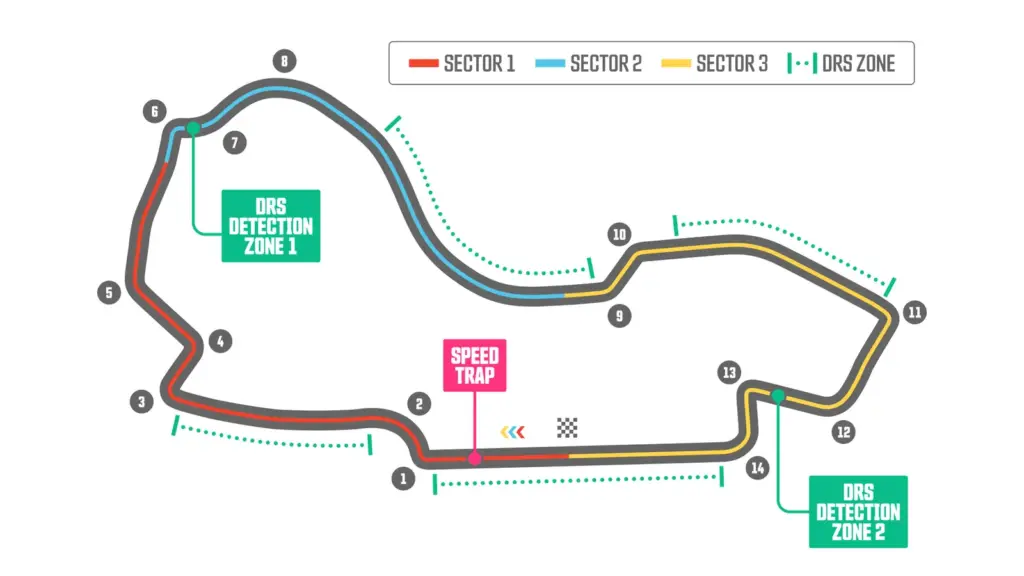
T1–2
The start
A right-left sequence at the end of the main straight, where the whole field arrives together on lap 1. The Brabham and Prost grandstands look straight at it, and it’s where a lot of first-lap trouble starts.
T3
Turn 3
A heavy braking zone for a slow right-hander and one of the main overtaking spots. This is where Martin Brundle’s Jordan went airborne in 1996. The Hill grandstand faces it.
T4–5
Turns 4 and 5
A quick left, then a fast right kink. Get T4 right and you carry speed down toward the back of the park.
T6
Turn 6
A right-hander that was widened in the 2021 changes, so it’s now much quicker than it used to be. A clean exit matters because it leads onto Lakeside Drive.
T7–8
Onto Lakeside Drive
The track swings onto the lakeside road and starts to open up. The Button grandstand sits at Turn 8, and the Clark grandstand just past it on the long run that follows.
T9–10
The old chicane
Where a slow chicane used to be, there’s now a fast sweep that F1 cars take flat out. It’s the biggest change of the 2022 layout and one of the quickest parts of the lap.
T11–12
Turns 11 and 12
A fast left-right flick that rewards commitment and punishes you with a wall if you get it wrong. The Lauda grandstand is out near Turn 12.
T13
Turn 13
A hard braking zone at the end of the lakeside run, reprofiled in the rework to make passing easier. In 2026 F1’s Overtake Mode detection point sits just after its exit.
T14
Final corner
The last turn onto the pit straight. The Schumacher grandstand covers the final section, and a good exit sets you up for a run into Turn 1.
Albert Park Lap Records
Only laps set in a race count as official lap records, so qualifying times are listed separately. The 2026 cars are slower over a lap than their predecessors (the 2026 fastest lap was 1:22.091), so the current records date from 2024 and 2025.
1:19.813
F1 race lap record
Charles Leclerc set the race lap record in a Ferrari SF-24 during the 2024 Australian Grand Prix.
1:15.096
Fastest lap ever
Lando Norris took pole for the 2025 race in a McLaren MCL39 with the quickest lap ever recorded on this layout.
1:46.006
Supercars record
Scott Pye set the Supercars race lap record in a Holden ZB Commodore in 2022.
1:24.125
Old layout record
Michael Schumacher’s 2004 lap in a Ferrari stood as the record on the 1996–2020 layout with the chicane.
Races and Events at Albert Park
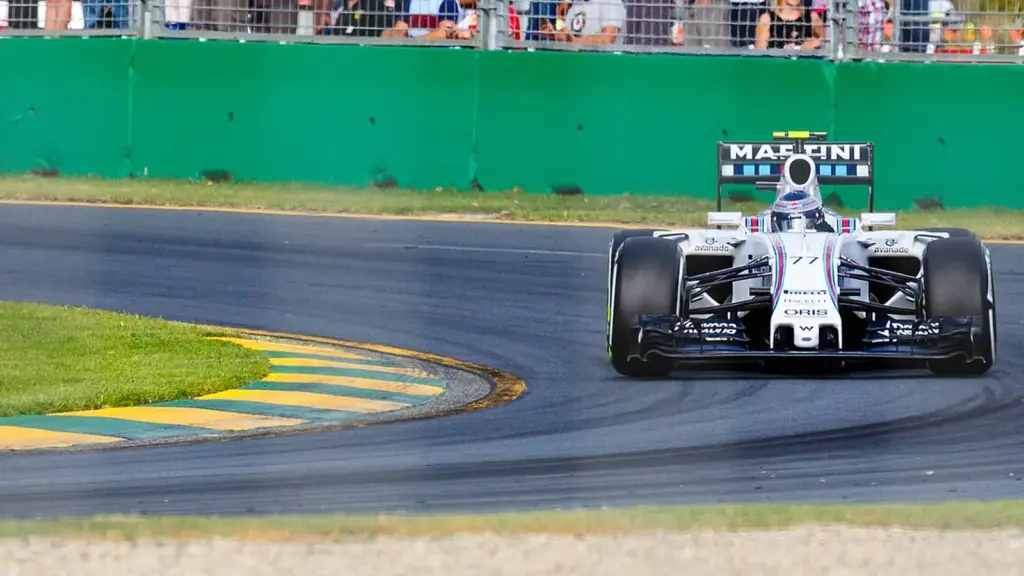
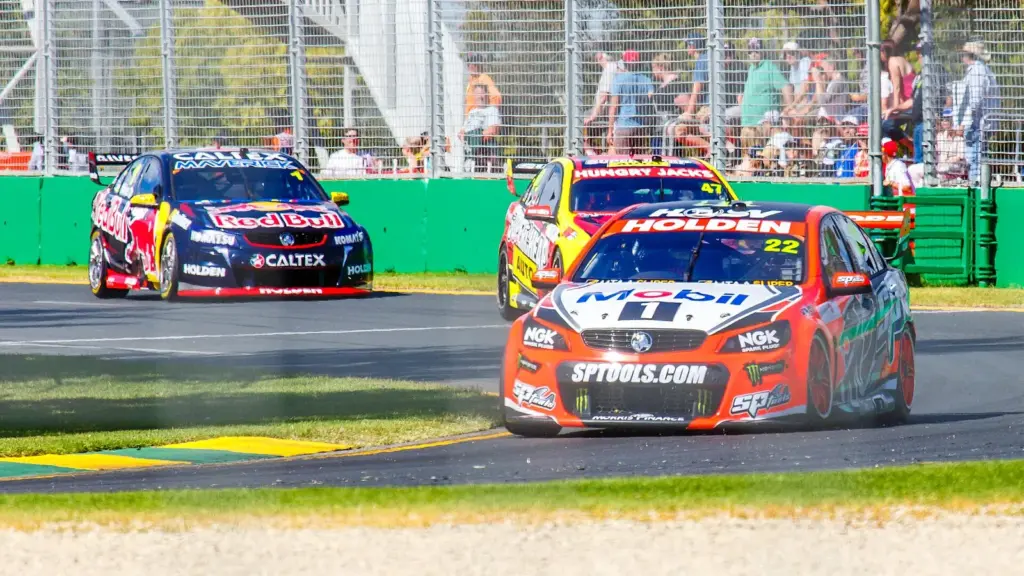
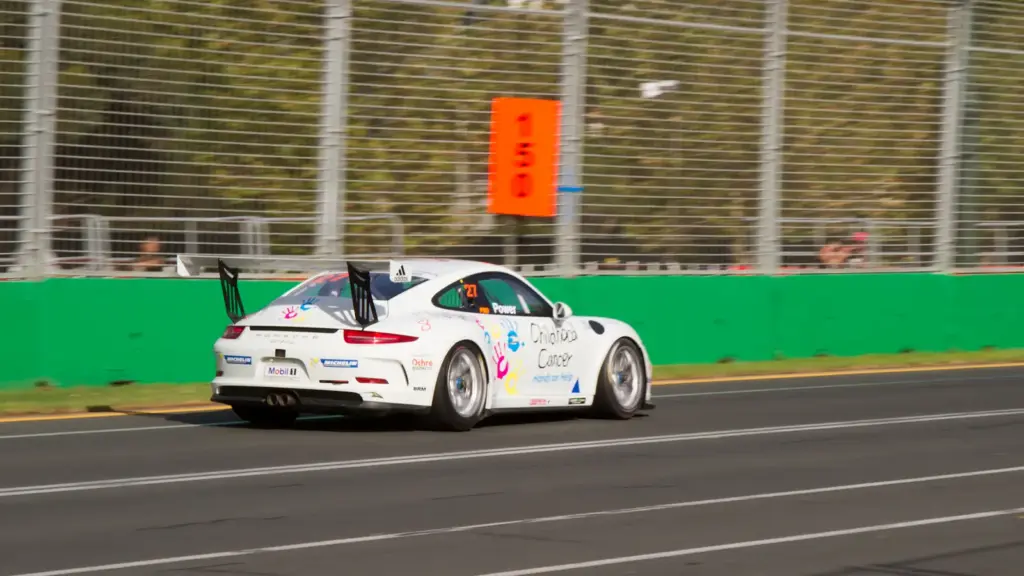
Because the track is built for one event a year, everything happens on the Australian Grand Prix weekend. Formula 1 tops the bill, the Supercars Championship races on the same weekend, and support series such as FIA Formula 2, Formula 3 and Porsche Carrera Cup Australia fill out the schedule. The rest of the year the park is home to the Melbourne Sports and Aquatic Centre, Lakeside Stadium and a golf course.
March or April
Formula 1 Australian Grand Prix
Formula 1 FIA Formula 2 and 3
The headline act and one of F1’s biggest crowds. The 2026 race opened the season on March 8, with George Russell winning for Mercedes. In 2027 it moves to April 1–4 as round 3 and hosts Australia’s first F1 Sprint.
Same weekend
Supercars at the Grand Prix
Australia’s Supercars have raced for championship points at the Grand Prix since 2018 and headline day one. A deal signed in March 2026 keeps them on the bill until 2029. Brodie Kostecki won the final race of the 2026 weekend.
Same weekend
Porsche Carrera Cup Australia
Porsche Carrera Cup Support races
Porsche’s one-make series is a regular on the Grand Prix support bill, with 911 GT3 Cup cars filling the grid. Max Vidau holds its lap record here from 2023.
Albert Park Race Calendar: 2026 and 2027
Albert Park only becomes a racetrack once a year, so the calendar is really the Grand Prix weekend and the races that share it. The track build starts weeks before the event and the teardown takes weeks afterward, with parts of the park closed during that time.
2026 season
| Dates | Event | Series | Status |
|---|---|---|---|
| Mar 5–8 | Formula 1 Australian Grand Prix | Formula 1 (season opener) | Done |
| Mar 5–8 | Supercars at the Australian Grand Prix | Supercars Championship | Done |
2027 season
| Dates | Event | Series | Status |
|---|---|---|---|
| Apr 1–4 | Formula 1 Australian Grand Prix | Formula 1 (round 3, with a Sprint) | Upcoming |
| Apr 1–4 (expected) | Supercars at the Australian Grand Prix | Supercars Championship | Date TBA |
Albert Park Weather by Season
Melbourne has a mild climate, but it changes fast, and race weekends have seen everything from heat to downpours. The figures below are Bureau of Meteorology averages for Melbourne (Olympic Park), just across the river from the circuit.
25–27°C / 77–81°F
Summer · Dec–Feb
Average highs of 25–27°C (77–81°F) and lows around 14–17°C (57–62°F). Hot days well above that are common, but so are sudden cool changes, which is where Melbourne’s “four seasons in a day” reputation comes from.
18–24°C / 64–76°F
Autumn · Mar–May
March averages about 24°C (76°F) by day and 15°C (59°F) at night, with only about 36 mm (1.4 in) of rain. April is cooler and wetter, around 21°C (70°F) with 63 mm (2.5 in), so pack a jacket for the April 2027 race.
15°C / 59°F
Winter · Jun–Aug
Highs of about 15°C (59°F) and lows near 8°C (46°F), with frequent light rain. There’s no racing, but the lake loop is a popular walk.
18–22°C / 64–72°F
Spring · Sep–Nov
Highs climb from about 18°C to 22°C (64–72°F), and October is one of the wetter months at about 64 mm (2.5 in). Changeable, with wind off the bay.
Visiting Albert Park: Tickets, Trams and Where to Watch
The Grand Prix is a huge event, so a little planning goes a long way. General admission Park Pass tickets for 2027 start from A$45 for a single adult day, according to the organizers, and grandstand seats cost more. Tickets for 2027 went on sale in early October 2026 through the official Grand Prix site.
Where to watch
- Turns 1 and 2. The Brabham and Prost grandstands give you the start and the first-lap scramble.
- Turn 3. The Hill grandstand faces the heaviest braking zone and the best overtaking spot.
- Turn 8 and the back straight. The Button and Clark grandstands show off straight-line speed as cars head onto Lakeside Drive.
- Turn 12. The Lauda grandstand is out in the fast section, with a lively crowd.
- General admission. Walk the lake side with a Park Pass and use the big screens to keep up with the race.
Getting there
Don’t plan on driving: there’s no public parking at the event. Your ticket includes free travel on the shuttle trams that run from the city center to the circuit gates throughout the weekend, and there are bike valets and rideshare drop-off points at some gates. If you’re staying in the city, you can also walk; it’s about 30 to 60 minutes depending on the gate.
Tips
Get in early, since the trams and gates get busy close to the main sessions. Melbourne weather is famously changeable, so bring sunscreen and a rain jacket on the same day. And give yourself time to walk around: the park is big, and part of the fun is moving between viewing spots across the weekend.
Can You Drive Albert Park?
Sort of. Outside the Grand Prix period, Aughtie Drive and Lakeside Drive are ordinary public roads, so you can drive (or cycle) most of the lap at everyday park speeds. Lakeside Drive has double lines and no overtaking, and there’s no racing line to chase here, just the fun of seeing the walls and grandstands that aren’t there for most of the year. Parts of the park close progressively while the circuit is being built and taken down.
There’s no regular track-day program, because the track only exists for a few weeks. If you want a lap at speed, the official Formula 1 games are the easiest route: F1 22 and later include the current layout, while earlier games have the old one with the chicane. Albert Park isn’t in Gran Turismo 7, and in Assetto Corsa it’s available only as a community mod.
Talk Albert Park With Other Enthusiasts
Planning your first Australian Grand Prix, picking a grandstand or swapping tram tips? Share what you know, ask questions and find people going the same weekend in the AutoGathering community.
- Australian Grand Prix trips
- Best grandstands
- Tram and transport tips
- Supercars at the Grand Prix
- The 2027 Sprint
- Albert Park photos
- Sim racing lap times
- Melbourne travel
Albert Park FAQ
How long is the Albert Park Circuit?
The current layout, used since 2022, is 5.278 km (3.280 miles) long with 14 turns. The F1 race runs 58 laps.
Is Albert Park a street circuit?
Yes. It’s a temporary circuit built on public roads around Albert Park Lake in Melbourne. The roads are open to traffic for most of the year.
What is the lap record at Albert Park?
The F1 race lap record is 1:19.813, set by Charles Leclerc in a Ferrari in 2024. The fastest lap ever is Lando Norris’s 1:15.096 pole lap in 2025.
Who won the 2026 Australian Grand Prix?
George Russell won for Mercedes from pole on March 8, 2026, ahead of teammate Kimi Antonelli and Ferrari’s Charles Leclerc.
When is the 2027 Australian Grand Prix?
April 1–4, 2027. It’s round 3 of the season and will include the first F1 Sprint held in Australia.
How do you get to the Australian Grand Prix?
By tram. Event tickets include free travel on shuttle trams from the city center to the circuit gates, and there’s no public parking.
Can you drive the Albert Park track?
Outside the Grand Prix period, most of the lap is made up of public park roads you can drive at normal speeds. There are no track days.
How long will F1 race at Albert Park?
The Australian Grand Prix is contracted to stay at Albert Park until 2037.
Explore More Racing Circuits
Albert Park is one of 24 venues in our Oceania racing directory. If you’re in Melbourne, Sandown Raceway is in the southeastern suburbs, and Phillip Island, home of the Australian motorcycle Grand Prix, is about two hours’ drive away.
Photo credits
- Header image: Chris Phutully, CC BY 2.0, cropped and resized.
- Satellite view of the circuit around Albert…: Planet Labs, Inc., CC BY-SA 4.0, cropped and resized.
- A Williams FW37 Formula 1 car on…: Scott Cresswell from Melbourne, Australia, CC BY 2.0, cropped and resized.
- V8 Supercars racing at Albert Park during…: Scott Cresswell from Melbourne, Australia, CC BY 2.0, cropped and resized.
- A Porsche 911 GT3 Cup car in…: J.H. Sohn from Melbourne, Australia, CC BY 2.0, cropped and resized.
- Albert Park Circuit track map with its…: ごひょううべこ, CC BY-SA 4.0, cropped and resized.