
 Written by
How to Build a Weekend Race Car: Best Cars, Real Costs and Where Beginners Can Race
Racing your own car on the weekend isn’t just for rich people with a team of mechanics. Thousands of regular folks do it every year in old Miatas, BMWs and Hondas, and some of them spent less on the car than you’d spend on a set of wheels. The trick is knowing which car to build, where to race it and where the money really goes.
This guide covers all of it: how you get from street car to race license, the best weekend race cars from dirt cheap to seriously spendy, the safety gear you can’t skip, and the series that welcome beginners, like Spec Miata and the 24 Hours of Lemons.
Guide · Grassroots Racing
Updated October 2026 · 15 min read
Weekend Racing at a Glance
A few numbers to get your head around before you buy anything:
Cheapest way to race $500 Lemons car budget, safety gear not included
Used Spec Miata $15K–$30K Typical race-ready price in 2026
Spec E46 weekend $1,500–$2,000 NASA’s estimated running cost per event
Basic safety kit $1,000+ Budget helmet, neck restraint, suit, gloves and shoes
SCCA novice permit 3 weekends Clean race weekends to earn a full license
Pro MX-5 Cup car $99,000 Turnkey price in 2024, up from $53,000 at launch
01 · Getting started
From Street Car to Race Car: The Path Most Racers Take
Here’s what nobody tells you: step one isn’t buying a race car. It’s driving the car you already own on a track, then earning a competition license. Buy a caged race car first and you could have a very expensive garage ornament for a year while you wait to be allowed to race it.
- 1. AutocrossTimed runs through a cone course in a big parking lot. Cheap, safe and the best way to learn car control. You mostly just need a helmet.
- 2. Track days (HPDE)Instructor-led sessions in your own car on a real circuit. SCCA’s Track Night in America has been around $170 for members.
- 3. School and licenseA drivers school, a medical declaration and a rules test get you a novice permit with SCCA or a provisional license with NASA.
- 4. Your first raceFinish a few clean weekends as a rookie and you graduate to a full competition license.
Autocross is where a lot of racers caught the bug. You run one car at a time, so the only things to hit are cones, and SCCA’s Solo program and local car clubs run events all over North America. Track days, often called HPDE (High Performance Driver Education), put you on a full road course with an instructor in the passenger seat. Expect roughly $200 a day at many tracks, plus a Snell-rated helmet.
Do a handful of track days before you spend a dime on a race car. You’ll find out whether you love it, and you’ll learn what kind of car suits you before you’ve committed to one.
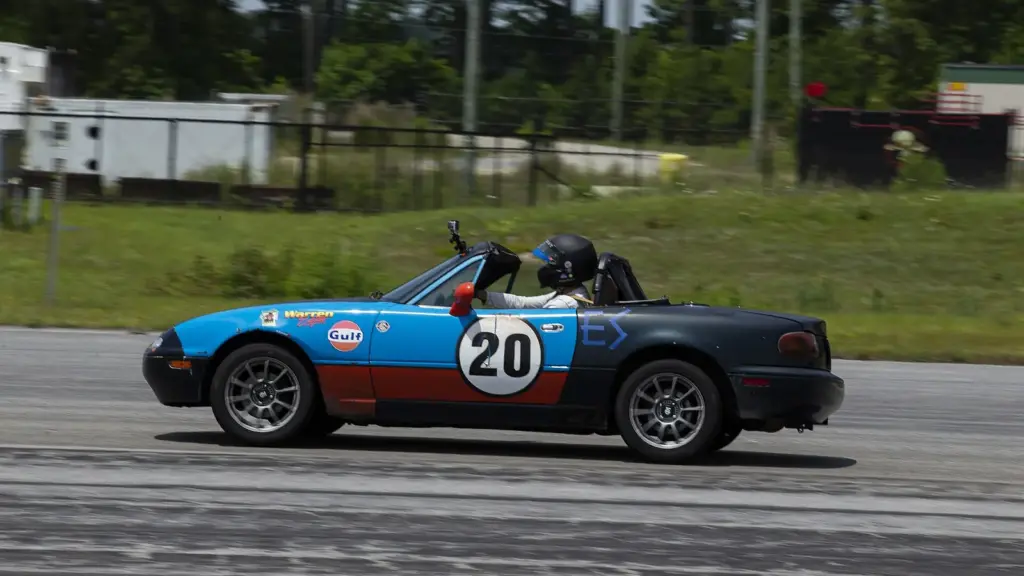
Autocross: a helmet and the car you already drive are all you need to start.
How racing licenses work
- SCCASports Car Club of AmericaJoin, finish the online drivers school modules, upload your driver’s license, complete the medical declaration and buy a Novice Permit. Earn credit at an SCCA drivers school or an accredited school, then run three successful race weekends to turn the permit into a full competition license.
- NASANational Auto Sport AssociationWork your way up HPDE levels 1 to 4, pass a regional competition school and an open-book rules test, then race four times without incident on a provisional license before you get the full “hard card.”
- Endurance seriesLemons, ChampCar and friendsThese series generally don’t ask for a previous race license. Teams of drivers share one car, rookies attend the drivers’ meeting before the race, and everyone still needs full fire-rated gear.
- CanadaCASC Ontario Region and othersIn Ontario, CASC-OR wants an interview with its chief race instructor, a sanctioned racing school with a race procedures exam, a doctor-signed medical form and membership in an affiliated club. Other provinces have their own clubs, so check what’s local to you.
Already have experience? SCCA offers waivers or credit for previous racing experience, and CASC-OR has a fast-track option for drivers with a recognized license. Ask before you pay for a second school.
02 · The cars
The Best Weekend Race Cars, From Cheap to Spendy
A good weekend race car isn’t the fastest car. It’s the one with cheap parts, a big community to ask for help and a class to race in. That’s why the same handful of cars show up at almost every track in North America. We’ve grouped them by what it takes to get them on the grid.
Cheap and cheerful: the endurance-racing favorites
ChampCar’s own build guide points beginners at common cars with simple mechanicals and parts everywhere: the Mazda Miata, the E30, E36 and E46 BMW 3 Series, the Honda Civic or Accord, the Ford Focus and the Volkswagen Golf or Jetta. Buy a tired one, strip it, cage it and go.
Budget pick
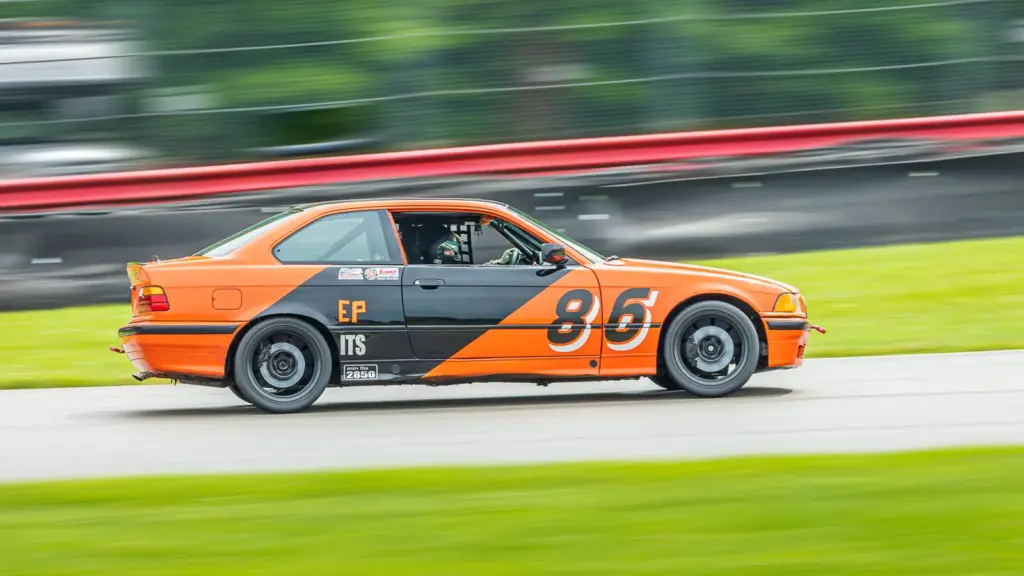
BMW E36 3 Series
Rear-wheel drive Inline-six Huge aftermarket
An endurance-racing staple. The 325i and 328i give you a smooth inline-six, rear-wheel drive and parts from a dozen suppliers. Like most older BMWs, it needs a fresh cooling system before it sees a track.
Budget pick
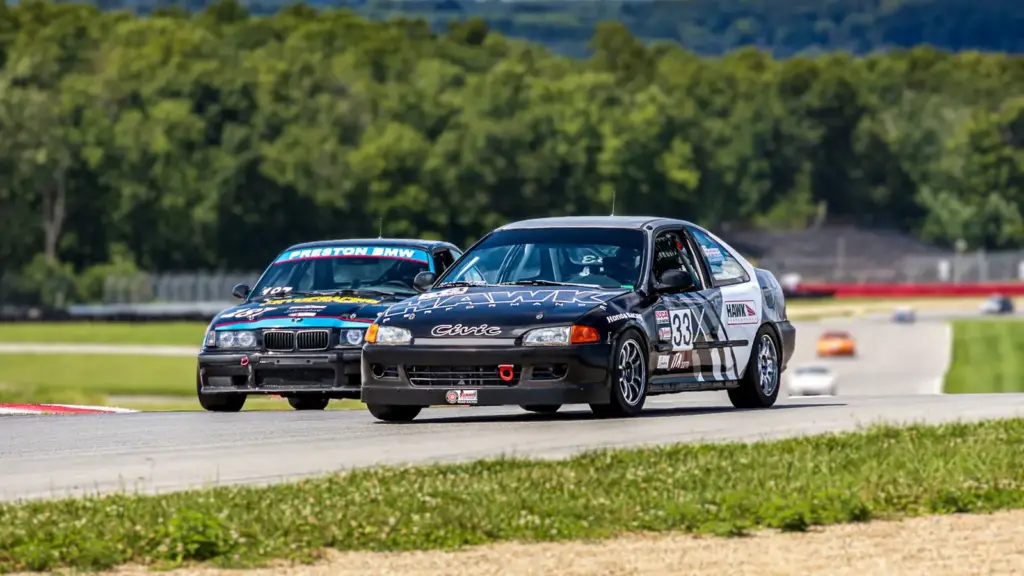
Honda Civic
Front-wheel drive Light Cheap parts
Light, tough and everywhere. Front-wheel drive means it pushes wide when you overdo it, which is a forgiving way to learn, and spare parts are easy to find in junkyards and online.
Budget pick
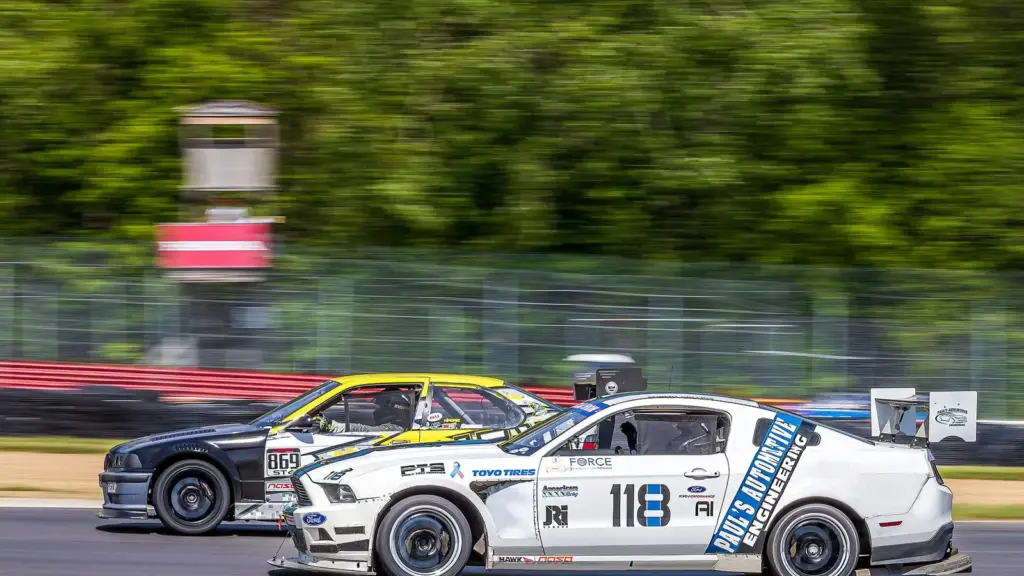
Ford Mustang
V8 power Rear-wheel drive American Iron
Want V8 noise? A Fox-body Mustang (1979–1993) has long been the cheap way in, at roughly $3,000 to $10,000 for a running car, and newer Mustangs race in NASA’s American Iron class. Tires, brakes and fuel cost more than in a Miata.
Spec classes: the sweet spot
Spec classes lock down the engine, suspension and tires, so everybody’s car is basically the same. That keeps costs predictable and puts the result on the driver, not the checkbook. It’s also where you’ll find the biggest grids.
SCCA · NASA
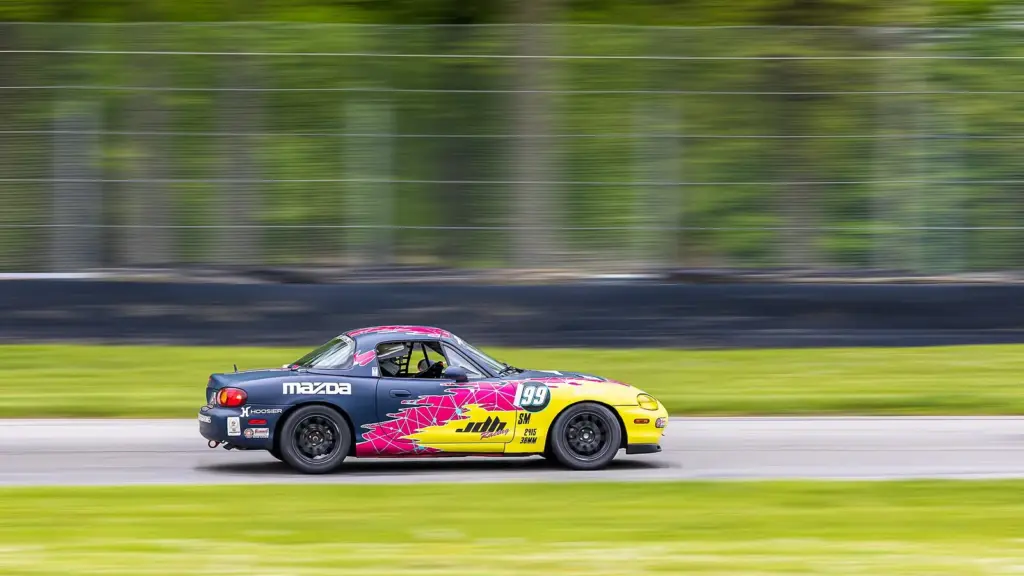
Spec Miata
1990–2005 Miata Biggest grids
The default answer. Spec Miata started in 1999 and grew into a club racing giant: 67 cars started a single race at the 2013 SCCA Runoffs. Race-ready cars run about $15,000 to $30,000, parts are cheap and help is in every paddock.
NASA
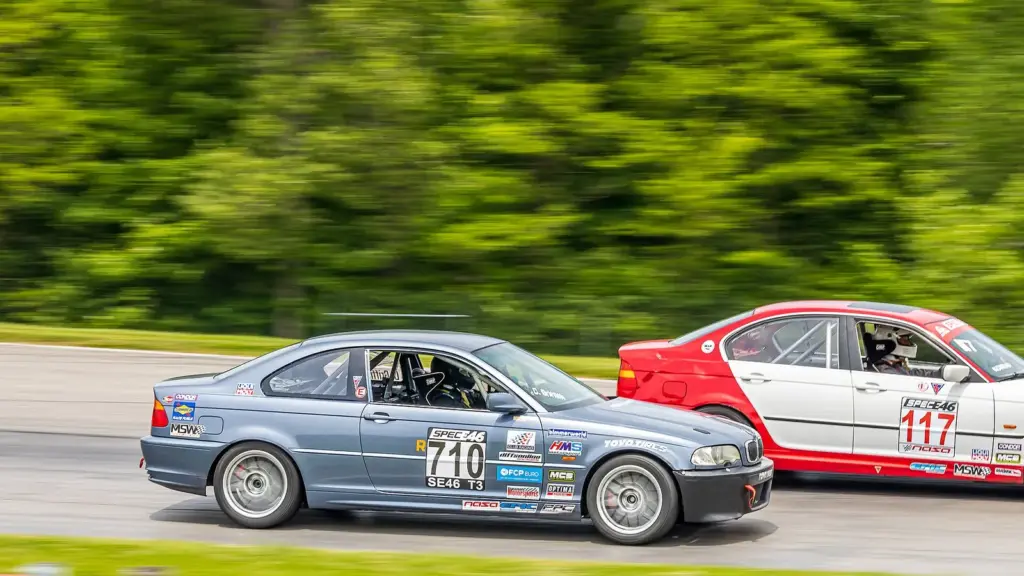
Spec E46
BMW 330i 225 hp
More power and more room than a Miata. NASA puts a donor 330i at $1,000 to $4,000, a solid home build at $25,000 to $35,000 and used race cars at about the same. Weekends run $1,500 to $2,000.
NASA
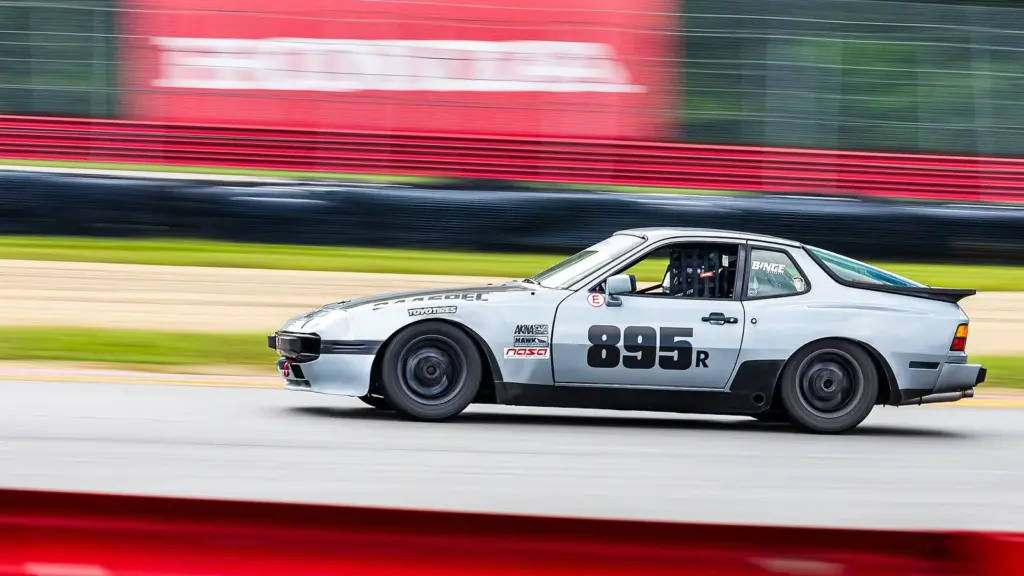
944 Spec
Porsche 944 About 150 hp
Yes, a Porsche. The 8-valve 944 and 924S make about 150 hp. When Winding Road profiled the class in 2014, used cars were $4,000 to $9,000 and a weekend $500 to $700; treat those as a floor today.
SCCA
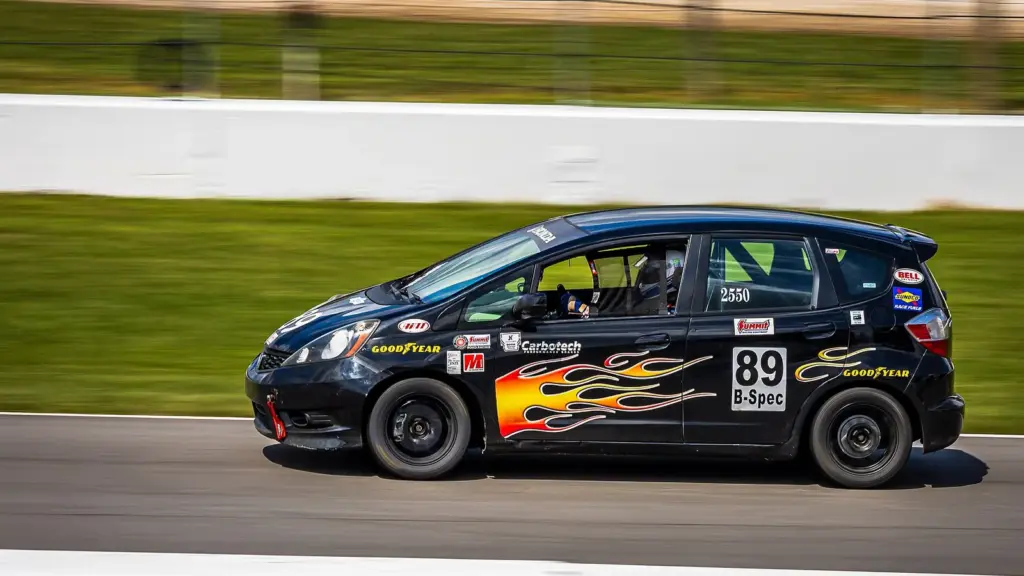
B-Spec
Fit, Mazda2, Fiesta Low costs
Small hatchbacks like the Honda Fit, Mazda2 and Ford Fiesta, racing on near-stock power. Expect about $12,000 to $22,000 for a car and some of the lowest running costs in club racing.
Old-BMW fans should also look at Spec E30, NASA’s class for 1984–1991 BMW 325i coupes and sedans, all running the same M20 six-cylinder. It’s another low-cost, entry-level way to go wheel-to-wheel.
Bigger budgets: purpose-built and pro cars
Spec Racer Ford Gen3 is a purpose-built sports racer, built and sold by SCCA Enterprises, with a sealed 1.6-liter Ford engine making 135 hp and a top speed of about 240 km/h (150 mph). There’s no donor car to hunt down and no cage to build, but it costs a lot more than a used Spec Miata.
Formula Vee is the old-school open-wheel option: a tube-frame single-seater built around Volkswagen Beetle parts. It’s been racing at the SCCA Runoffs since 1964.
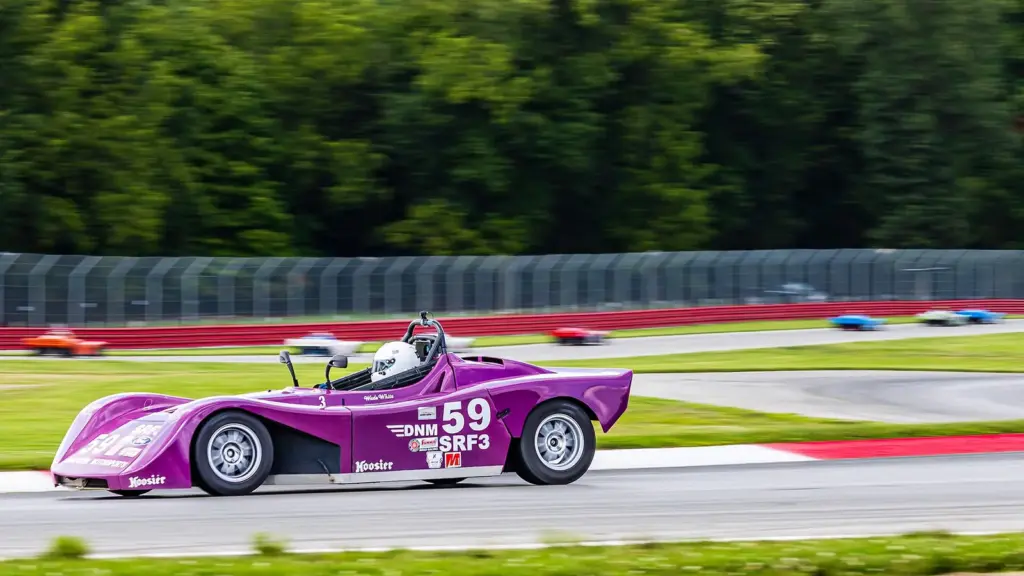
Spec Racer Ford Gen3: 135 hp, a sealed Ford engine and nothing to build.
- Mazda MX-5 CupPro seriesThe big step up from club racing. The turnkey car cost $99,000 in 2024, and Motor1 estimated a front-running season at $150,000 or more. The champion takes home $250,000.
- Toyota GR CupPro seriesA spec Toyota GR86 with a 228 hp 2.4-liter four and a sequential gearbox. SlashGear put the car at about $125,000, plus a $32,000 season entry fee.
| Car or class | Getting on the grid | Running costs | Where it races |
|---|---|---|---|
| Lemons or ChampCar car | $500 car value plus safety gear; ChampCar builds typically $3,000–$10,000+ | Under $500 per driver per race day, shared by the team (2020) | 24 Hours of Lemons, ChampCar |
| B-Spec | $12,000–$22,000 | $6,000–$10,000 a year | SCCA Club Racing |
| 944 Spec | $4,000–$9,000 used (2014) | $500–$700 a weekend (2014) | NASA |
| Spec Miata | $15,000–$30,000 used | $8,000–$18,000 a year | SCCA, NASA |
| Spec E46 | $25,000–$35,000 used | $1,500–$2,000 a weekend | NASA |
| MX-5 Cup | $99,000 (2024) | $150,000+ for a front-running season | Mazda MX-5 Cup (pro) |
Our take: unless you’ve got pro ambitions and a sponsor, spend the money on seat time in a club series instead. A used Spec Miata plus a full season of racing still costs less than one MX-5 Cup car.
03 · The budget
What a Weekend Race Car Really Costs
The car is only the start. Here’s where the money goes once you’re racing, using NASA’s published Spec E46 prices as an example of a mid-budget class. These are parts every car in the class has to have:
$4,400
Spec suspension kit
Required, one-time
$3,000
3.46 limited-slip differential
Required, one-time
$1,260
Four Hoosier racing tires
$315 each, and you’ll go through several sets
$459
Hawk DTC-60 brake pads
Front and rear set
Then there’s everything around the car: a truck and trailer (or a friend with one), fuel for the tow, a hotel, entry fees and a fund for the day something goes wrong. Rush Autoworks’ 2026 cost comparison puts a Spec Miata season at $8,000 to $18,000 before transport, safety gear and crash repairs, with a race school at $200 to $400 and an annual license at $50 to $150.
Build it yourself if… you’ve got a garage, tools, some mechanical skill and more time than money. Doing the labor yourself is where the savings are, and you’ll know every bolt on the car.
Buy one ready to race if… you want to race this season. NASA’s numbers show a used Spec E46 costs about the same as a typical build, and the previous owner has already sorted out the problems.
Try before you buy. ChampCar runs an Arrive and Drive program that puts drivers with existing teams, and plenty of club teams rent seats in their cars. It’s the smart way to find out if racing is for you before you own a race car.
04 · Safety gear
The Safety Gear You Can’t Skip
Club racing is about as safe as motorsport gets, and that’s down to the gear. NASA’s rulebook, for example, requires a helmet rated for car racing, a driver’s suit, fire-resistant gloves, underwear, socks and shoes, a balaclava if you have facial hair, and an SFI 38.1 or FIA-approved head and neck restraint.
The car needs its own safety kit too: a full roll cage built to the rules, a proper racing seat and harness, a fire system and an electrical cut-off switch. ChampCar calls the cage the foundation of the build, and it’s worth paying an experienced fabricator to do it right.
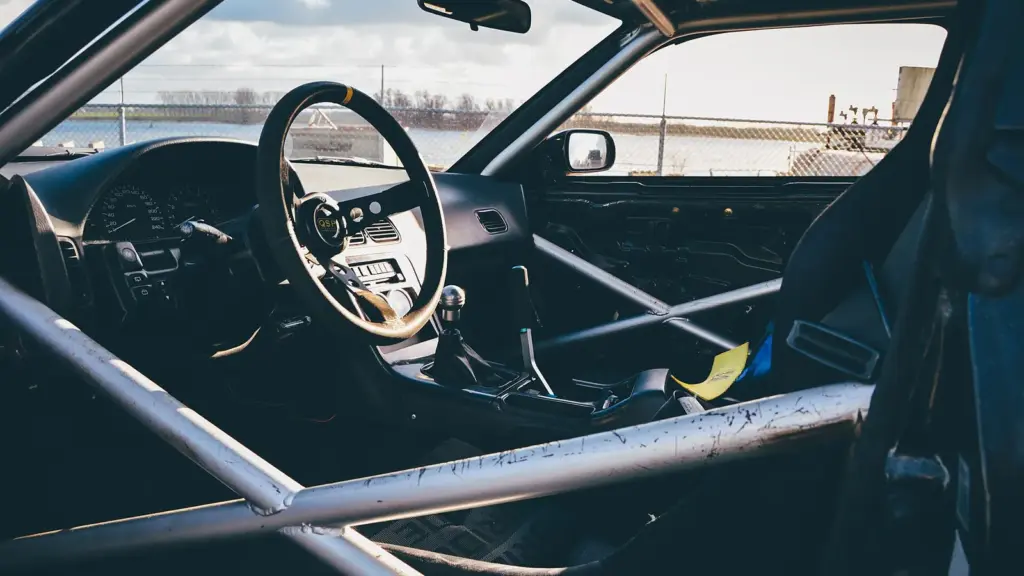
Cage, seat and harness: this is where your build budget goes first.
| Item | Budget price | What many racers spend |
|---|---|---|
| Helmet (Snell SA) | From about $200 | $400–$1,200 |
| Head and neck restraint | About $450 | Up to about $1,000 for pro versions |
| Fire suit | Under $300 | $2,000+ for a custom fit |
| Gloves | From $20 | $30–$60 |
| Racing shoes | From $70 | $300+ |
| Fire-resistant socks | About $15 | $25–$30 |
Helmet tip: Snell’s new SA2025 standard took effect on October 1, 2025, and manufacturers will stop making SA2020 helmets by the end of 2026. If you’re buying new, an SA2025 helmet should stay legal the longest. Your sanctioning body’s rulebook lists the ratings it accepts.
05 · Where to race
Beginner-Friendly Racing Series, Including Spec Miata
Where you race matters as much as what you drive. These series welcome first-timers, from the gloriously silly to the seriously competitive.
24 Hours of Lemons is the gateway to racing for a lot of people. Teams buy a car for $500 or less (safety gear, tires, brakes and a few other parts don’t count), share it among several drivers and race for hours. It started as a one-off in 2006, more than 40,000 people have raced in it since, and in a 2026 survey 8 in 10 racers said Lemons was their first wheel-to-wheel race. It marked its 20th anniversary with its first race at Laguna Seca on October 12, 2026.
ChampCar Endurance Series is the slightly more serious cousin. The $500 car value is measured with a points system, typical builds run about $3,000 to $10,000 or more, and the classic format is two 8-hour races in one weekend. Its 2026 schedule listed 20 events.

24 Hours of Lemons at Ridge Motorsports Park: cheap cars, long races, big grins.
- Spec MiataSCCA and NASAOne of club racing’s biggest classes, open to 1990–2005 Miatas on spec suspension and tires. It’s sprint racing: short qualifying sessions and races, wheel to wheel with a full grid. If you want to learn racecraft, this is the place.
- SCCA Club RacingRegional and nationalDozens of classes, from Spec Miata and B-Spec to Spec Racer Ford and Formula Vee. Start at regional races on your novice permit, then step up to national events if you catch the bug.
- NASARegional road racingSpec E30, Spec E46, 944 Spec, Spec Miata and American Iron, among others. Its HPDE ladder takes you from your first track day to a race license with the same club.
- Lucky Dog Racing LeagueEnduranceRegional enduros with cups in the Southeast, Pacific Northwest and Southwest. When Grassroots Motorsports profiled the league, cars had to be 2006 or older (with Miatas and B-Spec cars as exceptions) and every team ran the same Hankook tire.
- GRIDLIFEFor experienced driversFestival-style weekends with sprint racing built on a power-to-weight formula. Its competition license asks for significant, advanced-level experience, so treat it as a second step, not your first.
Our pick for a first season: if you’ve got friends who want in, start with Lemons or ChampCar and split the costs. If you’d rather race solo, do a season of track days, then buy a used Spec Miata. Both roads end in the same place: hooked.
Frequently Asked Questions
What is the cheapest way to start racing?
Autocross and track days in the car you already own. When you’re ready to go wheel-to-wheel, endurance series like the 24 Hours of Lemons and ChampCar let a team of drivers split the cost of a $500 car, plus everyone’s safety gear.
What is the best beginner race car?
For most people, a Mazda Miata. Spec Miata is one of the biggest classes in club racing, parts are cheap and every paddock has someone who can help. A BMW E36 or Honda Civic make great budget alternatives for endurance racing.
How much does a Spec Miata cost?
A race-ready used Spec Miata typically costs about $15,000 to $30,000 in 2026, though proven race winners sell for much more. Plan on another $8,000 to $18,000 a season to run it, before towing and travel.
Do I need a license to race my car?
For SCCA or NASA wheel-to-wheel racing, yes: you go through a drivers school or competition school and race as a novice first. Autocross and track days only need a valid driver’s license, a safe car and a helmet.
Can I race my daily driver?
You can autocross it and take it to track days, which is the best way to start. Wheel-to-wheel racing needs a roll cage, racing seat, harness and fire system, and that makes a car pretty miserable to drive on the street.
How long does it take to get a racing license?
With SCCA, three successful race weekends on a novice permit earn you a full competition license. NASA’s path is longer: HPDE levels 1 to 4, a competition school, then four clean races on a provisional license.
Before Your First Race Weekend
Get to know the tracks you’ll be racing on, and the series you might be watching from the grid one day.
Sources
- SCCA: getting an SCCA competition license
- NASA Speed News: how to go racing in seven easy steps
- CASC Ontario Region: getting your racing license
- Wikipedia: Spec Miata
- Mazda Motorsports: Spec Miata set to break Runoffs records
- Rush Autoworks: best spec racing car to buy in 2026
- Rush Autoworks: spec racing series cost comparison
- NASA: Spec E46 class information and costs
- Wikipedia: Spec E30
- Winding Road: race class profile, 944 Spec
- Wikipedia: Spec Racer Ford
- Wikipedia: Formula Vee
- Motor1: the 300th Mazda MX-5 Cup race car
- SlashGear: what racers drive in the Toyota GR Cup
- ChampCar Endurance Series: build guide
- Wikipedia: ChampCar Endurance Series
- The Shop: 24 Hours of Lemons marks its 20th anniversary at Laguna Seca
- Winding Road: the five low-cost ways to go road racing
- Grassroots Motorsports: how Lucky Dog Racing League does enduros differently
- Grassroots Motorsports: Lucky Dog’s 2024 schedule
- GRIDLIFE: Touring Cup and competition license
- GearJunkie: cheap ways to drive on a race track
- NoMoneyMotorsports: the budget safety gear you need
- Performance Racing Industry: new Snell SA2025 standard takes effect
- HotCars: affordable cars to take to the racetrack
Photo credits
- Header image: Kdildei, CC BY-SA 3.0, cropped and resized.
- 24 Hours of Lemons cars racing through…: Jcordle, CC BY-SA 4.0, cropped and resized.
- First-generation Mazda Miata driving through the cones…: Tristen Reed, Public domain, cropped and resized.
- Second-generation Mazda Miata Spec Miata race car…: Robert Yorde from Ohio, USA, CC BY 2.0, cropped and resized.
- BMW 330Ci Spec E46 race car leading…: Robert Yorde from Ohio, USA, CC BY 2.0, cropped and resized.
- Silver Porsche 944 Spec race car at…: Robert Yorde from Ohio, USA, CC BY 2.0, cropped and resized.
- Purple Spec Racer Ford Gen3 sports racer…: Robert Yorde from Ohio, USA, CC BY 2.0, cropped and resized.
- Black Honda Fit B-Spec race car on…: Robert Yorde from Ohio, USA, CC BY 2.0, cropped and resized.
- White Ford Mustang American Iron race car…: Robert Yorde from Ohio, USA, CC BY 2.0, cropped and resized.
- Orange and grey 1994 BMW 325is E36…: Robert Yorde from Ohio, USA, CC0, cropped and resized.
- 1995 Honda Civic Improved Touring race car…: Robert Yorde from Ohio, USA, CC BY 2.0, cropped and resized.
- Inside a stripped race car: roll cage,…: Lloyd Dirks lloydaleveque, CC0, cropped and resized.