
WeatherTech Raceway Laguna Seca
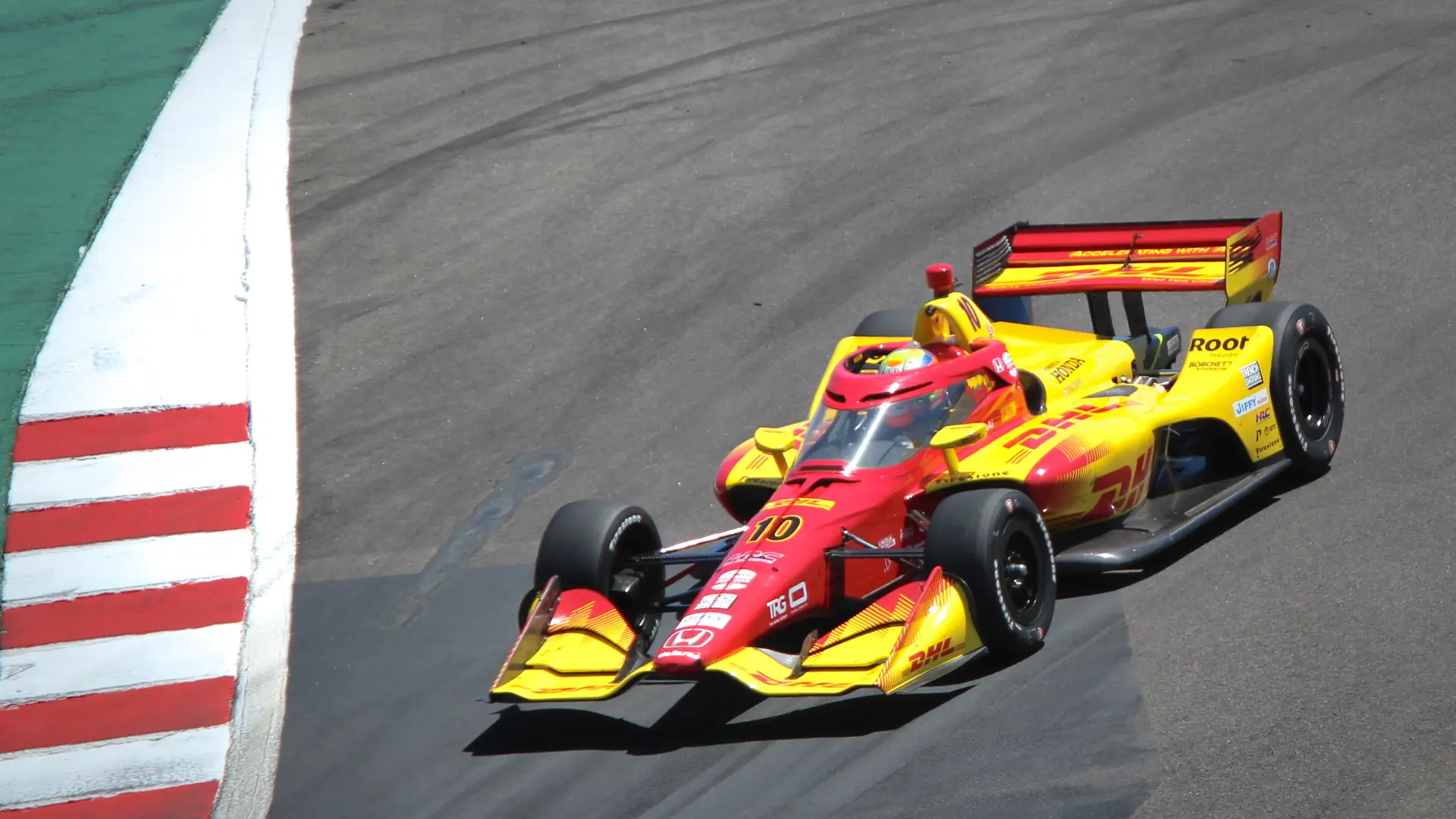
Laguna Seca is the hillside racetrack outside Monterey, California, where the Corkscrew drops you 59 feet in a few hundred feet of track. Here’s everything you’ll want to know before you watch a race, book a track day or just fire it up in Gran Turismo: the name, the history, a corner-by-corner lap, the lap records, what races there and how to visit.
Laguna Seca at a Glance
Length 3.602 km / 2.238 mi Grand Prix circuit, used since 1996
Turns 11 including the Corkscrew at Turns 8 and 8A
Elevation change 55 m / 180 ft from about 749 ft to 929 ft above sea level
Opened November 9, 1957 Pete Lovely won the first race in a Ferrari
Location & owner Monterey County, CA county park off Highway 68, run by Friends of Laguna Seca
Race lap record 1:08.4168 Álex Palou, IndyCar, 2023
Laguna Seca, Mazda Raceway or WeatherTech Raceway?
It’s all the same track. Officially it’s still Laguna Seca Raceway, and the sponsor’s name simply gets added to the front. Mazda held the naming rights for about 17 years, so if you grew up on Gran Turismo you probably know it as Mazda Raceway Laguna Seca. WeatherTech took over in April 2018, which is why tickets, signs and TV broadcasts now say WeatherTech Raceway Laguna Seca.
The name itself is Spanish for “dry lake.” The circuit was laid out around an old dry lake bed in the hills east of Monterey, and two artificial ponds were added later. So when someone searches for Laguna Seca, Mazda Raceway or WeatherTech Raceway, they’re all looking for the same place.
Monterey County owns the track, which sits inside the county’s Laguna Seca Recreation Area. For decades the nonprofit SCRAMP (the Sports Car Racing Association of the Monterey Peninsula) ran it and gave its profits to local charities. Since a long-term agreement approved in July 2023, another local nonprofit, Friends of Laguna Seca, manages the park and the raceway, with A&D Narigi handling day-to-day operations.
Laguna Seca History
Laguna Seca was built because racing on the public roads at Pebble Beach had become too dangerous. Local businesses and residents raised the money, the Army supplied the land, and a young architect named Wallace Holm literally walked the shape of the track into the dirt for the bulldozers. Since then it has hosted just about everything with wheels: Can-Am, Trans-Am, Formula 5000, IMSA, CART and IndyCar, MotoGP and World Superbike, plus concerts, a papal Mass and one of the biggest cycling festivals in the country.
- 1957 The track opens on November 9 on land from the Army’s Fort Ord, built for $1.5 million after the Pebble Beach Road Races were judged too dangerous. Pete Lovely wins the first race in a Ferrari.
- 1966 Can-Am arrives, bringing big-horsepower sports cars to the hills of Monterey for the first of many seasons.
- 1974 The property is deeded to the Monterey County parks department, and the Monterey Historic Automobile Races, today’s Monterey Motorsports Reunion, begin.
- 1983 CART’s Monterey Grand Prix starts a run that lasts until 2004. Bobby Rahal wins four in a row from 1984 to 1987, which is why the back straight carries his name.
- 1987 Pope John Paul II celebrates Mass at the track for about 72,000 people, and the Grateful Dead play five shows here the same year.
- 1988 The infield section (today’s Turns 3, 4 and 5) is added so the track meets motorcycle Grand Prix length rules, and the US motorcycle Grand Prix arrives.
- 1996 The current Grand Prix layout is set, and Alex Zanardi makes “The Pass” on Bryan Herta at the Corkscrew on the last lap of the CART finale.
- 2005 MotoGP returns for a run through 2013. In 2008 Valentino Rossi passes Casey Stoner through the Corkscrew on his way to the win.
- 2018 WeatherTech takes over the naming rights from Mazda in April.
- 2019 IndyCar comes back after a 15-year gap. The Monterey race has closed the season in most years since.
- 2023 Monterey County approves the long-term agreement that puts Friends of Laguna Seca in charge of the park and raceway.
- 2026 Alex Zanardi dies on May 1. On September 4 the track renames Turns 8 and 8A the Zanardi Corkscrew, and two days later Scott McLaughlin wins the IndyCar season finale from pole.
The Corkscrew at Laguna Seca
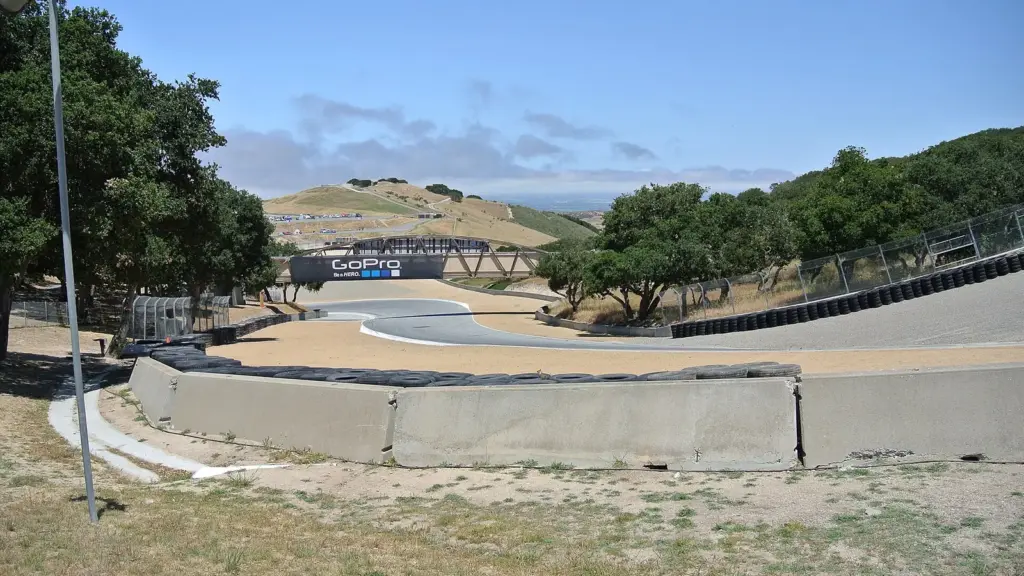
The Corkscrew is the reason most people have heard of Laguna Seca. You charge up the Rahal Straight, crest a blind hill at Turn 7 and then, with no view of where the track goes, turn left as the ground disappears. Turn 8 drops you into a right-hand flick at 8A, and you’re still falling as you go through it. Drivers and riders pick a reference point, often a tree or a curb edge on the horizon, because they can’t see the apex until they’re committed.
59 ft / 18 m
The drop
From the entry of Turn 8 to the exit of Turn 8A, roughly the height of a five-story building.
~450 ft
Over a short distance
That whole fall happens in about 450 feet (137 m) of track.
18%
Steepest point
The slope at the apex of Turn 8A, where the car feels like it’s falling away under you.
Two passes made it famous. On the last lap of the 1996 CART finale, Alex Zanardi dived inside Bryan Herta at the Corkscrew, put two wheels in the dirt and took the win; fans still call it “The Pass.” In 2008 Valentino Rossi did something similar to Casey Stoner in MotoGP, cutting across the dirt on the inside, and went on to win. Since September 2026 the corner has officially been the Zanardi Corkscrew, a tribute after Zanardi’s death that May.
Laguna Seca Track Guide: A Lap, Corner by Corner
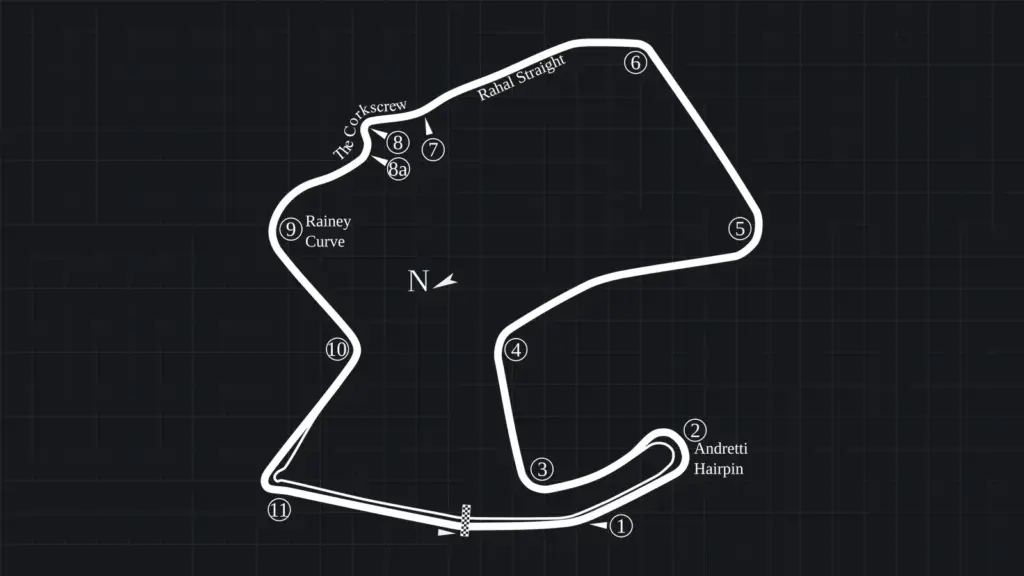
Laguna Seca runs counter-clockwise, so most of its 11 turns are lefts. The lap splits into three parts: a fast front section into the Andretti Hairpin, a climbing infield that takes you up to the Rahal Straight, and the plunge from the Corkscrew back down to the start. Here’s how a lap goes, with the corner names you’ll hear on TV.
T1
Turn 1
A fast left over a crest on the front straight. In most cars it’s flat out, so your job is simply to settle the car and drift to the right for the braking zone that follows.
T2
Andretti Hairpin
A long, downhill double-apex left named for Mario Andretti. Brake in a straight line, be patient for the second apex and expect the camber to fall away on the exit. It’s the main overtaking spot on the lap.
T3
Turn 3
A right-hander with a late apex. It’s flatter than it looks, so corner speed is lower than you’d guess; turning in early just costs you on exit.
T4
Turn 4
A quicker right. Turn in too soon and you’ll be lifting on the way out, which is exactly where cars get loose.
T5
Turn 5
A left that starts the climb up the hill. Brake smoothly and carry momentum, because everything from here to Turn 6 is uphill.
T6
Turn 6
A left at the top of the hill that launches you onto the Rahal Straight. Exit speed here decides your speed all the way to the Corkscrew.
RS
Rahal Straight
The longest straight on the lap, climbing toward the crest at Turn 7. It’s named for Bobby Rahal, who won four CART races in a row here from 1984 to 1987.
T7
Turn 7
A right-hand kink just before the crest. You brake before the top of the hill with the track cambered against you, and you set up the Corkscrew from here.
8/8A
Zanardi Corkscrew
Turn in late at Turn 8, aim straight down the hill and let the car fall into the right-hander at 8A. A little throttle on the way down keeps the rear planted.
T9
Rainey Curve
A long, blind downhill left named for Wayne Rainey, the 500cc world champion from nearby Salinas. Brake only enough to turn in and stay smooth; lifting here usually means you’ve already got it wrong.
T10
Turn 10
A right that needs more braking than it looks like it should. Get back on the power early, and watch for the tight pit entrance on the left.
T11
Turn 11
The slowest corner on the track, a left hairpin onto the front straight. Brake early and go slow in, fast out; a good exit pays off all the way past the pits.
Laguna Seca Lap Records
Lap records at Laguna Seca come with an asterisk or two, because only times set in a race count as official. Here are the numbers people usually ask about, so you can see how a Formula 1 car, an IndyCar, a MotoGP bike and a road car compare on the same 2.238 miles.
1:08.4168
Race lap record
Álex Palou set the official race lap record in an IndyCar during the 2023 Grand Prix of Monterey.
1:05.786
Fastest unofficial lap
Marc Gené lapped in a 2003 Ferrari Formula 1 car (F2003-GA) during the 2012 Ferrari Racing Days.
1:20.554
Motorcycle benchmark
Jorge Lorenzo set this pole on a Yamaha YZR-M1 at the 2012 US MotoGP, the last era of MotoGP here.
1:27.62
Production car
Randy Pobst drove an unmodified 2019 McLaren Senna to this lap during MotorTrend testing.
Races and Events at Laguna Seca
Laguna Seca’s big weekends follow a fairly steady calendar from spring to fall, with club racing, track days and car-club events filling the gaps. Dates change every year, so check the official schedule before you plan a trip. Here’s what usually runs, with the 2026 dates for reference.
September
IndyCar Grand Prix of Monterey
IndyCar Indy NXT
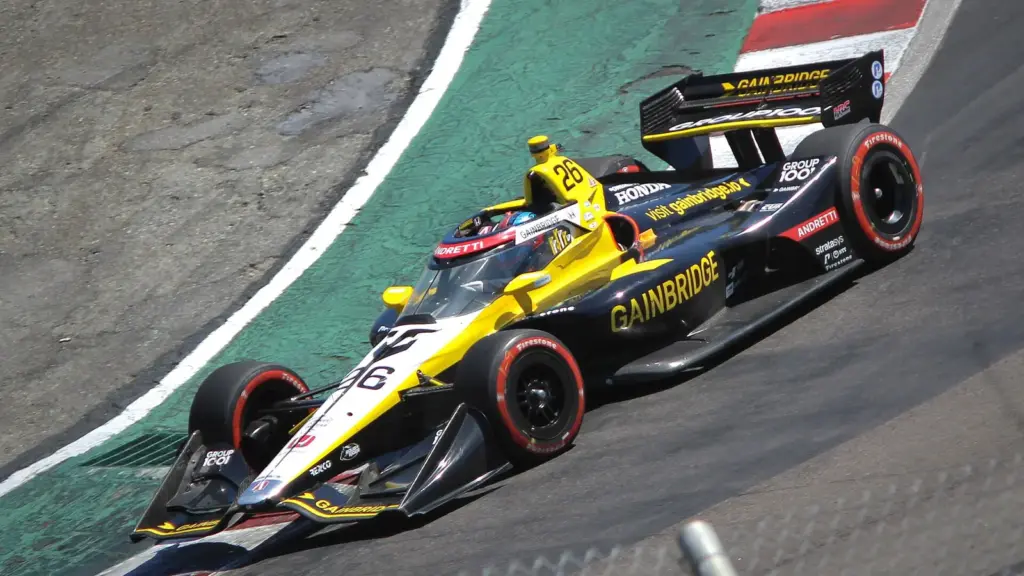
Since IndyCar returned in 2019, the Monterey race has usually been the season finale. In 2026 it ran on September 6: Scott McLaughlin won from pole, two days after the Corkscrew was renamed for Alex Zanardi.
May
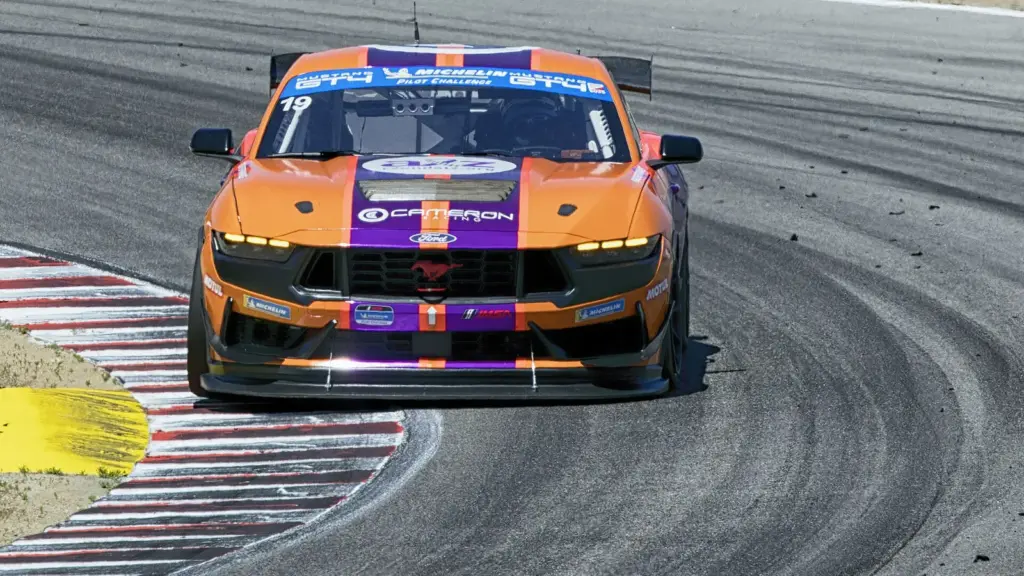
IMSA Monterey SportsCar Championship
IMSA Michelin Pilot Challenge
IMSA’s WeatherTech SportsCar Championship visits in spring, with prototypes and GT cars sharing the track and a two-hour Michelin Pilot Challenge race on Saturday. The 2026 weekend ran May 1–3.
July
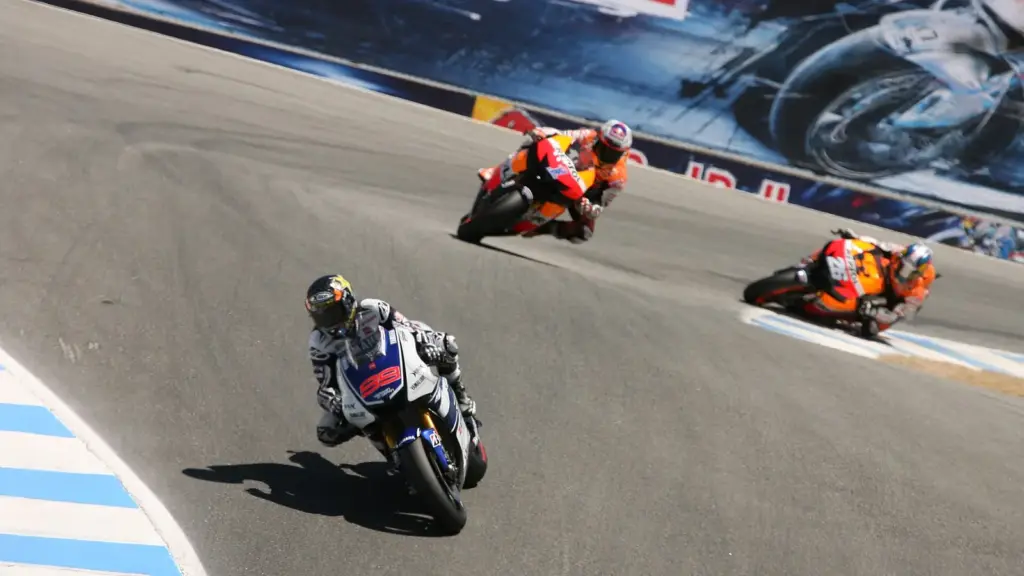
MotoAmerica Superbike Speedfest
MotoAmerica Former MotoGP and WSBK
America’s superbike championship comes in July (July 10–12 in 2026). It carries on a long motorcycle history here, including the US motorcycle Grand Prix (1988–1994 and 2005–2013) and World Superbike (1995–2004 and 2013–2019).
August
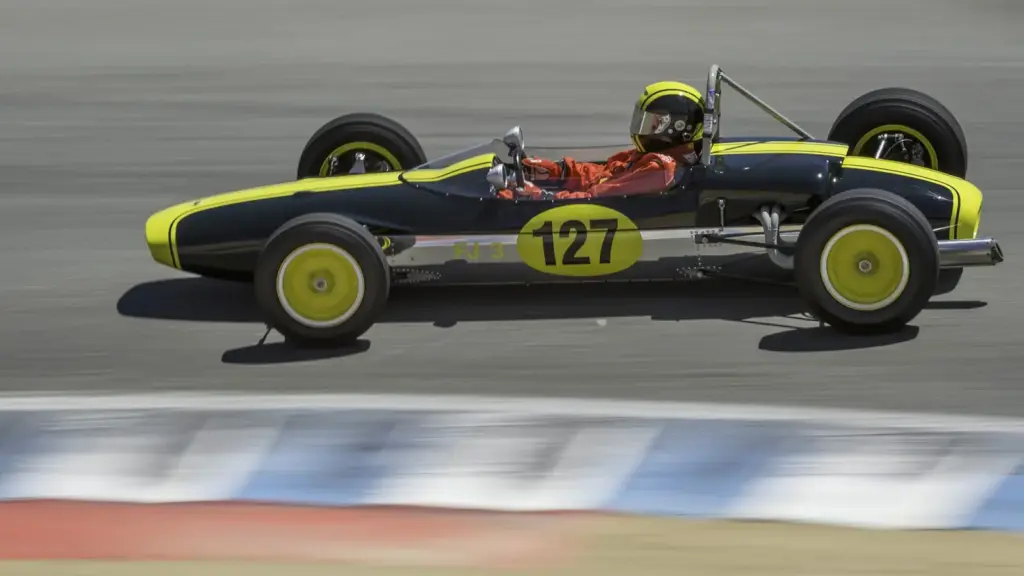
Rolex Monterey Motorsports Reunion
Historic racing Monterey Car Week
Hundreds of historic race cars take over the track during Monterey Car Week. The 2026 Reunion ran August 12–15 with a salute to Japanese motorsports and anniversaries for Can-Am and the Trans-Am series.
April
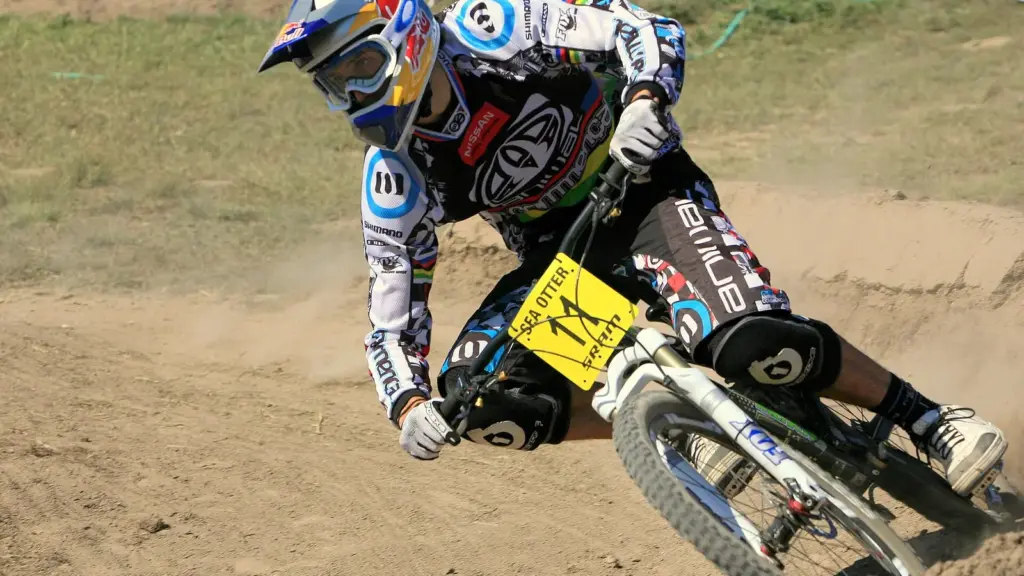
Sea Otter Classic
Cycling Mountain bike
Not everything here has an engine. The Sea Otter Classic is a huge cycling festival with road, mountain bike and gravel racing on the track and the old Fort Ord trails; the 2026 edition ran April 16–19.
Laguna Seca Race Calendar: 2026 and 2027
Here are the big public weekends at Laguna Seca, so you can plan a trip around the racing you want to see. Club races, track days and car-club events fill most other weekends. Dates marked TBA haven’t been announced yet; we’ll add them as soon as the series confirm, and it’s always worth checking the official track calendar before you book.
2026 season
| Dates | Event | Series | Status |
|---|---|---|---|
| Apr 16–19 | Sea Otter Classic | Cycling festival | Done |
| May 1–3 | IMSA Monterey SportsCar Championship | IMSA WeatherTech, Michelin Pilot Challenge | Done |
| Jun 19–21 | Ferrari Challenge | Ferrari Challenge North America | Done |
| Jul 10–12 | MotoAmerica Superbike Speedfest | MotoAmerica | Done |
| Aug 8–9 | Monterey Pre-Reunion | Historic racing | Done |
| Aug 12–15 | Rolex Monterey Motorsports Reunion | Historic racing | Done |
| Sep 4–6 | IndyCar Grand Prix of Monterey | IndyCar season finale | Done |
| Sep 18–20 | GRIDLIFE Laguna Festival | Time attack, drifting, music | Done |
| Oct 2–4 | Racing America @ Laguna Seca | Trans Am, SVRA, IGT | Done |
2027 season
| Dates | Event | Series | Status |
|---|---|---|---|
| Apr 9–11 | Porsche Sprint Challenge North America | Porsche one-make racing | Upcoming |
| Apr 15–18 | Sea Otter Classic | Cycling festival | Upcoming |
| Apr 30–May 2 | IMSA at Laguna Seca | IMSA WeatherTech, Michelin Pilot Challenge, Mustang Challenge | Upcoming |
| July (TBA) | MotoAmerica Superbike Speedfest | MotoAmerica | Date TBA |
| August (TBA) | Rolex Monterey Motorsports Reunion | Historic racing, Monterey Car Week | Date TBA |
| Fall (TBA) | IndyCar Grand Prix of Monterey | IndyCar, expected season finale | Date TBA |
Laguna Seca Weather by Season
Laguna Seca sits in the hills between Monterey on the coast and Salinas inland, so its weather falls between the two: mild all year, rarely hot, and shaped by the ocean. The numbers below are typical daily highs for Monterey and Salinas (1991–2020 averages), and the biggest surprise for first-timers is how much the temperature swings between a foggy morning and a sunny afternoon.
61–68°F
Spring · Mar–May
Daily highs of 61–68°F (16–20°C) and lows of 44–50°F (7–10°C). Rain tapers off from about 2–3 inches in March to almost none by May, and the hills are at their greenest. It’s IMSA and Sea Otter season, so bring a rain shell for March and April weekends.
65–72°F
Summer · Jun–Aug
Daily highs of 65–72°F (18–22°C) and lows of 52–55°F (11–13°C) and virtually no rain. Expect the classic Monterey pattern: cool, foggy mornings from the marine layer, then sun and a stiff afternoon breeze. Layers beat shorts for MotoAmerica and Car Week.
63–74°F
Fall · Sep–Nov
Daily highs of 63–74°F (17–24°C) and lows of 44–54°F (7–12°C). September is the warmest month of the year here, which makes the IndyCar finale weekend one of the nicest times to visit. Rain starts to return in November.
58–63°F
Winter · Dec–Feb
Daily highs of 58–63°F (15–17°C) and lows of 41–44°F (5–7°C) and the wettest months, with about 2–3.5 inches of rain a month. There are no big races, but track days and club events still run on dry days; pack a warm jacket and expect soggy grass if it has rained.
Visiting Laguna Seca: Where to Watch, Camping and Tips
Laguna Seca is a spectator track in the old-school sense: grassy hillsides, oak trees and long walks rather than giant grandstands everywhere. That’s a big part of the charm, but it means good shoes and a plan help a lot.
Where to watch
- The Corkscrew. Climb the hill on the inside of Turns 8 and 8A and you can watch cars crest the top and drop past you. It’s a hike, and it’s worth it at least once.
- Andretti Hairpin (Turn 2). The heaviest braking zone and the best place to see passing, especially on the opening laps.
- Turns 5 and 6. The hillside here lets you follow cars climbing toward the Rahal Straight, with plenty of room to spread out a blanket.
- Rainey Curve to Turn 11. Watch cars come off the Corkscrew and fight for position through the last three corners.
- The paddock. At events with open paddock access, such as the Motorsports Reunion and MotoAmerica, you can walk right up to the cars and bikes.
Camping at the track
The raceway sits inside the Laguna Seca Recreation Area, so you can camp right on site. Outside the major event dates, RV and tent camping is open year-round, with room for RVs up to 40 feet. On big weekends there are premier sites with track views and partial hook-ups, reserved sites, and first-come general camping around Turns 9, 10 and 11 with no hook-ups. Race weekend camping sells out, so book early, and remember every camper over 15 also needs an event ticket.
Getting there and what to bring
The track is off Highway 68 between Monterey and Salinas, and Monterey Regional Airport is the closest airport. On race weekends the traffic on 68 backs up, so arrive early. The weather fools a lot of first-timers: mornings are often cool and foggy, while afternoons turn sunny and windy, so bring layers, sunscreen and a hat. Rain is possible in spring and fall.
One more thing to know: Laguna Seca has strict sound limits because of its neighbors. They mostly matter if you’re driving, but they’re also why some loud race cars only run here on a limited number of days each year.
Can You Drive Laguna Seca?
Yes. When there’s no big race, the track is rented to clubs and organizers that run track days and driving schools, so you can bring your own car and drive it at speed with instructors on hand. Groups such as Hooked on Driving, SpeedSF, Lightspeed and NCRC all run days here, and many are friendly to first-timers.
The catch is noise. Most track days have a limit of 90 or 92 decibels, measured at a sound booth on the climb between Turns 5 and 6. Go over it and you’ll get a black flag, and a few strikes can end your day. Plenty of stock sports cars are too loud at full throttle, so drivers lift as they pass the booth, use exhaust valve controllers or fit quieter pipes. Check the limit with your organizer before you sign up.
If you’d rather start on a screen, you’re in good company. Laguna Seca has been in the Gran Turismo series since Gran Turismo 2, and it’s also in Forza Motorsport and iRacing, plus the MotoGP games. Real life is harder, though: in 2005 Top Gear’s Jeremy Clarkson tried to match his Gran Turismo 4 lap of 1:41.148 in a Honda NSX and managed only 1:57 on the real track.
A few times a year the track also opens to bicycles for a couple of hours, which is a fun and cheap way to feel how steep the Corkscrew really is.
Talk Laguna Seca With Other Enthusiasts
Heading to a race, booking your first track day or trying to pass the sound check? Share what you’ve learned, ask questions and find people going the same weekend in the AutoGathering community.
- Track-day experiences
- Best viewing spots
- Corkscrew photos
- Camping tips
- Sound limits and exhaust setups
- Race weekend meetups
- Sim racing lap times
- Monterey Car Week
Laguna Seca FAQ
How steep is the Corkscrew at Laguna Seca?
The Corkscrew drops 59 feet (18 m) from the entry of Turn 8 to the exit of Turn 8A, in about 450 feet of track. At its steepest, at the apex of 8A, the slope is about 18%.
Why is it called WeatherTech Raceway Laguna Seca?
WeatherTech has held the naming rights since April 2018. Before that, Mazda was the sponsor for about 17 years and the track was called Mazda Raceway Laguna Seca. The track’s own name is Laguna Seca Raceway.
What does Laguna Seca mean?
Laguna Seca is Spanish for “dry lake.” The circuit was built around a dry lake bed east of Monterey.
How long is Laguna Seca?
The current Grand Prix circuit is 3.602 km (2.238 miles) long, with 11 turns and about 180 feet (55 m) of elevation change.
Can you drive your own car at Laguna Seca?
Yes. Several organizers run track days and driving schools there throughout the year. Most have a sound limit of 90 or 92 decibels, so check that your car is quiet enough before you book.
What races are held at Laguna Seca?
The regular calendar includes the IndyCar Grand Prix of Monterey (usually the season finale), IMSA’s Monterey SportsCar Championship, the MotoAmerica Superbike Speedfest, the Rolex Monterey Motorsports Reunion during Monterey Car Week and the Sea Otter Classic cycling festival.
What is the lap record at Laguna Seca?
The official race lap record is 1:08.4168, set by Álex Palou in an IndyCar in 2023. The fastest unofficial lap is 1:05.786, set by Marc Gené in a 2003 Ferrari Formula 1 car in 2012.
Can you camp at Laguna Seca?
Yes. The track is part of the Laguna Seca Recreation Area, which has campsites open year-round outside major events, including spots for RVs up to 40 feet. On race weekends, premier and reserved sites sell out early.
Explore More Racing Circuits
Laguna Seca is one of 40 tracks in our North American racing circuit directory. If you’re planning a West Coast trip, Sonoma Raceway is about a three-hour drive north.
Photo credits
- Header image: Ben Goyette , CC BY-SA 4.0, cropped and resized.
- The Corkscrew at Laguna Seca seen from…: 菅野崇, CC BY-SA 3.0, cropped and resized.
- Rick Mears leads Mario Andretti at the…: Stuart Seeger, CC BY 2.0, cropped and resized.
- Jorge Lorenzo leads the Repsol Honda riders…: Raniel Diaz, CC BY 2.0, cropped and resized.
- Colton Herta in the Corkscrew during the…: Ben Goyette , CC BY-SA 4.0, cropped and resized.
- A Ford Mustang GT4 racing in IMSA…: Gillfoto, CC BY-SA 4.0, cropped and resized.
- A 1963 Lotus 27 Formula Junior at…: Mike Majewski, CC BY 3.0, cropped and resized.
- Gee Atherton racing dual slalom at the…: Thomas.fanghaenel, CC BY-SA 3.0, cropped and resized.
- Track map of WeatherTech Raceway Laguna Seca…: Will Pittenger, CC BY-SA 3.0, cropped and resized.