
Suzuka Circuit
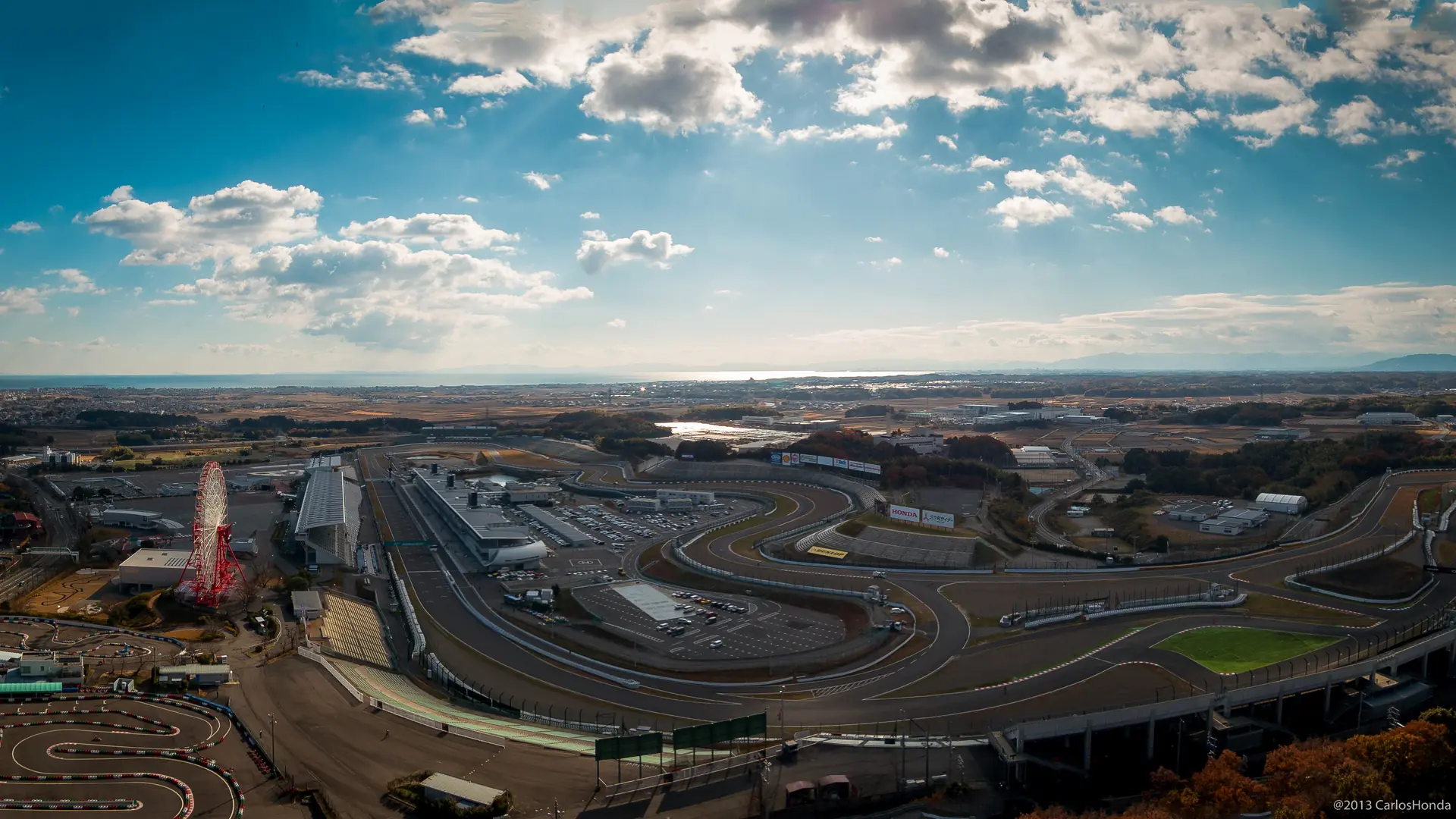
Suzuka is the figure-eight racetrack Honda built in the hills of Mie Prefecture in 1962, home of the Japanese Grand Prix, the Suzuka 8 Hours motorcycle race and corners like the S Curves, Spoon and 130R that drivers rate among the toughest anywhere. Here’s everything you’ll want to know before you go or before you fire it up in a sim: the name, the history, a corner-by-corner lap, the lap records, the 2026 and 2027 race dates, the weather by season, and how to drive it yourself.
Suzuka Circuit at a Glance
Length 5.807 km / 3.608 mi full car layout, unchanged since 2003
Corners 18 on a figure-eight: the back straight crosses over the front section
Elevation change About 40 m / 130 ft with F1 top speeds of about 325 km/h (202 mph)
Opened September 20, 1962 Japan’s first permanent racing circuit
Location & owner Suzuka, Mie Prefecture owned and run by Honda Mobilityland, part of Honda
Race lap record 1:30.965 Kimi Antonelli, Formula 1, 2025
Suzuka Circuit or Suzuka International Racing Course?
Same place. The official name is Suzuka International Racing Course, but everyone, including the circuit itself, mostly just says Suzuka Circuit (鈴鹿サーキット). It’s named for Suzuka City, in Mie Prefecture, about an hour south-west of Nagoya, where Honda has had a big factory since 1960.
It’s also not just a racetrack. Next to the circuit is Suzuka Circuit Park, a car-themed amusement park with more than 30 rides, including kid-sized cars and karts, a Ferris wheel and summer pools, plus an on-site hotel. That’s why searches for “Suzuka Circuit” often turn up theme-park tickets as well as race tickets.
The circuit belongs to Honda Mobilityland, a Honda company that also runs Mobility Resort Motegi, Japan’s other big Honda-owned track. Its figure-eight layout makes it unique on the Formula 1 calendar: the long back straight crosses over the front part of the lap on a bridge.
Suzuka Circuit History
Suzuka was Honda’s idea from the start: Soichiro Honda believed that “without racing, cars will not improve,” and built the track to prove it. Since then it has become the heart of Japanese motorsport, and the scene of a lot of Formula 1 drama, with plenty of world titles decided here, including Michael Schumacher’s sixth in 2003 and Sebastian Vettel’s second in 2011.
- 1959 Soichiro Honda buys land in Suzuka for a Super Cub motorcycle factory, and decides to build a test and racing circuit in the wooded hills nearby.
- 1962 The circuit, designed by Dutchman John Hugenholtz, opens on September 20. At its first race meeting in November, Ernst Degner crashes his Suzuki at the corner that now bears his name.
- 1963 The first Japanese Grand Prix, a non-championship sports-car race, is held at Suzuka.
- 1978 The first Suzuka 8 Hours motorcycle endurance race runs.
- 1987 Formula 1 comes to Suzuka for the first time, and Nelson Piquet takes the title after Nigel Mansell is hurt in a practice crash.
- 1989 Ayrton Senna and Alain Prost collide at the chicane, and Prost takes the title. A year later, Senna hits Prost at Turn 1 and clinches it himself.
- 2003 After Allan McNish’s big crash in 2002, 130R is rebuilt with a new shape. In April 2003, Daijiro Kato is fatally injured there in the MotoGP race, and MotoGP hasn’t returned since.
- 2007 Formula 1 moves to Fuji Speedway for two years while Suzuka is renovated.
- 2009 F1 returns to Suzuka, which has hosted every Japanese Grand Prix since.
- 2014 Jules Bianchi crashes into a recovery vehicle at Dunlop Curve in the rain; he dies nine months later. The corner and recovery procedures are changed afterwards.
- 2022 After two years lost to COVID, F1 returns, and Max Verstappen clinches his first world title here.
- 2024 The Grand Prix moves from autumn to spring, and a deal keeps F1 at Suzuka through at least 2029.
- 2026 Kimi Antonelli wins the Japanese Grand Prix from pole for Mercedes on March 29, in front of 315,000 fans over the weekend.
130R at Suzuka
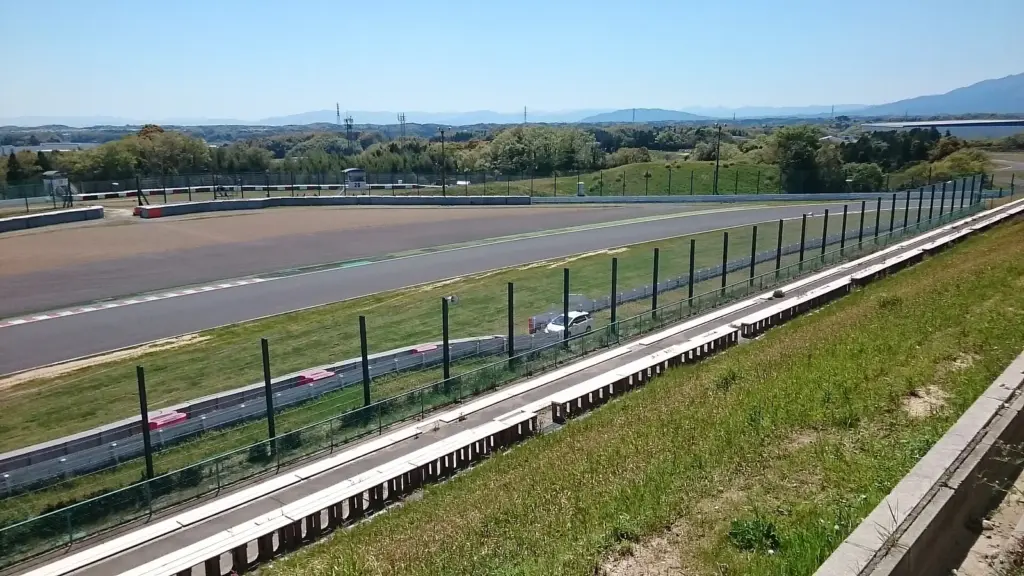
130R comes at the end of the long back straight, after you’ve crossed over the bridge. It’s a long, fast left that modern Formula 1 cars take flat out, and it’s named for its original radius of 130 metres. For years it was one of the scariest corners on the calendar, because it was so fast and the run-off was short.
Turn 15
Flat-out left
Taken at over 300 km/h (186 mph) by modern F1 cars in the dry.
85 m + 340 m
Double radius
Since 2003, a tighter first part followed by a wider second part.
130 m
The name
The original corner had a radius of 130 metres, hence “130R.”
After Allan McNish’s huge crash in 2002, the corner was rebuilt with two radii and more run-off, and the Casio Triangle chicane that follows was moved closer. Today it’s easier for the cars but still a real test for drivers, especially in the wet. It also has a darker side: Daijiro Kato’s fatal MotoGP crash in 2003 happened here.
Suzuka Track Guide: A Lap, Corner by Corner
Suzuka is a figure-eight, so the first half of the lap runs clockwise and, after you pass under the bridge, the second half runs anti-clockwise. That means drivers get a real mix of lefts and rights, and the tyres on both sides of the car get worked hard. Sector 1, through the S Curves, is all about rhythm; sector 3 is about bravery. Here’s how a lap goes, with the corner names you’ll hear on TV.
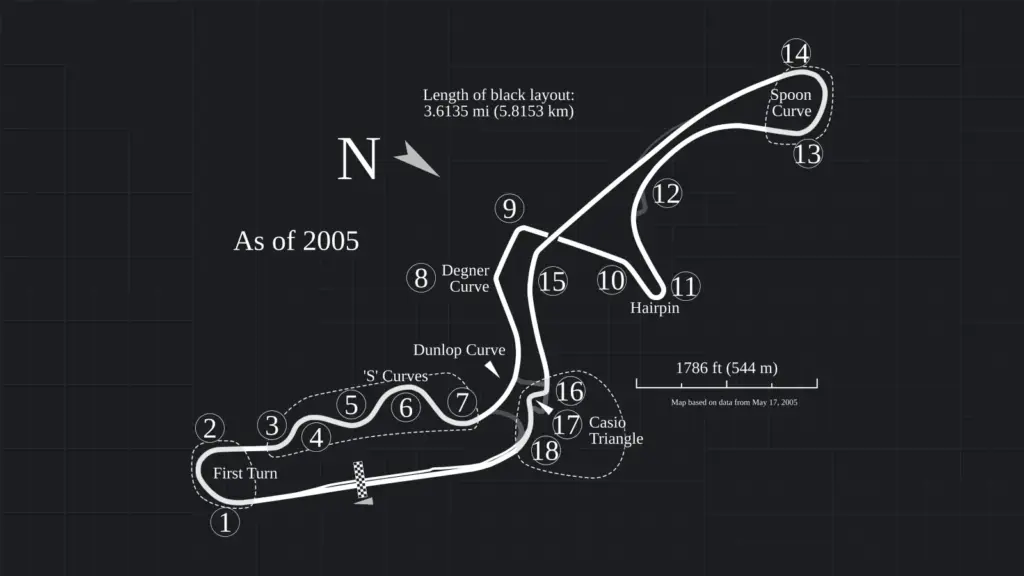
T1–2
First Curve
A fast downhill right at the end of the main straight, taken with only a small lift, then a tighter right. It’s the main overtaking spot.
T3–6
S Curves
A left-right-left-right slalom up the hill. Miss the first one and the whole sequence falls apart; get it right and it feels amazing.
T7
Dunlop Curve
A long, flat-out left that climbs uphill toward the top of the track.
T8
Degner 1
A medium-speed right that needs early braking, named after Ernst Degner.
T9
Degner 2
A tighter right straight after. Run wide here and you’re in the gravel.
T10
Under the bridge
The track dives under the back straight and through a flat-out right kink. From here the lap runs anti-clockwise.
T11
Hairpin
The slowest corner on the lap, in first or second gear. Watch the wheelspin on the way out.
T12
200R
A long, fast right that leads you out toward the far end of the circuit.
T13–14
Spoon Curve
A double-apex left. The exit decides your speed all the way down the back straight.
BS
Back straight
About 1.2 km long, over the bridge across the front part of the circuit.
T15
130R
A long, flat-out left at the end of the back straight.
T16–18
Casio Triangle and final corner
A heavy-braking left-right chicane, the second overtaking spot, then a quick right onto the main straight.
Suzuka Lap Records
As at every track, only laps set in a race count as the official record, so the fastest lap ever at Suzuka is a qualifying time. Here are the numbers people usually ask about. Motorcycles use a slightly different 5.821 km layout with an extra chicane, so bike and car times aren’t directly comparable.
1:30.965
Race lap record
Kimi Antonelli set the official race lap record in a Mercedes during the 2025 Japanese Grand Prix.
1:26.983
Fastest lap ever
Max Verstappen’s pole lap for the 2025 race in a Red Bull. It doesn’t count as the official record because it was set in qualifying.
1:28.778
2026 pole
Kimi Antonelli’s pole time for the 2026 Japanese Grand Prix, which he went on to win.
2:04.290
Suzuka 8 Hours record
Johann Zarco on a Honda in the 2025 Top 10 Trial, the fastest lap on the motorcycle layout.
Races and Events at Suzuka
Suzuka is busy all year, with national championships, club racing, motorcycle meetings and track days on top of the big international events. Here are the headline events, with 2026 dates and results for reference.
Spring
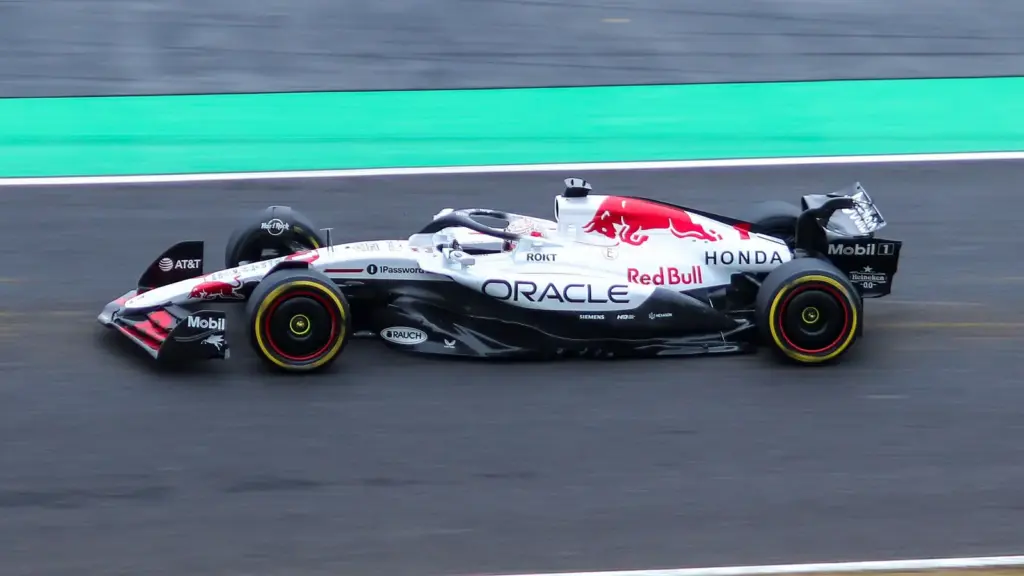
Formula 1 Japanese Grand Prix
Formula 1 Since 1987
The 2026 race ran March 27–29, and Kimi Antonelli won from pole for Mercedes. The 2027 race is set for April 9–11, as a sprint weekend.
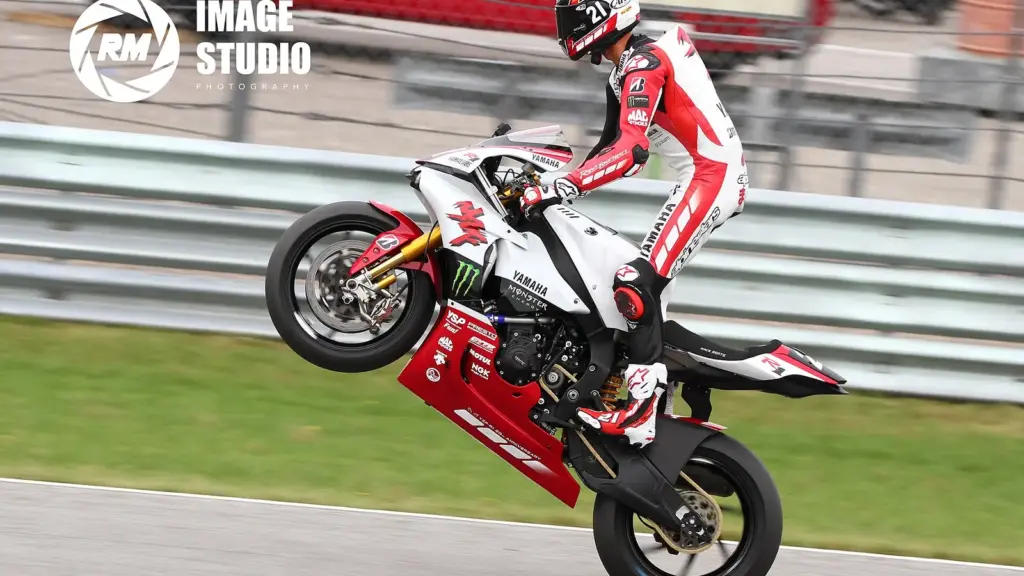
Early July
Suzuka 8 Hours
Motorcycle endurance FIM EWC
A huge summer motorcycle race, run since 1978. In 2026 Honda HRC won for the fifth year in a row, in a race cut short by heavy rain. The event is signed through 2029.
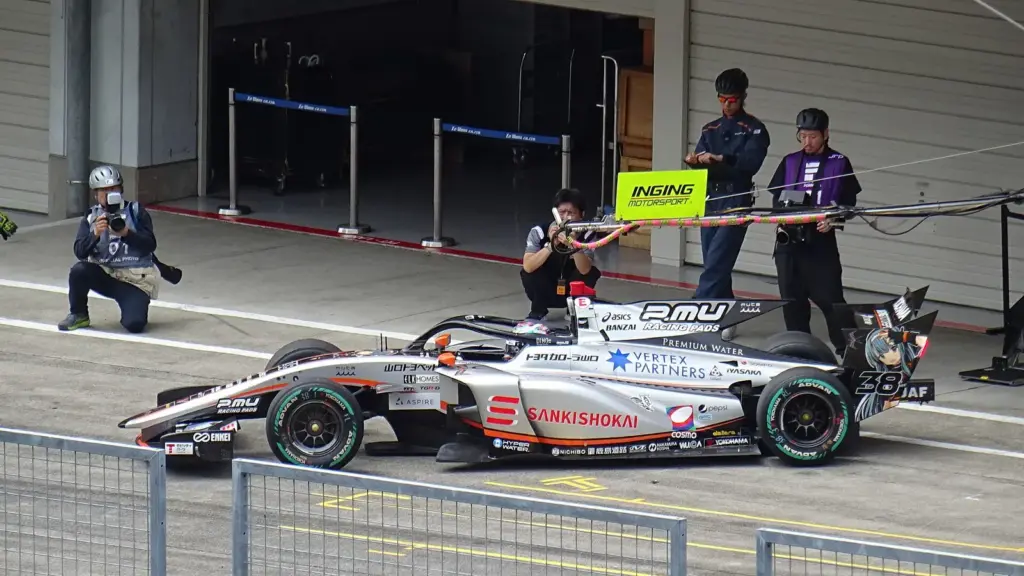
Spring and November
Super Formula
Super Formula Season finale
Japan’s top single-seater series, with cars not far off F1 pace. Suzuka hosted a double-header in May 2026 and closes the season on November 21–22.
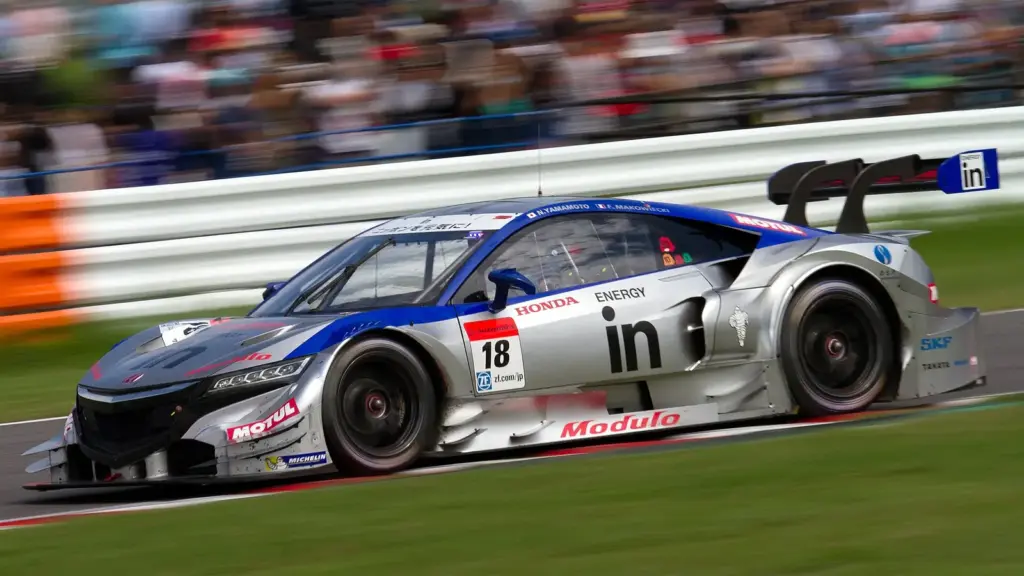
August and September
Super GT and the Suzuka 1000km
GT racing Endurance
Japan’s Super GT series races here in summer, and the Suzuka 1000km, part of the Intercontinental GT Challenge, ran its 50th edition on September 13, 2026.
Suzuka Race Calendar: 2026 and 2027
Here are the big public weekends at Suzuka, so you can plan a trip around the racing you want to see. National series, club races and motorcycle events fill many of the other weekends. Provisional dates can still change, so always check the official schedule before you book.
2026 season
| Dates | Event | Series | Status |
|---|---|---|---|
| Mar 27–29 | Formula 1 Japanese Grand Prix | Formula 1, round 3 | Done |
| May 23–24 | Super Formula, rounds 4 and 5 | Super Formula | Done |
| Jul 5 | Suzuka 8 Hours (race day) | FIM Endurance World Championship | Done |
| Aug 21–23 | Suzuka GT 300 km | Super GT | Done |
| Sep 13 | Suzuka 1000km (50th edition) | Intercontinental GT Challenge | Done |
| Nov 21–22 | Super Formula season finale | Super Formula | Upcoming |
2027 season
| Dates | Event | Series | Status |
|---|---|---|---|
| Jan 1–3 | Circuit Cruise | Drive your own car (tickets on sale November 1) | Upcoming |
| Mar 12–14 | Super Formula season opener | Super Formula | Provisional |
| Apr 9–11 | Formula 1 Japanese Grand Prix | Formula 1, sprint weekend | Upcoming |
| Jul 2–4 | Suzuka 8 Hours | FIM Endurance World Championship, round 3 | Upcoming |
| Aug 1 | Super GT Suzuka round | Super GT | Provisional |
| Sep 5 | Suzuka 1000km | Intercontinental GT Challenge | Upcoming |
| Nov 26–28 | Super Formula season finale | Super Formula | Provisional |
Suzuka Weather by Season
Suzuka sits near the coast of Ise Bay, so it has a typical central-Japan climate: mild, dry winters, a wet early summer, hot and humid summers and a stormy start to autumn. The numbers below are typical daily highs and lows for Tsu, the nearest major weather station, about 15 km south of the circuit (1991–2020 averages from the Japan Meteorological Agency). Weather can change quickly, so check the forecast on the day.
13–23°C
Spring · Mar–May
Daily highs climb from about 13°C (56°F) in March to 23°C (74°F) in May, with lows from 5°C to 15°C (41–60°F). Grand Prix weekend falls here now, and late March and April can feel chilly in the grandstands, especially once the sun drops, so bring a warm layer. Rain picks up as May goes on.
26–32°C
Summer · Jun–Aug
Daily highs of 26–32°C (79–89°F) and muggy nights with lows of 20–25°C (68–77°F). June and early July are the rainy season (tsuyu), with about 200 mm of rain in June. The Suzuka 8 Hours runs in early July, and the heat is brutal for riders and fans alike: drink plenty, wear a hat and look for shade.
17–28°C
Autumn · Sep–Nov
Daily highs fall from about 28°C (82°F) in September to 17°C (63°F) in November, with lows from 21°C to 10°C (70–49°F). September is the wettest month, with about 280 mm of rain, and typhoon season: Typhoon Hagibis pushed 2019 Grand Prix qualifying to race day. By November it’s dry and pleasant for the Super Formula finale.
10–12°C
Winter · Dec–Feb
Daily highs of about 10–12°C (50–54°F) and lows of 2–5°C (36–40°F), and the driest time of year, with about 50 mm of rain a month. There’s little racing, but the park is open and the Circuit Cruise lets you drive your own car on the track over New Year.
Visiting Suzuka: Tickets, Getting There and Tips
Suzuka is famous for its fans: the Japanese Grand Prix crowd is knowledgeable, polite and seriously dedicated, and the atmosphere is one of the best on the calendar. It’s also a big event in a fairly small city, so it pays to plan your travel and your seats early.
Where to watch
- The main straight. The covered grandstands opposite the pits give you the start, the pit stops and the big screens. They’re the most expensive seats and sell out first.
- The S Curves and Dunlop. Many fans’ favourite view: from the hillside seats you can watch cars flick through the whole slalom, and see just how good the best drivers are.
- The Hairpin and Spoon. Slower corners where you can see the cars clearly, with passing chances into the Hairpin. These areas are usually cheaper and more relaxed.
- 130R and the Casio Triangle. Raw speed through 130R, then heavy braking and late moves into the chicane, one of the best places for overtaking.
Tickets
Grand Prix tickets are sold through the circuit’s official site, and the best grandstand seats go fast once sales open, usually in the autumn before the race. Reserved grandstand seats are sold for the whole weekend, and cheaper general-admission areas are available too. For the 8 Hours, Super Formula, Super GT and the 1000km, tickets are much cheaper and often available close to the day. Book a hotel in Nagoya, Yokkaichi or Tsu early for F1 weekend.
Getting there and what to bring
The nearest airport is Chubu Centrair, near Nagoya. From Nagoya, take the Kintetsu Nagoya Line to Shiroko Station and a shuttle bus to the circuit, or JR and the Ise Railway to Suzuka Circuit Inō Station, about a 20–25 minute walk from the gates. Trains and buses are packed after the race, so be ready to queue for a long time, or hang around and enjoy the circuit until the crowds thin out. Bring layers and a rain jacket for spring, and sunscreen and plenty of water for summer.
If you’ve got kids with you, or just a free afternoon, Suzuka Circuit Park next door has rides, kid-sized cars and karts, and a Ferris wheel with a view over the track. There’s also the Suzuka Circuit Hotel right on site, though it’s booked up very early for big race weekends.
Can You Drive Suzuka?
Yes, though not as freely as the Nürburgring. The easiest way in is the circuit’s own Circuit Cruise, where you drive your own road car around the track behind a pace car at a gentle speed. The next one runs January 1–3, 2027, with tickets on sale from November 1. It’s more of a sightseeing lap than a track day, but it’s a great way to feel the S Curves and the climb to Degner for yourself.
For proper speed, Suzuka runs sports-driving and racing schools, including the Honda Racing School, and approved clubs hold track days and licence days for members. You’ll usually need a racing licence or a course certificate first, and the rules are strict, so check each organizer’s requirements before you plan a trip. The circuit also offers passenger rides on some event days.
Want to learn the lap first? Suzuka is in the official F1 games, Gran Turismo 7, iRacing and Assetto Corsa, and sim racers love it because every sector asks something different of you. Just remember the real thing is narrower and bumpier than it looks on screen.
Talk Suzuka With Other Enthusiasts
Heading to the Japanese Grand Prix, planning a Japan car-culture trip or chasing a Suzuka sim time? Share what you’ve learned, ask questions and find people going the same weekend in the AutoGathering community.
- Japanese Grand Prix trips
- Best grandstands
- Getting to Suzuka
- Suzuka 8 Hours
- Super Formula and Super GT
- Circuit Park with kids
- Sim racing lap times
- Japan car-culture trips
Suzuka Circuit FAQ
How long is Suzuka Circuit?
The full car layout is 5.807 km (3.608 miles) long, with 18 corners. The Japanese Grand Prix is 53 laps, or about 307 km.
Why is Suzuka a figure-eight?
Designer John Hugenholtz used a figure-eight so the track would mix left- and right-hand corners. The back straight crosses over the front section on a bridge, and Suzuka is the only Formula 1 track laid out this way.
When is the 2027 Japanese Grand Prix?
April 9–11, 2027, as a sprint weekend. The 2026 race ran March 27–29.
Who won the 2026 Japanese Grand Prix?
Kimi Antonelli won from pole for Mercedes on March 29, 2026, ahead of Oscar Piastri and Charles Leclerc.
What is the lap record at Suzuka?
The official race lap record is 1:30.965, set by Kimi Antonelli in 2025. The fastest lap ever is Max Verstappen’s 1:26.983 from qualifying the same year.
What is 130R?
130R is the fast left-hander at the end of the back straight, named for its original 130-metre radius. Formula 1 cars take it flat out at over 300 km/h.
How do you get to Suzuka Circuit?
From Nagoya, take the Kintetsu Nagoya Line to Shiroko Station and a shuttle bus, or the Ise Railway to Suzuka Circuit Inō Station and walk about 20–25 minutes.
Can you drive your own car at Suzuka?
Yes, at the circuit’s Circuit Cruise events, where you follow a pace car at low speed. Faster driving needs a racing school course or a club track day.
Explore More Racing Circuits
Suzuka is one of 28 circuits in our Asian racing directory, and one of eight in Japan. Making a trip of it? Fuji Speedway, home of the WEC 6 Hours of Fuji, is about three hours away by car.
Photo credits
- Header image: carloshonda, CC BY 3.0, cropped and resized.
- The 130R corner at Suzuka Circuit seen…: Wata0929, CC BY-SA 4.0, cropped and resized.
- Max Verstappen’s Red Bull during the 2025…: Liauzh, CC BY-SA 4.0, cropped and resized.
- Michael van der Mark on a Yamaha…: RM-Imagestudio, CC BY-SA 4.0, cropped and resized.
- Sena Sakaguchi’s Super Formula car in qualifying…: BWard 1997, CC BY 4.0, cropped and resized.
- Frédéric Makowiecki racing at the 2014 Super…: Morio, CC BY-SA 4.0, cropped and resized.
- Track map of Suzuka Circuit showing the…: Will Pittenger, CC BY-SA 3.0, cropped and resized.